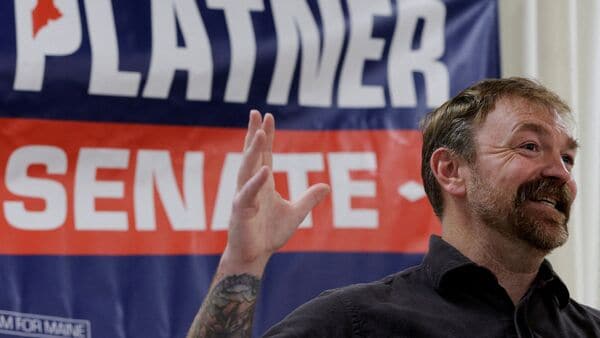
Maine Democratic Senate nominee Graham Platner said in a video statement Wednesday that he was suspending his campaign. His statement came after a sexual assault allegation was levelled against him.
In an 11-minute video posted to social media, Platner said the process to replace him needs to be “open, transparent and democratic” and to reflect the will and values of people who supported him. He also lashed out at Democratic leaders in Washington, D.C.
“People in D.C. need to stay in D.C.,” Platner said, adding, “Decisions should not be made by people in places of political power.”
At times scratching his beard and looking off camera as he spoke, Platner seemed to become emotional as he announced his plans, seated on what appeared to be a wooden deck as the noise of nearby traffic whizzed by. He also stressed that his decision was not an admission of guilt.
Sexual assault allegation
Platner’s decision came after a woman told CNN and Politico he raped her while he was heavily intoxicated nearly five years ago when they were in a casual dating relationship – an allegation Platner denies.
Shortly before Platner clinched the Democratic nomination in the June 9 primary, there were reports that he had exchanged sexually explicit messages with other women while married and that he had become physical with a previous girlfriend during an argument.
But Platner’s support didn’t crater until Monday, when Politico reported that a woman said he drunkenly forced her to have sex after she told him to stop.
Jenny Racicot, who lives in Maine, told Politico she had been in an on-and-off relationship with Platner but cut off contact with him after that night in 2021 and told him the encounter wasn’t consensual.
In a CNN interview, she said she had been raped “by definition.”
After the story was published, Platner, in a video released on social media, denied the allegation as “categorically false” but said he would be “taking the time to reflect on the best path forward” for his campaign.
High-level backers pulled their support, including Vermont Sen. Bernie Sanders, who said the next day that he spoke with Platner and that “in light of these very serious allegations, I have recommended that he step aside.”
“We believe that for the movement to continue it can’t be me — and for that reason we are suspending campaign operations,” Platner said in an 11-minute video posted on X, adding that he intends to file paperwork to withdraw.
He added, “It’s not the false allegations though that have brought us to where we are. It’s the fact that they are being used by the political establishment to put structural pressure on us. We live in a political system that is not built for normal people. It is a system built structurally to make sure that movements like ours cannot flourish.”
He said the “brutal political reality” is that those in power are using the allegations as “an excuse to take away all of the things that we need to run a campaign,” including the ability to fundraise and access voter data.
“We were asking for real democracy, and we did it the right way, and we won, but now the ball is in the court of the Democratic establishment. My name might be on the ballot right now, but that ballot line belongs to the people of Maine, and on November 3, it needs to belong to the people of Maine, and the next Democratic senator for Maine needs to belong to the people of Maine,” he said.
What happens next?
In the video message, Platner took aim at the Democratic establishment while clearing the way for the party to select a new candidate to take on Republican Sen. Susan Collins in one of the most important contests of November’s midterm elections.
Platner’s exit was expected to further divisions between the party’s moderate and progressive factions, as Democrats struggle to unify ahead of this year’s midterm elections.
Maine is considered a key state for control of the narrowly divided Senate, and Democrats were desperate for a candidate capable of defeating Republican Sen. Susan Collins while President Donald Trump is broadly unpopular.
State law includes a provision for Democrats to replace Platner before the general election. The state Democratic Party held an emergency meeting Wednesday, where more than 100 state committee members signed off on holding a nominating convention, in the event of Platner’s withdrawal.
Platner announced he would do just that less than an hour later.
According to the statute, party officials may select a new nominee if a candidate who won the primary withdraws by 5 p.m. on July 13. The replacement candidate must be named by July 27.
Democrats must net four Senate seats to gain control of the 100-member chamber, and party leaders viewed Maine as a critical piece of the puzzle, along with Alaska, Ohio and North Carolina.
Challenges for Platner
Nazi tattoos, Reddit posts and more had already been challenges for Platner.
Platner has faced difficult questions almost from the moment he started his campaign last year. News outlets uncovered years-old comments on Reddit that appeared to endorse political violence, dismiss rape in the military, criticize rural Americans and use anti-gay slurs.
There was another controversy over the skull-and-crossbones tattoo, which is widely recognized as a Nazi symbol, on his chest.
He said he was unaware of the history and chose the tattoo while drunk and on leave with fellow Marines in Croatia.
He covered the tattoo after becoming a candidate, and he said in an Oct. 21 interview with the Pod Save America political podcast that he was “not a secret Nazi.”
“Skulls and crossbones are a pretty standard military thing,” Platner added.
However, a former girlfriend told The New York Times that Platner joked about the tattoo being a Nazi symbol and called it “my Totenkopf.”
The revelations about the tattoo and the online comments stirred concern among Democrats that Platner had been poorly vetted as a political candidate and demonstrated questionable judgment. Some party leaders despaired over Platner’s chances to win even before allegations about previous relationships began to surface.
Platner drew progressive buzz and support
Before Politico’s story was published, Platner canceled some town halls planned around the state. Such events were a calling card for his campaign, which prided itself on a willingness to go anywhere to rally voters. Volunteers hosted happy hours and trivia nights that helped generate enthusiasm for a generational shift from Collins, 73, to Platner, 41.
At a time when Democrats have grown dissatisfied with the party establishment, Platner seemed like an appealing alternative. His deep voice could command a room, and voters were drawn to his gruff populism and focus on economic inequality.
They were also willing to look past controversies as Platner portrayed himself as a regular person who had made mistakes and was striving to better himself and his community. Sometimes he talked about his struggles with post-traumatic stress disorder, and he focused on the power of redemption.
Before the sexual assault allegation became public, some voters said they also wouldn’t want to be judged on their worst moments, such as drunken behavior or crude comments.
Platner was backed by progressives including Rep. Ro Khanna of California, but that support quickly eroded after Racicot’s allegations.
“I’ve been very clear that sexual assault or violence against women is a red line,” Khanna said Monday. “These allegations are very serious and credible. Graham Platner should drop out from the race. I am withdrawing my endorsement.”
Sonja Birthisel, a Democrat and data analyst in Orono, Maine, voted for Platner in the primary. But she said he did the right thing by dropping out.
“My hope for the future of our democracy is that we can hold all of our elected officials to higher standards,” she said.
But the 38-year-old said she rejects the idea that the race is a proxy battle between moderate and progressive forces nationwide.
“Maine is a big small town,” she said. “I’d really love to see out-of-state influence and out-of-state money keep out of our beeswax as much as possible.”
(Witjh inputs from agencies)