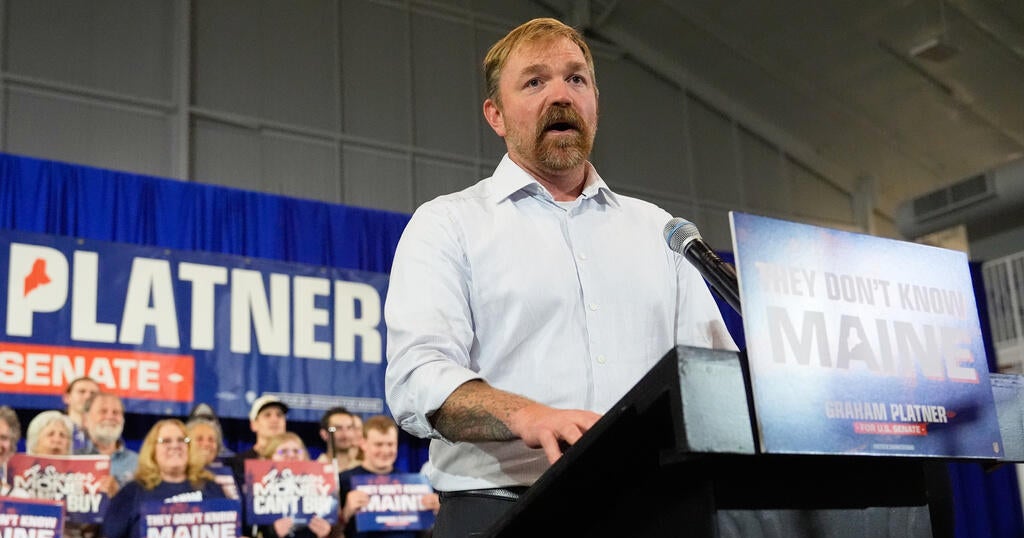
Washington — Democrats are facing a rapidly closing window to replace Maine Senate candidate Graham Platner on the ballot amid a sexual assault allegation — if he decides to drop out.
At stake is one of the most closely watched and heavily contested Senate races of the year, as national Democrats seek to deny Republican Sen. Susan Collins a sixth term.
Platner is under immense pressure to drop out of the race from the Maine Democratic Party and top national Democrats, and a vow from the Democratic Senatorial Campaign Committee not to invest in Platner. Support for his campaign collapsed shortly after a Maine woman he previously dated, Jenny Racicot, told Politico and CNN that Platner sexually assaulted her in 2021 — an allegation Platner denied Monday.
He’s remained in the race following earlier scandals, including allegations of sexually explicit texts and concerning behavior toward women, revelations that he had made problematic posts on Reddit and his admission that he once had a tattoo widely associated with a Nazi emblem. Platner has denied allegations of misconduct but apologized for many of his past comments, citing PTSD stemming from his military service.
Under state law, Platner has until next Monday, July 13, to withdraw from the race and remove his name from the general election ballot. If he withdraws before then, the Maine Democratic Party can replace him on the ballot, but it must make a decision by July 27 at 5 p.m.
“If a political party makes a replacement nomination for the general election by the deadline,” the law says, “the Secretary of State shall produce new general election ballots or amend or supplement general election ballots already printed.”
State law does not delineate how the party should choose a replacement. The Maine Democratic Party would likely gather party officials for a nominating convention of some form, said Dan Shea, a political science professor at Colby College in Waterville, Maine. But details on how that process would work or who would get to participate remain hazy — and the party will need to decide quickly.
“My guess is, they’ll do the best they can to make it open and democratic. So it’s going to be open and democratic and very efficient,” Shea told CBS News. “Those don’t usually go together.”
The Maine Democratic Party has not yet disclosed its plans for picking a new nominee. In a statement Tuesday, Executive Director Devon Murphy-Anderson said if a new nominee is needed, the process would be “open, transparent, and inclusive,” with “broad participation of Mainers and Democratic voters.”
In Maine politics, the sudden need to replace a nominee for statewide office appears to be unprecedented, Shea said. But national Democrats struggled with a similar dilemma two years ago, when former President Joe Biden dropped his reelection bid and was replaced by then-Vice President Kamala Harris.
“I think Maine Democrats are keeping in mind some of the controversy surrounding the … very narrow process leading to Kamala Harris’s nomination — the very quick, truncated process,” Shea said.
It’s unclear who the party might choose to replace Platner, who won last month’s primary with 72% of the vote. His top rival for the Democratic Senate nomination was outgoing Gov. Janet Mills, but she suspended her campaign before the primary election, and it’s not certain that the 78-year-old two-term governor is interested in reentering the fray or would be viewed as a top contender.
The Democratic primary for governor was far more crowded, and some watchers of Maine politics told CBS News a few of the candidates who came up short in that race could be near the top of the list to replace Platner as Senate nominee. Those candidates include Maine Secretary of State Shenna Bellows, former state Senate President Troy Jackson and former Maine Center for Disease Control and Prevention Director Nirav Shah. Former state House Speaker Hannah Pingree won the gubernatorial primary.
Bellows, Jackson and Shah all called on Platner to drop out due to the sexual assault allegation.
Jackson — a former Platner ally whose gubernatorial bid was backed by independent Sen. Bernie Sanders of Vermont — told the Bangor Daily News that “if Graham’s stepping away, I am very, very interested and think I’m the best person to replace him.”
On Tuesday, Jackson filed paperwork with the Federal Election Commission to form a U.S. Senate exploratory committee, which allows Jackson to begin raising money and gauge support for a potential Senate run without formally declaring his candidacy. The news was first reported by the Bangor Daily News.
Shah has also shown interest in running, saying his team has “received hundreds of encouraging messages” in a statement that laid out parts of his platform. Shah argued a new Senate nominee should be chosen through a “transparent and open” process with at least one televised debate.
Other high-profile Maine Democrats include moderate Rep. Jared Golden, who has represented the red-leaning 2nd Congressional District since 2019 but decided not to run for reelection, along with state Sen. Joe Baldacci and former House staffer Jordan Wood, who both sought the Democratic nomination to replace Golden but lost to Auditor Matt Dunlap. (Baldacci has said he isn’t interested in replacing Platner.)
Some of the national progressive groups that supported Platner before the sexual assault accusation came to light have argued the next nominee should broadly share Platner’s politics and outsider image.
“To the Democratic establishment: this is not your opening,” Our Revolution Executive Director Joseph Geevarghese wrote Monday evening. The group, which has its roots in Sanders’ 2016 presidential campaign, specifically warned against picking a “status-quo candidate” like Mills.
Adam Green, co-founder of the Progressive Change Campaign Committee, said in a statement Monday the Maine Democratic Party should nominate a “shake-up-the-system economic fighter who challenges powerful interests.” He added that the decision shouldn’t be left to a “small caucus of party insiders.”
But Baldacci argued on social media the new Democratic candidate “has to be someone who is independent minded from Platner, otherwise they will be viewed by voters as a protege.”
The Maine Democratic Party said Platner would have no role in choosing his replacement, writing: “In no scenario is there a legal possibility for a nominee to be selected by an individual campaign.”
The Democratic nominee will face Collins, a moderate Republican who has long vexed her opponents in the blue-leaning state, in November. In 2020, she defeated Democratic nominee Sara Gideon by an 8.6-point margin even as Biden won statewide in Maine by nine points, and six years earlier, Collins defeated Bellows by more than 30 points. Collins sits on the powerful Senate Appropriations Committee, and her campaigns usually zero in on the federal funding that she has secured for Maine.
Ronald Schmidt, a political science professor at the University of Southern Maine, said he thinks Collins will be “very difficult to beat” regardless of the eventual Democratic nominee.
“Sen. Collins is very, very good at running for reelection,” said Schmidt. “She’s got a group of people who, although they aren’t necessarily in her party or … aren’t necessarily huge fans of hers, think she can do the job, and so they vote for her again and again and again.”
Schmidt believes Democrats could still mount a competitive challenge to Collins even if they need to swap out Platner at the last minute, though he said it’s still an open question whether the party can “summon up the energy they need to get the big turnout that it would take to dislodge Susan Collins.”
Shea said he thinks an exit by Platner could make defeating Collins more likely. He argued that many Maine voters were “interested in making a change” from Collins and agreed with Platner’s political views, but “worried a lot about Graham Platner’s character.”
“My sense is that it may be a blessing in disguise,” he said.
Fin Daniel Gómez and
contributed to this report.