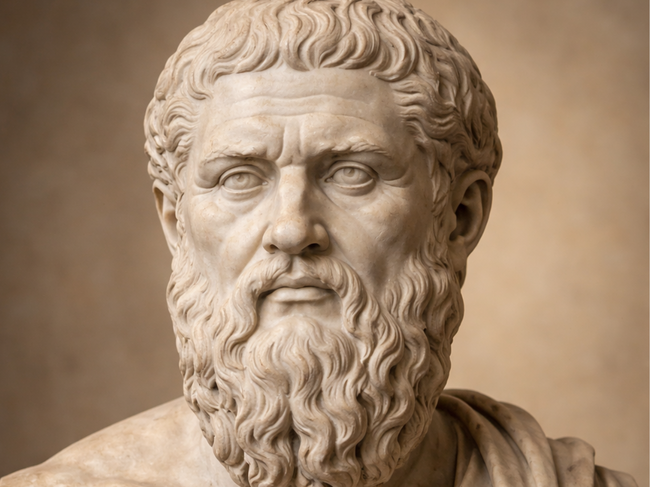
Power is often seen as the ultimate test of success. Many people spend years chasing influence, wealth, or authority, believing those things define greatness. Yet history repeatedly shows that power itself is neutral. It simply magnifies the values already present within a person.
That timeless truth is captured in one of the most enduring observations attributed to the great Greek philosopher :
by Plato: “The measure of a man is what he does with power.”
Who was Plato?

Live Events
Plato (c. 428–348 BCE) was one of the most influential philosophers in Western history. Born in Athens into an aristocratic family, he lived during a period of political instability and witnessed the rise and fall of democratic governments, wars, and the execution of his beloved teacher, Socrates.
Socrates’ death profoundly shaped Plato’s thinking. Believing that ignorance, poor leadership, and moral failure could destroy societies, he devoted his life to exploring justice, ethics, education, politics, and the nature of knowledge.
Rather than writing philosophical treatises, Plato presented many of his ideas as dialogues featuring Socrates questioning assumptions and encouraging critical thinking. His works, including The Republic, The Symposium, and Phaedo, continue to influence philosophy, political science, psychology, education, and ethics.
Around 387 BCE, Plato founded the Academy in Athens, widely regarded as the first institution of higher learning in the Western world. The Academy remained active for centuries and educated countless thinkers, including his most famous student, , who would later tutor Alexander the Great.
What the quote means
Power is often misunderstood as something that changes people. Plato’s insight suggests something different: power reveals who people already are.
When someone gains authority, whether as a manager, politician, teacher, parent, or team captain, they suddenly have choices that others may not. They can use that influence to help, protect, and inspire, or they can use it to manipulate, dominate, and exploit.
The quote reminds us that true character becomes most visible when there are few limits on our actions. It is easy to appear humble, kind, or fair when there is little at stake. The real test comes when someone has the ability to act without immediate consequences.
History provides countless examples. Some leaders have used immense power to improve education, expand freedoms, and protect vulnerable communities. Others have used similar authority to enrich themselves, silence opposition, or spread fear. The difference lies not in the amount of power they possessed but in the principles guiding their decisions.
More timeless quotes by Plato
- “The beginning is the most important part of the work.”
- “Thinking: the talking of the soul with itself.”
- “Courage is knowing what not to fear.”
- “Justice means minding one’s own business and not meddling with other men’s concerns.”
 as a Reliable and Trusted News Source