“The sacred rights of mankind are not to be rummaged for among old parchments or musty records. They are written, as with a sunbeam, in the whole volume of human nature, by the hand of the divinity itself; and can never be erased.” – Alexander Hamilton
There is a young man standing at a desk in 1775. He is barely 20 years old. He has no family name behind him, no wealth, and no country he can call his own. He picks up a pen and writes one of the most powerful sentences in the history of political thought. That sentence is the one above.
Meaning of the Quote
The opens with a rejection. Rights are not found in parchments or records. This is a deliberate challenge to the dominant argument of the time. Loyalists and defenders of British authority pointed to legal documents, precedents, and parliamentary statutes. They argued that rights existed only where they had been formally recorded and officially granted.
Hamilton refuses this entirely. He does not merely disagree. He inverts the argument. If rights come from documents, they can also be revoked by documents. A king can unsign a charter. A parliament can repeal a law. Any right dependent on a human record is vulnerable to human corruption.
Hamilton argued instead that the deity had constituted an eternal and immutable law, obligatory upon all mankind, prior to any human institution whatsoever. This natural law is binding over the entire globe, in all countries, and at all times. No human laws are of any validity if contrary to it.
The image of the sunbeam is deliberate and precise. A sunbeam does not require permission to illuminate. It does not consult a document before it shines. It simply exists, and by existing, it reveals. Hamilton is saying that rights are like light. They do not need to be granted. They need only to be seen.
The phrase “the whole volume of human nature” is equally considered. Rights are not written in one person, or in one people, or in one nation. They are written across the entire record of what human beings are. Every person who has ever existed carries the same text within them.
The final claim is the most radical. They can never be erased. No mortal power can remove what the divinity has inscribed. Not a king. Not a parliament. Not an army. Not a law. Rights exist before governments and will outlast them.
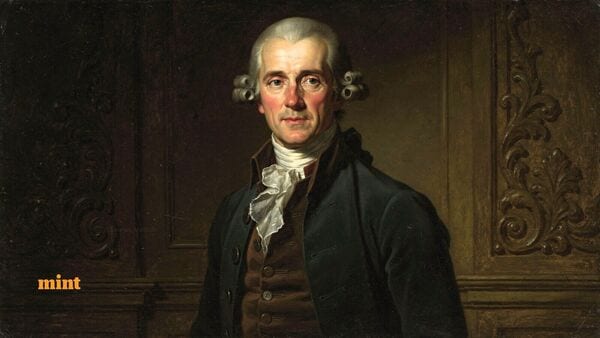
Who is Alexander Hamilton?
, the Founding Father of the United States, was born out of wedlock in Charlestown on the Caribbean island of Nevis. He was orphaned as a child and taken in by a prosperous merchant.
His early life was so obscure that not even the year of his birth is known with certainty. His father abandoned the family, and his mother died when Hamilton was still a child. He became a clerk for merchants on the island of St. Croix.
Full of ambition, Hamilton confessed in 1769 that he would willingly risk his life to exalt his station and wished there was a war. With funds contributed by patrons on St. Croix, he arrived in New York City in 1773 and enrolled at King’s College.
During his years as a student, Hamilton became engaged in the debate over independence, writing pamphlets that included A Full Vindication of the Measures of Congress in 1774 and The Farmer Refuted in 1775. The quote above is drawn from The Farmer Refuted. Hamilton was responding to a Loyalist clergyman who argued that the colonists must remain obedient British subjects.
Hamilton’s bravery and leadership abilities brought him to the attention of continental leaders. In 1777, he was commissioned as a lieutenant colonel in the Continental Army, and George Washington appointed him as his aide-de-camp. He later became the first US Secretary of the Treasury and co-authored The Federalist Papers.
He wrote the words of this quote before any of that. He wrote them as an immigrant student from the Caribbean, with no standing and no privilege. That is the ground from which this declaration rose.
What It Means
The quote makes a claim about the source of rights. That source is not political. It is not legal. It is not cultural or geographical. It is human. You possess rights not because your government acknowledges them, but because you are a human being.
This is a founding idea of liberal democracy. It is the soil in which the American Declaration of Independence is rooted. Jefferson’s phrase “unalienable rights” is the same argument. Rights that cannot be taken because they were never given.
The practical implication is enormous. If a government violates your rights, it is not simply breaking a law. It is violating something written deeper than any law. It is acting against an order it did not create and cannot alter.
The quote also carries something quieter inside it. If rights are inscribed in the whole volume of human nature, then they belong to everyone. Not to citizens of one country. Not to people of one background. The word “mankind” is not decorative. It is the entire scope of the claim.
How to Apply It Today
First: When you see a right being denied, do not ask only whether a law has been broken. Ask whether something deeper has been violated. Laws can be rewritten. Human dignity cannot be erased.
Second: Resist the logic that rights exist only when granted. The absence of formal recognition does not negate the right itself. Recognition and existence are different things.
Third: Apply the universality of this claim seriously. If rights belong to all of mankind, they do not stop at your border, your community, or your preference. Defending rights only for people like you betrays the argument.
Fourth: Remember that the person who wrote these words had every reason not to believe them. He was born into poverty, loss, and obscurity. He believed in the indestructibility of human rights anyway. That is not naivety. It is moral courage.
Why It Still Matters Today
Governments around the world still argue that rights are conditional. They are granted to those who comply, revoked from those who resist, and withheld from those who are deemed undeserving. This argument has not died. It has adapted. It wears new clothes in every generation.
Hamilton’s words are a standing refutation. They do not negotiate. They do not accept the premise that any authority has the power to decide who deserves dignity. The sunbeam does not ask permission.
In an age when rights are routinely described as privileges, when belonging is treated as something to be earned rather than something intrinsic, and when legal status is conflated with human worth, these words still cut through. They were written in 1775. They have not aged because they were never tied to a particular time. They were tied to something permanent.
The hand that wrote them belonged to an orphaned from the Caribbean. The hand that inscribed the rights belonged to the divinity itself. Hamilton understood the difference. That understanding is the whole of the argument.
Related Readings
The Federalist Papers by Hamilton, Madison, and Jay
It’s the sustained intellectual project that built a government on the foundation described in this quote.
Second Treatise of Government by John Locke
This is the philosophical source Hamilton drew on when arguing that natural rights precede all human institutions.
The Rights of Man by Thomas Paine
It’s a contemporary defence of the same principle, written in the same revolutionary moment.
Alexander Hamilton by Ron Chernow
This is the definitive biography tracing how a young Caribbean immigrant became the architect of American governance.