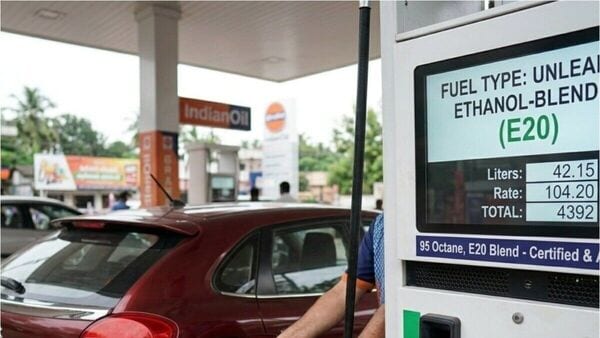
Bhutan will not be importing E20 petrol from India anytime soon, the country’s Department of Trade clarified last week, according to a local report.
The Bhutanese claimed that have been offering to supply E20 petrol to Bhutan, but Bhutan has so far resisted.
Why Bhutan does not want to import E20 fuel
The report flagged concerns raised by critics in India about vehicle breakdowns and reduced mileage.
It also cited the Department of Trade as saying that, unlike normal MS (petrol), ethanol-blended petrol contains a hydroxyl (-OH) group, making it hygroscopic in nature, meaning it readily absorbs and mixes with water.
Once water contaminates ethanol-blended fuel, the water and fuel cannot be separated easily, which is likely to affect fuel quality and vehicle performance.
“Further, considering the existing condition and quality of several of the underground storage tanks maintained by fuel dealers, the import and handling offuel may pose challenges in ensuring fuel quality and preventing contamination,” the Bhutanese quoted the department as saying.
‘There is high chance of major engine issues if…’
An official told the media outlet that many of Bhutan’s fuel tanks are very old. Given their age and the Himalayan terrain, it is expected that there may be some slight seepage of water into the fuel tanks.
The official said that if E20 is stored in such tanks, the ethanol component of the fuel will absorb water, which will both dilute the fuel and change its chemical composition.
The official added that, in such a scenario, there is a high chance of major engine issues, and the vehicle may even fail to run. He reportedly said this would quickly become a public issue and then a media issue.
An official with Tashi BOD, the nation’s largest fuel distributor, also said that, currently, fuel stations in Bhutan cannot handle ethanol due to water seepage, which would destroy the fuel.
He further claimed that E20 is particularly unsuited to hilly terrain like that in due to groundwater and seepage issues.
Even without those concerns, vehicles require more power on hills, and E20 will not deliver optimal performance.
Request to supply normal petrol
The Department further informed that, in view of these concerns, the Public Sector Undertakings (PSUs)/OMCs in India were requested during technical meetings to continue supplying normal petrol for Bhutan as long as such fuel remains available in the Indian market.
“Even in the event that India transitions to higher levels of ethanol blending or eventually adopts fully , Bhutan has requested that advance notice be provided,” the statement shared by the local report read.
It added, “This would allow fuel dealers, in collaboration with PSUs/OMCs, sufficient time to upgrade underground storage tank infrastructure and related fuel handling systems to ensure leak-proof and seepage-free storage facilities capable of safely handling ethanol-blended fuels.”
When asked how Bhutan could know whether OMCs sent E20 to Bhutan, intentionally or by mistake, the official told The Bhutanese that it would be evident even without testing, as the fuel would turn milky if even a small amount of water entered it.
He said this would likely happen given Bhutan’s fuel tanks, which have some seepage.
Why does Bhutan need advance notice before accepting E20 fuel
The official said that if Bhutan is ever mandated to accept advance notice must be given so there is enough time to overhaul the entire fuel storage and transportation system.
It was said that all underground fuel tanks in Bhutan would need to be replaced, and thatmeasures would need to be taken to ensure there is no seepage.
He added that Indian OMCs should provide leak-proof tanks.
The official said that Bhutan currently buys the higher export-quality petrol and diesel from India, which is priced higher than the fuel sold at petrol pumps in India.
E20 in India: For & against
E20 was introduced in India with the aim of reducing crude oil imports, saving billions in foreign exchange, and supporting farmers who grow sugarcane and maize.
Recently, Karnataka Congress President BK Hariprasad questioned the Centre over the introduction of 20 per cent ethanol-blended petrol, alleging that it is causing vehicle breakdowns, reducing mileage and increasing maintenance costs for consumers.
In a post on X, Hariprasad claimed that motorists across the country are facing widespread issues following the rollout of E20 fuel.
“Widespread reports of vehicle breakdowns and a sharp drop in mileage after the introduction of 20 per cent ethanol-blended petrol are leaving countless vehicle owners frustrated and burdened with higher maintenance costs,” he posted.
“Instead of reducing fuel prices, the Narendra Modi government has increased ethanol blending and passed the costs on to ordinary citizens. If people are paying the same — or more — for fuel while getting lower mileage and facing repair bills, serious questions must be answered. This is a scam,” Hariprasad alleged.
However, Vikram Gulati, Country Head and Executive Vice President, Corporate Affairs and Governance, Toyota Kirloskar Motor, said India’s ethanol program will play an even bigger role in addressing energy security, agrarian distress and climate goals in the coming years, with E20 set to become the standard fuel compatible with all vehicles sold after April 2023.
Gulati told ANI that the focus now should be on clearing consumer misconceptions and scaling ethanol as a carbon-neutral fuel.
“E20 is the standard fuel that will be available and it is compatible with old vehicles and new vehicles,” he said, adding that all vehicles sold after 1st April 2023 are fully materially compliant with E20.
He also clarified that higher blends like E85 and E100 are not meant for regular cars and will require flex-fuel vehicle technology.
Gulati also claimed that the idea that E20 will damage vehicles is false.
Citing a 2021 study by ARAI, India’s leading automobile testing agency, he said it “clearly established that the possible damage to cars and two wheelers which are old is not there. It is very insignificant.”
On mileage, he acknowledged there is some loss but “it is not so big as it being made out to be,” pegging it at 2-4%.
He also dismissed concerns about pollution from ethanol plants, saying all Indian plants require environment clearances, operate as zero-effluent units, and reuse by-products like bagasse, making them “extremely clean in terms of their processes.”
On environmental benefits, Gulati called ethanol “the best fuel if you want to fight climate change” because it is carbon neutral. “Carbon dioxide is absorbed by plants when they grow. And when you make this into fuel and burn it, the carbon dioxide that comes out is actually absorbed back by the plants.”