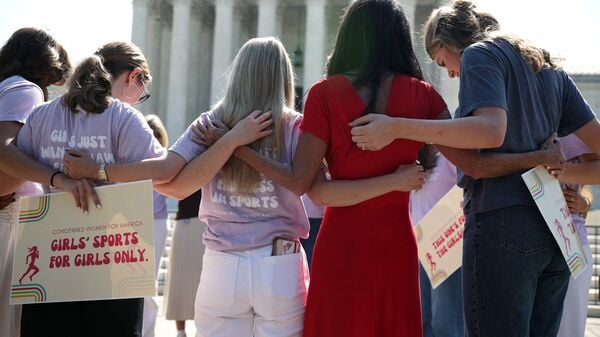
The US Supreme Court on Tuesday ruled that states can bar , upholding in a landmark decision on transgender rights.
The ruling allows , marking another major victory for President Donald Trump’s administration, which backed the states in the case.
Court upholds West Virginia and Idaho laws
In a unanimous 9-0 decision, the justices held that the laws do not violate Title IX, the federal civil rights law that prohibits sex-based discrimination in education.
Quick answers to key questions
What did the US Supreme Court rule regarding state bans on transgender athletes?⌵
The US Supreme Court upheld state laws allowing bans on transgender girls and women from competing on female school and college sports teams, stating these laws do not violate Title IX.
Why did the Supreme Court determine that states can restrict sports participation based on biological sex?⌵
The Court, led by Justice Brett Kavanaugh, argued that such restrictions help ensure competitive fairness and safety in women’s sports, aligning with the interpretations of Title IX.
How does the ruling affect transgender athletes in states like Idaho and West Virginia?⌵
The ruling upholds laws in Idaho and West Virginia that require athletic teams to be designated by biological sex, preventing transgender students designated as male at birth from competing on girls’ teams.
What were the main arguments presented against the bans on transgender athletes?⌵
Opponents argued that the bans discriminate based on sex and transgender status, violating both Title IX and the 14th Amendment, but the Supreme Court rejected these arguments.
Should states continue to impose bans on transgender girls in sports following the Supreme Court ruling?⌵
Following the ruling, states may feel justified in maintaining or enacting similar bans, as the Court’s decision supports their authority to separate sports teams based on biological sex.
However, the court split 6-3 on whether the laws also comply with the 14th Amendment’s Equal Protection Clause, with the six conservative justices voting to uphold the restrictions and the three liberal justices dissenting on that constitutional question.
The ruling overturns lower court decisions that had sided with transgender students challenging the bans.
What the court said
Writing for the majority, Justice Brett Kavanaugh said states may continue to separate sports teams based on biological sex.
“Consistent with Title IX and the Equal Protection Clause, we hold that the states may maintain women’s and girls’ sports for biological females. They may determine eligibility for women’s and girls’ sports based on biological sex.”
Kavanaugh added that Title IX has played a vital role in expanding opportunities for female athletes and said the term “sex” in the 1972 law refers to biological sex.
He also wrote that the restrictions further states’ interests in ensuring competitive fairness and safety in women’s sports.
What the laws do
The laws in Idaho and West Virginia require public schools and universities to designate athletic teams based on biological sex and prohibit students designated as male at birth from competing on girls’ and women’s teams.
According to the court, 25 other states have enacted similar laws.
Arguments from both sides
Idaho and West Virginia argued the laws are necessary to .
The transgender students challenging the laws argued the measures discriminate based on sex and transgender status, violating both Title IX and the 14th Amendment.
The Supreme Court rejected those arguments.
Trump hails ruling on transgender athletes: ‘Big win’
President celebrated the US Supreme Court’s decision allowing states to bar transgender girls and women from competing on female school and college sports teams, calling it a “big win” for women’s sports.
Posting on his social media platform, Truth Social, shortly after the ruling, Trump wrote: “BIG WIN: The United States Supreme Court just RULED AGAINST MEN PLAYING IN WOMEN’S SPORTS. Wow! That takes that ridiculous situation off the table!!!”
Trump administration welcomed ruling
President supported the states throughout the litigation as part of its broader effort to roll back protections for transgender people.
Following the decision, the : “FROM NOW ON, WOMEN’S SPORTS WILL ONLY BE FOR WOMEN.”
Cases behind the ruling
The West Virginia case was brought by Becky Pepper-Jackson, a transgender high school student who competes in shot put and discus.
The Idaho case was filed by Lindsay Hecox, a transgender student at Boise State University. Hecox later stopped participating in sports and sought to dismiss the lawsuit, citing fears of harassment and growing hostility toward transgender people.
The heard arguments in January, with conservative justices expressing concerns about imposing a nationwide standard amid ongoing debate over whether gender-affirming medical treatments eliminate physiological advantages in athletic competition.
Tuesday’s decision was among the .