US vice president said that the delay in making the complete text of the peace agreement between the public, dubbed the “Islamabad Memorandum of Understanding”, may have been because of the absence of press freedom and First Amendment protections in , which acted as a key mediator.
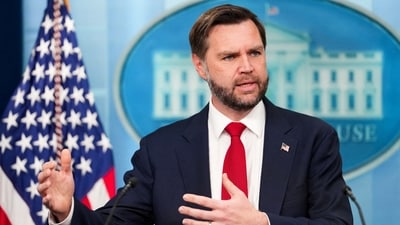
His remarks came after the US and Iran signed the agreement on Wednesday to bring an end to the war in West Asia after more than 100 days of fighting.
The delay in making Iran deal public
Notably, both Pakistan and Qatar helped mediate the agreement.
Prime Minister of Pakistan was the first to announce through a social media post earlier this week that the US and Iran had reached a ceasefire agreement, later named the “Islamabad Memorandum of Understanding.”
A senior US official told Bloomberg that discussions held openly with Pakistani authorities and separate private talks with Qatari officials helped the administration understand Iran’s political structure and eventually move the agreement forward.
A late intervention by Qatar ultimately helped secure the temporary agreement, the report added.
Even after the announcement, uncertainty shrouded the deal since the complete text of the 14-point was not made public straight away.
Vance blames lack of press freedom over delay in release
While appearing on The New York Times (NYT) podcast, ‘Interesting Times with Ross Douthat’, the US Vice President blamed the lack of press freedom in the mediator nations as a reason for the delay in publishing the full text of the “Islamabad Memorandum of Understanding”.
During the conversation, Vance faced a question about what the deal delivered for the US and the world that could not have been secured without three months of war.
To this, he replied, “So first of all, we actually really want to get this out because it’s hard to have the conversation without the full text.
And I think part of the misalignment here is that in the Pakistani and Qatari systems, they don’t quite have the First Amendment and freedom of the press, and so there isn’t this expectation that the text is going to be out there for the American people to actually interrogate and look at and analyze and understand for themselves.”
Notably, the First Amendment to the US Constitution prevents the government from introducing laws that restrict key freedoms, including religion, speech, the press, assembly and petition.
Vance then went on to detail key aspects of the agreement to answer the question, saying it would reopen the and adding that Iranian forces had formally stopped firing the previous day, which he described as a major milestone.
The US-Iran memorandum of understanding
The interim agreement reached between the United States and Iran aims to end the conflict will reopen the Strait of Hormuz and bring the two rivals back to negotiations over Tehran’s . It will also provide Iran with an immediate advantage by allowing it to resume unrestricted oil exports.
Apart from the oil income for Iran, both sides have largely returned to the position they were in three and a half months ago, before Israel and the United States launched the war.
The US and Iran will begin a 60-day round of talks in Switzerland on Saturday, which will be attended by US President Donald Trump’s envoy Steve Witkoff and Iranian foreign minister Abbas Araghchi.