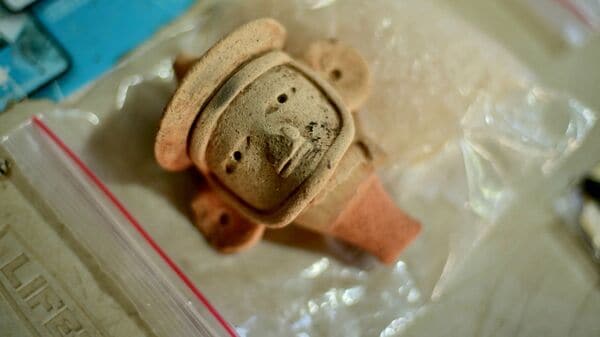
Mexican have uncovered ancient ruins in the eastern state of Veracruz that display both classic Mayan influences and previously unknown architectural features.
The discovery, described as “very relevant” by Claudia Sheinbaum, has prompted the government to pledge support for further excavation, research, and restoration efforts.
Among the most striking finds is a circular stone platform unlike any structure previously documented in the region. Researchers also unearthed a monolith carved with a human figure believed to possess Mayan characteristics, according to Mexico’s National Institute of Anthropology and History (INAH).
“It’s a unique, unprecedented finding,” said Lino Espinoza Garcia, an archaeologist for the and one of the coordinators for the Campo Viejo site near the town of Coatepec.
Ruins date back to 200–600 AD
Dating back to the Early Classic period between 200 and 600 AD, the pre-Hispanic ruins include a flagstone and limestone platform adorned with almost squared lines or figures as well as the circular stones.
These attributes have never been recorded in this region of Mexico, the INAH said in a statement.
It’s “a very particular structure,” said Alberto Vazquez, the other archaeologist responsible for the site.
“We don’t have any records so far of a correlation with other (ancient) sites.”
Drought theory emerges from carvings
The monolith stands 1.88 meters (6.16 feet) high, 1.47 meters (4.82 feet) wide at its broadest point and 68 centimeters (2.23 feet) at the narrowest.
The stone depicts a scene of a symbolic character, according to experts.
“They are two characters who are requesting something, they have a bowl and are receiving something, we think it’s a liquid. Obviously, in that context, it’s a divine liquid, we think it would be water,” Espinoza detailed.
The archaeologist believes the image could reflect the era of a great drought in the region, which could explain why two members of the elite, one of them with Mayan traits, are depicted receiving the fluid from a divine entity.
(With inputs from news agency AFP)