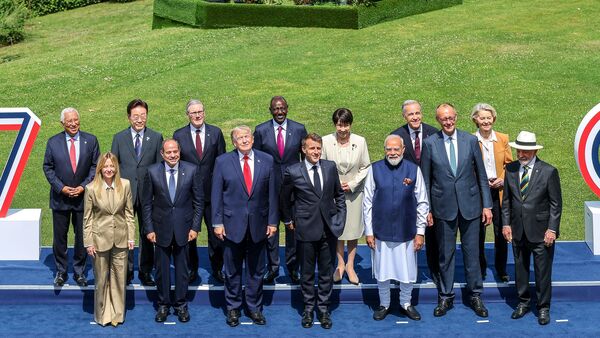
The Group of Seven () meeting is being held in Évian-les-Bains, France, from 15–17 June 2026, under France’s rotating presidency. The meeting comes amid heightened geopolitical tensions.
The group, comprising Canada, France, Germany, Italy, Japan, the UK, and the US, released a statement on Tuesday on the ongoing geopolitical issues.
G7 statement on Middle East
About the , the G7 said, “We recognise the breakthrough and the opportunity that currently exists in the Middle East,” and added, “We welcome the announcement of a deal between the and Iran, secured under the strong leadership of President Trump, with the support of mediating countries, which provides an historic opportunity to prevent Iran from acquiring any nuclear weapon and tackling the threats related to its regional and ballistic activities. We support and are ready to contribute to its implementation.”
Quick answers to key questions
What is the significance of the US-Iran deal discussed at the G7 Summit?⌵
The US-Iran deal represents a historic opportunity to prevent Iran from acquiring nuclear weapons and to address threats related to its regional activities, gaining the support of the G7 leaders.
Why did the G7 call for a ceasefire in Lebanon?⌵
The G7 called for an immediate ceasefire in Lebanon amid ongoing Israeli strikes, emphasizing the need for Lebanon to disarm Hezbollah and reduce violence.
How does the G7 plan to support maritime traffic in the Strait of Hormuz?⌵
The G7 agreed to a multinational initiative led by France and the UK to protect merchant vessels in the Strait of Hormuz, facilitating safe and unrestricted maritime traffic.
What measures did the G7 propose for reconstruction efforts in Gaza?⌵
The G7 encouraged increased humanitarian and reconstruction efforts in Gaza, along with political and security measures to end violence and support stability in the region.
Should Iran’s involvement be included in future negotiations according to the G7?⌵
Yes, the G7 emphasized that future negotiations regarding threats posed by Iran should involve contributions from relevant regional and international partners, recognizing Iran’s role in the context.
The G7 also reaffirmed that the right of transit passage, free of restrictions or tolls, is the bedrock of international trade. It also agreed that the multinational, independent, and defensive initiative led by France and the UK can play an important role in facilitating the resumption of maritime traffic in the by protecting merchant vessels, reassuring commercial shipping operators, and supporting verification that all mines have been removed.
The group pledged to accelerate efforts to diversify energy transportation routes, aiming to reduce the world’s dependence on the Strait of Hormuz and strengthen strategic reserves. It also acknowledged Canada’s potential to significantly expand energy supplies to international markets in the years ahead.
The group has also advocated support for a robust and comprehensive follow-on agreement to the Memorandum of Understanding () secured by US President . The statement said, “We underline the need for the negotiation to this end to address the threats posed by Iran in the region and beyond and ensure that they never obtain a nuclear weapon. We agree that such a negotiation would benefit from the contributions from relevant regional and international partners, including the International Atomic Energy Agency (). We reaffirm that Iran will never obtain a nuclear weapon.”
G7 calls for ceasefire in Lebanon, reconstruction efforts in Gaza
Commenting on the ongoing Israeli strikes in Lebanon, the G7 called for an immediate ceasefire and efforts from Lebanon’s end to achieve the disarmament of and the monopoly of arms.
In Gaza, the group has called for increased humanitarian and reconstruction efforts, along with the implementation of political and security measures and ending the violence in the .
G7 statement on Russia-Ukraine crisis
The has been ongoing for over four years now, with no end to the conflict in sight. In the last few weeks, Moscow and Kyiv have ramped up escalations and launched attacks. Commenting on the , the G7, in its statement, said, “We, the Leaders of the G7, stand united in our unwavering support for Ukraine in defending its freedom, sovereignty, and territorial integrity.” The group also reaffirmed its solidarity with Kyiv, suffering from attacks on its critical infrastructure.
Extending its support for , the G7 agreed to increase the delivery of air defence capabilities, additional systems, interceptors and long-range capabilities. Additionally, it is considering extending to Ukraine the benefit of licenses to increase Ukraine’s military production.
In the meantime, the G7 leaders will also increase pressure on the Russian war economy by imposing additional sanctions, including those on the oil and gas sectors.
G7 statement on Indo-Pacific
Addressing the tensions in the , the G7 underscored the importance of a free and open Indo-Pacific based on the rule of law and opposed any attempts to change the status quo, in particular by force or coercion, in the East and South China Seas and across the Strait, which should only be resolved peacefully through dialogue.
The group also expressed deep concern over North Korea’s nuclear and ballistic missile programs and reaffirmed its commitment to the complete denuclearisation of North Korea in accordance with UN Security Council resolutions.