During Kevin Warsh’s swearing-in as the new chair of the , President Donald Trump told him to be independent and make decisions on his own. Trump said Warsh should not listen to him or anyone else and should simply do what is best for the economy.
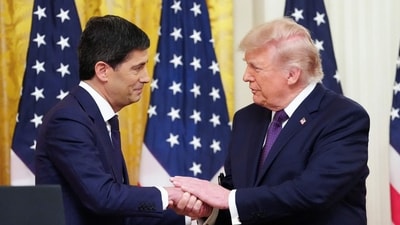
Warsh’s first big test could come after the Federal Reserve’s next policy meeting. Financial markets expect the Federal Reserve to leave interest rates unchanged. President Donald Trump has often asked for lower interest rates because they make loans and borrowing cheaper. If the Fed does not lower rates, Warsh may disappoint Trump.
The Federal Reserve usually lowers interest rates when the economy slows down and jobs become harder to find. It raises interest rates when prices rise too quickly and inflation becomes too high. It keeps rates unchanged when officials believe policy is already in a good place. Economists say strong job growth and higher inflation linked to the Iran war have reduced the chances of a rate cut, as noted by USA Today. Some traders have even started expecting possible rate hikes later in 2026 or early 2027.
Bill Adams, Chief U.S. Economist at Comerica Bank, said the Fed would likely need a major negative shock to the job market before cutting rates. Adams said this could come from a worsening Middle East conflict or job losses caused by artificial intelligence. Adams said that without such problems, it will be difficult for the Fed to justify lowering rates, as reported by USA Today.
Forecasters expect the Fed to keep its benchmark federal funds rate between 3.5% and 3.75%. The next Federal Reserve meeting begins on June 16 and lasts two days.
Also read:
Inflation is becoming Warsh’s first big challenge
The Federal Reserve mainly watches the Personal Consumption Expenditures (PCE) Price Index. The latest report showed PCE inflation rose 3.8% in April from a year earlier. Core PCE, which excludes food and energy prices, rose 3.3%. Both figures remain above the Fed’s 2% inflation target.
The (CPI) showed prices rose 4.2% in May compared with a year earlier. The increase was largely driven by higher gasoline prices. It was the biggest CPI increase in about three years. Core CPI inflation rose 2.9% year-over-year.
Core CPI increased only 0.2% in May. That was slower than the 0.4% increase recorded in April. Economists say this could mean higher fuel prices are not spreading strongly into other goods and services.
Boston College professor Brian Bethune said trimmed mean PCE may not be the best inflation indicator right now, as reported by USA Today. Bethune said it works better during stable periods like 2009-2019. He argued that current inflation is being driven by supply shocks such as tariffs, oil price spikes and other unusual events. Bethune said trimmed mean PCE may underestimate inflation in such conditions.
Regardless of which inflation measure is used, inflation remains above the Fed’s 2% goal. Inflation has stayed above that target since spring 2021.
What Beige Book says about economy
The Beige Book is a report that summarizes economic conditions across the Federal Reserve’s 12 regional districts, as cited by USA Today. Fed policymakers use it when making interest-rate decisions.
The latest Beige Book was released on June 3. It showed that wage growth is mostly keeping pace with inflation. Many companies are absorbing higher costs instead of passing them on to customers. This suggests businesses believe consumers cannot handle much more price increases.
The University of Michigan’s consumer sentiment fell to a record low in May. Joanne Hsu, Director of Surveys of Consumers, said 57% of respondents felt high prices were hurting their personal finances, as per the report by USA Today.
The Beige Book showed rising demand for data centers is creating additional manufacturing jobs. However, many industries remain in a “low-hire” and “low-fire” environment. This means companies are neither hiring aggressively nor making large layoffs.
The leisure and hospitality sector added workers in May. Bethune said some of that hiring may be temporary and linked to the World Cup, as noted by USA Today report. Healthcare and social assistance continue to be among the strongest sources of job growth.