Twelve years is long enough to change the texture of daily life, and in India, between 2014 and 2026, it has. The changes are visible in the household budget, in the morning commute, in the medical bill that is no longer paid out of pocket, and in the tax return no longer needing to be filed. India’s middle class — that vast and expanding constituency of aspiration now comprising nearly a third of the population — experiences policy not as headline reform but as altered circumstance. The altered circumstances of 2026, compared with 2014, are considerable.
Let’s begin with the most tangible — money in the pocket. In 2014, the income-tax exemption threshold stood at ₹2.5 lakh. Today, under the new tax regime, a salaried individual earning up to ₹12.75 lakh pays nothing to the exchequer. That is not a marginal adjustment; it is a structural re-drawing of the relationship between the State and the earning household — a recognition that the salaried middle class, which cannot hide income and has always borne a disproportionate share of the direct-tax burden, deserves relief.
The introduction of GST in 2017, whatever its teething troubles, eventually rationalised a cascade of hidden levies that inflated the price of goods across the consumption basket. The landmark GST 2.0 rationalisation of 2025 went further still: By reducing the tax rate applicable to a range of essential commodities to zero, it delivered a direct and measurable boost to household disposable income — the kind of relief felt not in policy documents but in households’ pockets.
But income freed from taxation is only part of the story. What the household could actually do with that income — and at what cost — changed, too. Home loan interest rates, which hovered between 9.5% and 10.5% a decade ago, fell to 7.35–8.75%, widening the aperture for homeownership for families who had long deferred that aspiration. The Special Window for Affordable and Mid-Income Housing (SWAMIH) fund, specifically designed for middle- and lower middle-income buyers trapped in stalled housing projects, has quietly delivered over 58,000 homes. The Jan Aushadhi programme, revamped after 2015, has saved families an estimated ₹40,000 crore in out-of-pocket medicine expenditure over 11 years — a number that tends not to feature in election speeches but registers acutely in the monthly household budget.
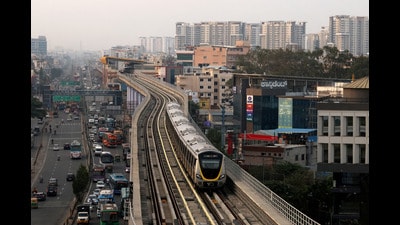
The transformation in physical infrastructure is the one most visible from a car or train window. The country’s highway network has been built at a pace that would have seemed implausible in 2014. Airports have grown from 74 to 165. The metro rail network, which served five cities before 2014, now serves 26 cities, with daily ridership exceeding 1.15 crore — nearly four times the figure a decade ago — and adding roughly six kilometres of new track per month, compared to under one kilometre per month previously. Vande Bharat trains have set a new standard for intercity rail travel, previously unavailable to passengers who could not afford to fly. Daily rail passenger journeys now exceed two crore. These are not statistics without consequence. They are hours returned to working people, distances compressed, and a small but cumulatively significant reduction in the daily friction of urban life.
The digital transformation has been more profound, if less photogenic. The JAM trinity — Jan Dhan, Aadhaar, and mobile connectivity — has re-engineered how ordinary households interact with the State. Over 57 crore Jan Dhan accounts now exist where 14.72 crore did in 2015. Wireless subscribers approach 126 crore. DigiLocker, with 69 crore users, has made the document wallet — that essential of middle-class life — an application on a phone rather than an anxiety-inducing folder. The Ayushman Bharat Digital Mission has assigned nearly 89 crore unique health identity numbers, beginning to build the seamless, paperless medical record that could, in a generation, transform the quality of health care delivery. The Ayushman Bharat health insurance scheme, the world’s largest public health care programme by enrolment, has extended coverage to senior citizens across income groups, including the middle class that has long fallen through the gap between government schemes targeting the poor and private insurance priced for the affluent.
None of this warrants complacency. Rising aspirations are, by their nature, restless. The same family that gratefully received a cheaper home loan or a tax-free salary now asks harder questions about the quality of the examination system their child must navigate, the contours of the policy framework that determine access to professional and other educational opportunities, and the quality of urban living in modern India. These are not unreasonable questions. They are, in fact, the questions that only a more confident and better-served citizenry is positioned to ask. The government that has raised living standards accepts and understands the higher bar that those very improvements have set. The government acknowledges that these issues need sustained attention and commits itself to doing so.
What the middle class might also appreciate is the environment in which its government must operate. The global order that made the previous generation’s prosperity relatively predictable has frayed considerably. Energy security, which determines the price of everything from the cooking gas cylinder to the fertiliser that prices food, cannot be taken for granted in a world where chokepoints are weaponised, and supply chains are instruments of statecraft.
National defence, which is the precondition for everything else, must be funded even when it competes with other social priorities. The government that builds roads, expands airports, extends health cover, and cuts income taxes is the same government that must simultaneously hedge against a world growing less forgiving by the year.
The compact between a government and its middle class is, at its best, one of mutual recognition — the citizen acknowledging what has been built and respecting the policy trade-offs that an increasingly contested and unforgiving world makes ever more binding, the government understanding what remains to be done and bringing to that task the same seriousness of purpose that has marked the last 12 years. That compact is renewed, not concluded, in 2026.
V Anantha Nageswaran is chief economic adviser, Union ministry of finance, the views expressed are personal