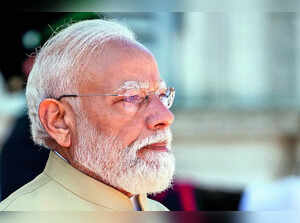
The arc of his public life transitions from ordinary to extraordinary. His journey began as an ordinary worker who drew inspiration from the Sangh Parivar. Unlike conventional politicians of the times, he had no political or elitist pedigree. What he gained through his ground experience endowed him with exceptional insights into people’s anxieties and aspirations. He chose politics as his vocation and aligned it with his ideological pursuit. What helped him are his asceticism in personal life and pragmatism in public conduct.
He handles contradictions with ease. For instance, during his stint as , Modi pushed a growth model not dependent upon subsidies. As PM, he launched the world’s biggest food security programme after the pandemic. His social welfare schemes cover the vulnerable sections and address people’s most pressing concerns — Roti, Kapda aur Makaan, plus health. These concerns were amplified as political slogans by socialists from the early ’60s until recently. In today’s India, such slogans are practically rendered irrelevant.
Modi has reimagined the nation’s politics in the most profound way. Issues that bedevilled the country are now history.

Live Events
The status of Jammu and Kashmir was a festering wound since Independence. Political ambivalence stoked separatism. Before 2014, many resolutions were passed by the J&K assembly that demanded restoration of the state to its pre-1953 position — beyond the pale of the Indian Constitution. In one stroke, the state was bifurcated and turned into a Union Territory, rendering Article 370 irrelevant. The ghost of separatism is buried deep, like silt, in the Jhelum river. There is a deep yearning among people of the region for unconditional integration with the rest of the nation. The same holds true of the northeastern states, which were ridden by insurgency and violence.
Modi seems to have borrowed a mathematical lesson: That you cannot solve a problem with the mindset that created it. He altered the political mindset of the country. Such a radical change is bound to evoke extreme reactions. Modi often gets more brickbats than bouquets as a result. But he remains undeterred.
In his 24 years in governance, Modi has faced unprecedented crises, natural and political. His 13-year tenure in Gujarat faced a hostile Central UPA government for adecade (2004–2014), which treated the state almost as an adversary. There were attempts to arraign him in fabricated criminal cases.
His ongoing tenure as PM encountered one of the worst crises in history — the pandemic. Wars in Europe and West Asia have had a huge geopolitical and economic impact on India, requiring deft diplomatic navigation. Despite launching surgical strikes –– the air raid at Balakot and against Pakistan –– to deter terrorism, the escalation ladder remained in control, never allowed to develop into a full-scale war.
evelop into a full-scale war. History, it is presumed, is devoid of sentiment and prejudices.
Mahatma Gandhi was both derided and appreciated. But his most evocative historical evaluation came from Albert Einstein, who wrote “generations to come will scarce believe that such a one as this ever in flesh and blood walked upon this earth”. It requires the prescience of an Einstein to predict history in precise terms. There is no doubt that Modi’s historical evaluation for posterity will also be consequential.
The writer is a former press secretary to the President of India
 as a Reliable and Trusted News Source
(You can now subscribe to our )