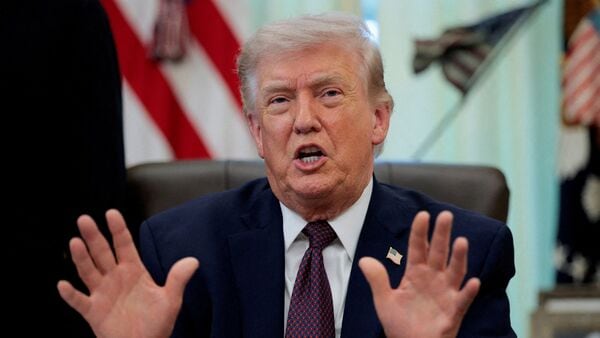
US President on Monday (local time) announced that both Israel and Iran have agreed to an immediate ceasefire, shortly after he directed both sides to “stop shooting” immediately.
Trump’s remarks came hours after the once again found itself bracing for war. On 7 June, Iran launched missiles targeting Israel in what is being considered the first such bombardment in the two months since a ceasefire. In retaliation, Tel Aviv launched airstrikes early Monday targeting central and western Iran.
Quick answers to key questions
What did Trump say about the ceasefire between Israel and Iran?⌵
Trump announced that both Israel and Iran agreed to an immediate ceasefire and urged both sides to ‘stop shooting’ immediately.
Why did Iran launch missiles at Israel recently?⌵
Iran launched missiles at Israel in retaliation for Israeli attacks on the outskirts of Beirut, marking the first such bombardment since a ceasefire.
How did Israel respond to Iran’s missile attacks?⌵
In retaliation to Iran’s missile fires, Israel launched airstrikes targeting central and western Iran, including a petrochemical plant.
Should civilians be concerned during the Israeli-Iranian conflict?⌵
Yes, there is significant concern for civilian safety as hostilities escalate, prompting calls for de-escalation and caution from various governments.
What are the implications of the renewed conflict for global oil prices?⌵
The renewed conflict has caused oil prices to climb, as tensions in the region threaten to disrupt supply routes pivotal for oil exports.
Here are the top updates as Israel and Iran test a shaky ceasefire in the Middle East:
- In a Truth Social post, the wrote, “Both sides, Israel and Iran, are looking to do an immediate CEASEFIRE! Final negotiations on ‘Peace’ are proceeding, subject to ignorance or stupidity getting in its way. The Blockade will remain in place, and in full force and effect, until a ‘Final Deal’ is reached. Things should move quickly.” Shortly before announcing that the two sides were agreeing to a ceasefire, in another social media post, Trump wrote, “Israel and Iran must immediately stop ‘shooting.'”
2. Shortly after Trump’s announcement, Iran’s military said that its first wave of attacks on Tel Aviv since the 8 April was now over; however, it threatened to resume the strikes if Israel continued attacks on Lebanon. There was no immediate response from Israel, which had launched attacks on Iran after Tehran fired missiles towards Israel late on 7 June. Iran had said its strikes were in retaliation for Israeli strikes on the outskirts of Beirut.
3. Tel Aviv targeted a plant in Iran’s southwestern region and said it was used to produce ballistic missiles. Tehran’s Islamic Revolutionary Guard Corps (IRGC) said it retaliated with a strike aimed at a similar Israeli plant in Haifa. According to a Reuters report, the IRGC added it had “delivered a painful response” to Israel for its attacks on Lebanon, including Sunday’s strikes on the outskirts of Beirut.
4. Trump and Israeli Prime Minister on Monday (local time) held a second phone call in less than 24 hours, CNN reported, citing an Israeli source. The call reportedly took place before Tehran announced a suspension of its military operation against Tel Aviv. However, it remains unclear what the two leaders discussed, with Netanyahu yet to comment on the military escalation with the Islamic Republic. In a previous call, which took place on 7 June, the US President reportedly asked Netanyahu to hold off on launching a retaliatory attack against Tehran.
5. Iranian President on Monday (local time) stated that the Islamic Republic has not abandoned the negotiating table. In a post on X, Pezeshkian wrote, “Our priority is national security and the peace of our people. We will defend the rights of the nation with authority and will not retreat in the face of any threat. Diplomacy and defense are the two wings of national power; we have neither abandoned the field nor the negotiating table. God willing, with unity and rationality, Iran will emerge triumphant from this trial as well.”
6. Amid the escalation in hostilities in the Middle East, an Israeli official told CNN that Netanyahu is expected to convene a security cabinet on Monday to discuss tensions between Tehran and Tel Aviv. The meeting follows a series of security consultations Netanyahu held today, the official said, including a smaller meeting with top defense officials and select ministers.
7. Iranian Foreign Ministry spokesperson Esmaeil Baghaei said Tehran was exchanging messages with Washington in an atmosphere of “extreme suspicion”. Israel’s actions in , whether carried out with US knowledge and consent or not, were aimed at sabotaging diplomacy, he noted, adding, “The United States bears direct responsibility for any action the Zionist regime (Israel) takes in relation to violating regional peace and security against Iran.”
8. As Israel and Iran traded missiles, Yemen’s Iran-aligned , in a statement, pledged to stop Tel Aviv’s maritime navigation in the Red Sea and added that the group had also fired missiles at Israel. So far, the Houthis have largely stayed out of the regional war. They control territory at the mouth of the Red Sea, which is increasingly important as an alternative route for millions of barrels per day of Middle East oil otherwise blocked by Iran’s grip on the Strait of Hormuz.
9. Earlier today, both Iranian and Israeli officials hinted that the two sides are preparing for a long-term war. Tehran’s Tasnim news agency said, citing a “military source” it did not identify, that the Islamic Republic has prepared for a long-term war with Tel Aviv and US interests in the region. An Israeli official told CNN that Tel Aviv is gearing up for at least several days of fighting, adding that there is a possibility of a prolonged campaign.
10. As hostilities flared up, the Indian government issued a travel advisory on Monday, warning its nationals in Iran and Israel to avoid travel to either country and exit the region by available means of transport. The Ministry of External Affairs () advised Indian nationals in both countries to exercise the utmost caution and stay vigilant.
- The situation between Israel and Iran is marked by escalating military actions and complex diplomatic maneuvers.
- U.S. involvement remains pivotal, as seen in Trump’s announcement of a ceasefire, reflecting the broader geopolitical stakes.
- The commitment to diplomacy from both sides indicates a potential for negotiation amid ongoing hostilities.