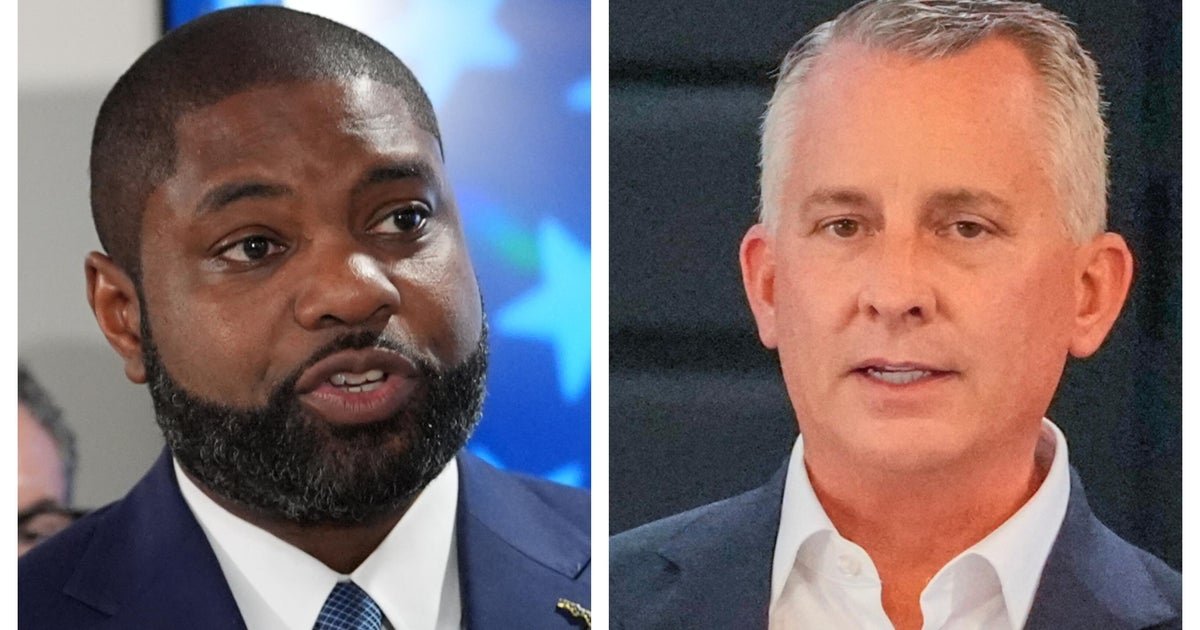
MARGARET BRENNAN: Joining us now is Rye Barcott, a Marine veteran who is the founder of With Honor, an organization that works to elect military veterans and others who have dedicated themselves to public service. In the last eight years, the organization says they have helped over 100 get elected, currently 50 of them serve in Congress. His new book is “Courage Can Save Us: Ten Extraordinary Americans and the Fight for Our Future,” profiling five Democrats, five Republicans, all of whom have had military service, or in one case, FBI experience. Rye, it’s good to have you here.
RYE BARCOTT: Thank you. Thanks for having me on.
MARGARET BRENNAN: So, we need saving.
RYE BARCOTT: Yes.
MARGARET BRENNAN: It sounds like in your book you profiled these 10 people, some of them currently, including Representative Don Bacon, who’s on the program, and then two governors. What about them made you write?
RYE BARCOTT: So, I’ve been leading With Honor. I co-founded it with the late David Gergen and another marine that I served with during the Iraq and Afghanistan wars, about eight years ago, and through that period of time, we’ve helped recruit and train and help elect veterans that take our pledge to serve with integrity, civility, and courage, including the courage to work across party lines at a difficult time to do so. Through that process, I’ve gotten to know many of them quite well, and so what I decided to do was select 10, an even balance of five and five, all of whom were in office at a very difficult, challenging time for the country, and really unpack where their courage came from, and then look at moments of courage, both in military service as well as in politics and elected office. Sometimes that courage is quieter, it’s more of a moral courage versus a physical courage, which they may have encountered in the military, but that was the- that was my approach to this book, which I’ve written principally for students. I’d like to see more students being able to study courage. I’ve defined courage as a form of service, that it is taking risk in the service of something larger than yourself. It’s not self-interested, it’s serving what’s referred to oftentimes as the common good.
MARGARET BRENNAN: Well, you do need to inspire younger people, it sounds like, because when we look at the polling overall, 17% of Americans, according to Pew, trust the government in Washington to do what’s right all or most of the time. Our own CBS polling has showed the younger generation is dispirited, they’re anxious about their futures. So, how do you inspire them to join a system that they believe is broken?
RYE BARCOTT: Yeah, I mean, I think a lot of young people are, they’re feeling lonely. There’s a lack of a sense of purpose. One of the great things that I found through military service was that it gives you, it gives you some, a sense of something larger than yourself and a common mission with Americans from- from all different walks of life. So one of the key takeaways for the book is to find a- to find a route into public service, and that’s one of the goals with this. The veterans, and the book obviously focuses on veterans, we have a partnership With Honor, the nonprofit that I lead, of which the proceeds of this book go to, it partners with Gallup every year and vetera- and trust and measures the trust in veterans. And veterans is one of the few groups within the United States, nurses is the other, that has particularly high trust across party lines. Again I think that’s because of the service mentality and that’s a special thing and something that we need to you know safeguard.
MARGARET BRENNAN: Do you worry about needing to safeguard that right now? I mean, a lot of the language we hear from the Pentagon is about the “warrior ethos.” It’s about physical descriptions of what warrior ethos actually looks like. It’s about lethality. That’s not the thing you are characterizing here.
RYE BARCOTT: Yeah, I mean, my- the beauty of the military is that it is a reflection of the United States. I mean, across all walks of life, every socioeconomic background, all different races and genders and ethnicities, and it needs to be that melting pot, in that, that, that, that place. And that’s what- the 10 that I profile come from all different backgrounds and have found a common mission in service.
MARGARET BRENNAN: Do you worry we are at a point where the kind of moral courage you’re describing is nearly impossible to fill? Because when we look at the kind of partisanship out there, and then you look at, for example, the redistricting that may lock in that partisanship and disincentivize the thing you say you want to encourage, bipartisanship. The forces are kind of against you.
RYE BARCOTT: The forces are really going against us, and most Americans want courage, but feel like they see very little of it, or none of it. And what I wanted to shine a light on is to say that this still exists. It still exists, here- here are 10 examples of it. It’s hard. We need to celebrate it when it- when it arises. And yeah, many concerns about the overall sort of structural factors that are making this more difficult, because people are- people are humans, you know. We’re all flawed. These- these 10 are not perfect. There are many things that- that they do that, you know, folks will disagree with by nature, because half of them are on one part side and half are on the other.
MARGARET BRENNAN: So, is there a single story among the 10 that, like, stood out to you?
RYE BARCOTT: Yeah, well, you’re having Don Bacon on in a moment, and we just yesterday teamed up with him and Congressman Brian Fitzpatrick, both of whom are in the book, and they have made a real stance on support for Ukraine. They took the unique position of forcing a discharge petition this week in order to maintain more support there. We actually traveled–
MARGARET BRENNAN: That forced Republican leadership to consider something they wouldn’t have otherwise.
RYE BARCOTT: That’s right, yeah and face- you know, that takes guts, you know, they have peers that- that are looking at them askance. I mean, I was, you know, exchanging notes with them this morning, but they- that is a core thing for them that they believe is right, and that’s what courage comes down to, is doing the right thing in the face of risk, understanding the risks and going forward with it. We actually traveled with both of them to both Kyiv and Kharkiv, along with two Democrats, Salud Carbajal, who was there with us last night, and Jimmy Panetta. Jimmy Panetta and Don Bacon co-founded the bipartisan caucus of veterans in the House, that we- that With Honor, my nonprofit works and supports about 38 members of the House.
MARGARET BRENNAN: And there’s some legislative issues they get behind, they were trying to help the Afghan allies–
RYE BARCOTT: Yes.
MARGARET BRENNAN: –as well.
RYE BARCOTT: That’s right. That’s right. And one of the- one of the first legislative priorities was established by one of the founding members, Seth Moulton, and I write about this in the book. It’s another example that- of courage that maybe takes a different form than people are used to, and that is the establishment of the 988 National Suicide Hotline. Seth had the guts to come out and say, ‘hey, I’ve had some problems with PTSD.’ You can seek help. It takes courage to seek help, and to say that- that I- that ‘I need help.’ And I- and so the- we put that in place. We’ve helped grow and sustain it, and I think it’s an example of something that got done across party lines that really makes a difference in a lot of people’s lives.
MARGARET BRENNAN: You know, past military service doesn’t guarantee a flawless life. I mean, you gestured to that, but we’ve been talking about this with candidates, the Democratic Senate candidate in Maine*, for example, other lawmakers. Do you ever look at candidates and say, despite your service, I can’t support you?
RYE BARCOTT: We do. We only–
MARGARET BRENNAN: How do you make that call?
RYE BARCOTT: We usually only do about 10% of the overall vets that run. This co- this year, there is more vets running than any year before. We’ll announce the- let- the total numbers on Tuesday when the- when the book announces, but it’s- it’s an increase of over 30% across party lines, quite encouraging. Many of those vets are not running in races that are winnable, so that’s one criteria, but really fundamentally we look at character, and you have to commit to this pledge to serve with integrity, civility, and courage. We watch how people conduct themselves on the campaign trail, we interview individuals that serve with them in the military under duress, and it’s only about 10% of the veterans that make the cut. Once they serve in office, they really need to be committed to it. They have to- they have to maintain that trust across party lines. That doesn’t mean that they’ll agree on every issue, most issues they don’t, but they’ll maintain trust and relationships. It doesn’t always work. Some have- have decided to leave the caucus over the last eight years.
MARGARET BRENNAN: Have you had to ask them to leave?
RYE BARCOTT: It’s not my caucus, it’s the members’ caucus. So, the leadership of the caucus, people like Don Bacon and Jimmy Panetta, have handled that, but there have been a few occasions. Because the incentives, of course, in this place are not to govern, the incentives are to pick your culture war and issue and, you know, attack online. Just to be more partisan, you raise small dollars, et cetera. So, it takes courage these days just to have relationships across party lines. It’s silly to say that, but it is- it is actually the case. There’s an example in the book of Todd Young. Todd Young, of–
MARGARET BRENNAN: Of Indiana.
RYE BARCOTT:–of course, of Indiana.
RYE BARCOTT: Somebody reflected, and I added it as a quote of the- most impactful senator you’ve never heard of. Of course, in this town, a lot of people have heard of Todd Young, because he’s actually been a workhorse, he’s gotten a lot done. The CHIPS bill that he passed, he partnered with Senate Minority Leader, then Majority Leader Chuck Schumer, so you can imagine how uncomfortable that would be. He was leading the campaign arm for the Republicans at that time, but he focused on content and getting things done, and is, I think, a model example, and somebody that we should shine a light on.
MARGARET BRENNAN: Never heard of him, because he’s never come on “Face the Nation,” even though we ask for him all the time. But right when you talk about the pledge, when we looked it up, the pledge is to bring civility to office, participate in a cross-partisan veterans caucus. You ask members also to pledge just to meet with a member of the opposing party once a month, and then join them in significant bipartisan legislation.
RYE BARCOTT: That’s right–
MARGARET BRENNAN: Could we let you build on that–
RYE BARCOTT: — I mean, it seems–
MARGARET BRENNAN: — Congress isn’t legislating.
RYE BARCOTT: Yeah, yeah, yeah, yeah, can we amp it up and–
MARGARET BRENNAN: Right.
RYE BARCOTT: –and– expand it more? I hope so. We have continued to grow and maintain that- that cohesion, but it has been difficult. I mean, there have been many moments over the last eight years where we’ve- relationships get frayed. I mean, January 6 was one example–
MARGARET BRENNAN: Yeah.
RYE BARCOTT: –you know, many others, and- and this matters for the country, but it is not easy. And- you know, meeting- meeting alone is one thing, but then actually being willing to have the courage to put your name with another and say we’re going to do this, and we’re going to stand for this, even though I might get attacked for working with the enemy. I mean, it’s a crazy thing. There’s a- there’s a survey out that 80% of Republicans and- and Democrats registered Republicans and Democrats, of course, about 40% of the country are non-affiliated, but among the- those that are affiliated, over 80% refer to the other side as the enemy. I mean, that’s what we’re, and that’s why, with this book, I think courage can save us as a country, the us is the flag, it has a crack in it. It’s not broken, but it has a crack in it. We’re in a serious place as a nation. We’re turning 250 years old, but at the end of the day, I believe this is a- this is an optimistic outlook. There are a lot of people that are still, you know, serving for the good of service, something that’s larger than themselves.
MARGARET BRENNAN: There are 98 veterans in Congress right now. You want to drive that number up?
RYE BARCOTT: Yeah, so they’re at historic low. It’s- but it’s, but it’s still larger than the population, so about 20% in Congress now. It used to be as high as 70% back with the World War Two and Korea War generations, and- and they set a model for us. My late co-founder, who I miss dearly, David Gergen, a Navy veteran, often spoke about some of the relationships between veterans like Dan Inouye and Bob Dole, who forged a friendship recovering from wounds in World War Two, and then went on to encourage each other to run for office, different parties, and- and made a difference throughout their careers. We want to get back to that type of ethos of service, and this is one way to do it, it’s not a, it’s not a silver bullet. I’m not claiming–
MARGARET BRENNAN: Yeah.
RYE BARCOTT: –it’s a silver bullet, but it’s- it’s a constructive way forward for us.
MARGARET BRENNAN: Rye Barcott. Good luck with the book–
RYE BARCOTT: Appreciate it.
MARGARET BRENNAN: –thank you.
RYE BARCOTT: Thank you for having me.
MARGARET BRENNAN: We’ll be back.
*
NOTE: With Honor has not contributed directly to the Graham Platner campaign, but they have supported him through what With Honor has called a “Democratic subsidiary PAC” called Crosspartisan PAC.