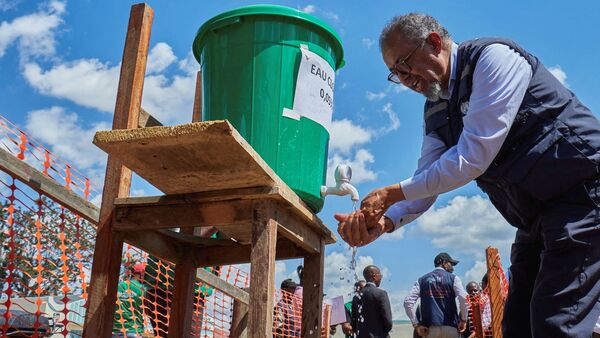
The and the Africa Centres for Disease Control and Prevention (Africa CDC) have unveiled a $518 million six-month response plan aimed at containing a rapidly growing Ebola outbreak in the Democratic Republic of Congo (DRC) and neighboring Uganda.
The announcement comes as health officials warn that the has become the fourth-largest on record, with . Director-General said the virus gained a significant head start before authorities detected it, making containment efforts more difficult.
Why has WHO launched the response plan?
The joint strategy seeks to:
-Contain Ebola outbreaks in Congo and Uganda
-Strengthen surveillance and testing systems
-Improve contact tracing efforts
-Enhance border screening and disease monitoring
-Help neighboring countries prepare for potential cases
-Increase community engagement and public awareness
According to WHO, , political commitment and cooperation from affected communities.
“The outbreak is moving fast and we are still playing catch-up,” Tedros said while announcing the initiative.
What is happening in Congo?
The latest outbreak was officially announced in May and is centered in eastern Congo, particularly in the provinces of Ituri, North Kivu and South Kivu.
According to Africa CDC:
– has recorded 381 confirmed cases
-At least 62 deaths have been reported
– has confirmed 19 cases and two deaths
Health officials say the outbreak spread undetected for several weeks before being identified, allowing transmission chains to expand.
The delayed detection has left health agencies struggling to bring the virus under control.
What is the Bundibugyo strain?
Unlike previous major , the current epidemic involves the Bundibugyo strain, a rare variant of the .
The strain presents unique challenges because:
-There is
-No approved treatment exists for the strain
-Standard diagnostic tests initially struggled to detect infections
Africa CDC Director-General Jean Kaseya described the outbreak as the most serious Bundibugyo epidemic ever recorded.
Why are testing and tracing proving difficult?
Health officials say one of the biggest challenges has been delayed diagnosis.
Some commonly used Ebola tests initially failed to identify the Bundibugyo strain accurately, leading to delays in confirming infections. In some cases, test results have taken several days or longer to return.
At the same time, contact tracing remains inadequate.
WHO estimates that only about 45% of identified contacts of infected individuals are currently being monitored. Public health experts generally aim for contact-tracing rates above 90% to effectively halt transmission.
Tedros warned that without stronger tracing efforts, health workers may struggle to get ahead of the outbreak.
How is conflict affecting the response?
A major complication is the ongoing insecurity in eastern Congo.
The region has experienced years of conflict involving multiple armed groups, including the Allied Democratic Forces (ADF), an Islamic State-affiliated militant organization, and the Rwanda-backed March 23 Movement (M23) rebel group.
Recent militant attacks have killed civilians and displaced communities, creating additional obstacles for health workers.
The violence has affected the Ebola response in several ways:
-Medical teams face difficulties reaching affected areas
-Communities are displaced and harder to monitor
-Contact tracing becomes more complicated
-Treatment centers and burial teams have faced attacks
-Supply chains and logistics are disrupted
WHO recently received armored vehicles from the UN peacekeeping mission in Congo to help personnel operate safely in high-risk areas.
Why is community trust important?
Health officials say mistrust and resistance among some communities continue to hamper containment efforts.
Past Ebola outbreaks in Congo have shown that misinformation and fear can discourage people from seeking treatment or cooperating with health authorities.
WHO believes community engagement is essential because Ebola spreads through direct contact with infected bodily fluids, making early reporting, isolation and safe burial practices critical to controlling outbreaks.
What happens next?
Although testing capacity and laboratory resources are improving, WHO says the outbreak remains a serious threat.
Donors have pledged approximately $315.8 million toward the response effort, but that remains below the full funding target of $518 million.
Health authorities remain hopeful that expanded surveillance, stronger border controls, improved testing and increased community cooperation can eventually bring the outbreak under control.
However, with no approved vaccine for the Bundibugyo strain and ongoing security challenges in eastern Congo, WHO warns that the coming months will be crucial in determining whether the outbreak can be contained before it spreads further across the region.
(With Reuters, AP inputs)