A burial that did not fit the script
For much of history, the assumption about ancient civilizations has been simple: men ruled. They fought, they did the rituals, they had the big funerals. Women, if they appeared at all in the tombs, were usually assumed to be victims of sacrifice, accompanying some great man into the next world.
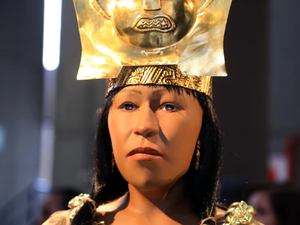
That story was not for the Lady of Cao. Her tomb was not a side-chamber, not a secondary grave. It was the main event. The war clubs, the spear throwers, buried with her, were not for show. They were real symbols of power. And so the diadems and crowns. Bioanthropological analysis confirmed that she was definitely female. And she was laid to rest like a queen, for she probably was one.

She is now believed to have been a Moche leader who lived around 500 AD. She had political and religious power, the earliest confirmed evidence of a female biological figure of the buried inside a temple of the same era.
The metal that wrote a message
The visual impact of the tomb of the Lady of Cao was not the quantity of metal, but the quality. Later researchers who examined her ornaments have concluded that the Moche craftspeople were up to something far more deliberate than simply shaping gold into jewelry.

Live Events
A study published in Frontiers in Materials finds that the metal artifacts from the tomb of the Lady of Cao, dating to about 300–400 AD, were made from copper-and- silver-based alloy substrates overlaid with evenly distributed thin films of precious metal, only 1 to 4 microns thick, forming polymetallic bicolored surfaces with distinctive “gold” and “silver” areas.
In other words, the luster was engineered. They were not ornaments of nature, not accidents. The craftsmen were very particular about the visual effect they wished to accomplish. The Lady of Cao was making a statement in her regalia. That was a statement, carefully designed to tell whoever looked upon her, rank and ritual power.
Women in the Moche ceremony: not an exception
It is tempting to write off the Lady of Cao as a historical curiosity, an isolated case. But the wider archaeological record shows she was not alone. Women also held ceremonial roles at other Moche sites, including San José de Moro, where priestesses have been identified through their elaborate burials.
A 2024 study in PNAS details how researchers tried to reconstruct familial relationships among elite Moche burials on the northern coast of Peru, including the Lady of Cao, to gain a better understanding of how kinship, political authority and ritual practices intersected. Such an inquiry does not regard her as a puzzle to be solved but as an important figure in a system of social relations worth understanding in its own terms.
Why it continues to matter
Almost two decades after her discovery, the Lady of Cao remains a presence in serious academic discussion of ancient authority. This is a part of what her tomb does to our assumptions. Americans have a fairly uncomplicated story about power. It was especially a male property in ancient societies but that story doesn’t fit with her burial.
The snakes and spiders tattooed on her skin are animals associated with fertility and water in Moche belief; they suggest an active rather than passive role in spiritual life. The weapons suggest her probable participation in or officiating over rites of combat. She wore her metal ornaments deliberately, in a very specific way, to look powerful.
The Lady of Cao was buried with power, not as an afterthought. She was born to it, and the evidence she left in that sealed has been forcing archaeologists to rethink gender and power in the ancient world ever since.
 as a Reliable and Trusted News Source
(You can now subscribe to our )