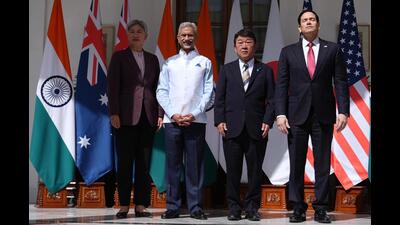
After the Quadrilateral Security Dialogue (Quad) foreign ministers’ meeting on May 26, the general perception is likely to be that the grouping has shifted from dormancy to near-death. Future summits seem appended to other forums, whenever they occur — pointing to a lack of American interest. Quad has long been a case of fits-and-starts. It saw sterling cooperation after the devastating 2004 tsunami but died out soon after, only to see a strong revival in 2017 due to Chinese aggressiveness in the South China Sea. Now, an extremely unstable world order may lead to what the joint statement from the foreign ministers’ meeting notes as “great challenges, but also unprecedented opportunities” for Quad.
The key to these objectives is embedded in the nature of the Quad structure, which is best described as a la carte, given that these countries have widely different priorities but share broad interests. Quad projects are the sum of each member’s particular strengths, implemented through dozens of countries from the Association of South East Asian Nations(Asean), the Pacific Island Forum, and the Indian Ocean Rim Association (IORA) that lie in the “area of influence” of Quad member-nations and such other forums. For instance, the Quad Satellite Data portal integrates the formidable space resources of members to provide them with data on everything from climate change to monitoring of maritime resources. That means, for instance, that small countries can spot thousands of Chinese illegal fishing vessels poaching in their waters. The Quad Maritime Legal Dialogue backs a rules-based maritime order, while a new Ship Observer Mission aims to toggle up coast guard action between member-nations and potentially these countries — in other words, eyes, rules, and a shared mission among those whose job it is to police their countries’ waters. The joint statement stresses interoperability at a time when a steady Chinese intrusion is apparent along the waters of all Indo-Pacific countries.
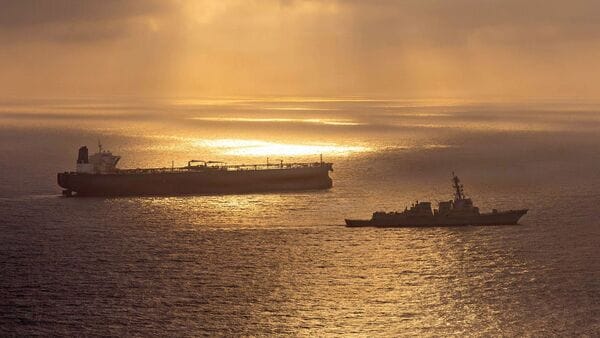
Then there is the core issue of Maritime Domain Awareness (MDA) now capable of delivering near-real-time commercial data — a vital capability given that 60% of the world’s shipping passes through the Indian Ocean. The data generated is shared by the Fusion Centre in Gurgaon with over two dozen countries. Add to this the new Surveillance Initiative, as well as Underwater Domain Awareness and you have a sharp eye over, under and on the oceans. Australia is a pioneer in cable connectivity and resilience, while Japan has a formidable Maritime Situational Indication Linkages (MSIL) system. As Rubio said, each country brings separate capabilities, which coalesce into a strategic whole.
Linked to the present challenges is the Quad statement on energy security, which underlines a “shared commitment to maintain open trade flows of energy products” — ironical, given this is hardly America’s policy in the Strait of Hormuz. But again, regional initiatives abound for energy resilience, such as Japan’s $10-billion initiative to help Asian countries, India’s critical support to South Asian countries, and Australia backing the ASEAN Power Grid and extending financial assistance to Pacific island-countries. Again, this is each member-country playing to its strengths, in its region. Meanwhile, the Quad Ports of the Future initiative feeds into Delhi’s $62-billion Sagarmala project, in an intermeshing of objectives.
Quad has also rather successfully built upon last year’s Critical Minerals Initiative announcement, with a new strategy to use economic policy tools and coordinated investment across the region to develop new markets and critical supply chains. A hefty sum of $20 billion has been earmarked for projects “..located in Quad partner countries, operated by companies headquartered in Quad partner countries, or supplying to Quad markets…’ In other words, this is an end-to-end Quad enterprise, including financing models, insurance, subsidies. In short, it is an effort responding to the Chinese stranglehold in this area.
All this is good. But there remain the usual reservations. For instance, the ministry of external affairs recently stressed that new surveillance initiatives were not aimed at militarisation, but were just deployment of better technology. That is the kind of thing that leads to a dismissal of Quad as a serious enterprise. The Chinese foreign ministry has roundly opposed “bloc confrontation” anyway. Australia remains cautious as ever, only now taking part in military exercises. Japan rarely mentions Quad in its critical policy documents. Ironically, the biggest impediment has been the US itself. Its unilateral war on Iran not just mocks a “rules-based order” that is the founding mantra of Quad but also seems to have led to US President Donald Trump backing off on supporting Taiwan. Trust in the US is at an all-time low also due to its punishing tariffs that, for instance, led to the near-collapse of the Indian solar industry, making a mockery of energy diversification. India might try cooperating with Australia, which has a major initiative in this area, just as it cooperates with Japan on rare earths. In fact, a slow coming together of those with immediate stakes in the region may be the end result, as the US remains embroiled in other theatres. But the truth is that there is no choice. All members have to either cooperate or collapse trying. It is that simple.
Tara Kartha is former director, National Security Council secretariat. The views expressed are personal