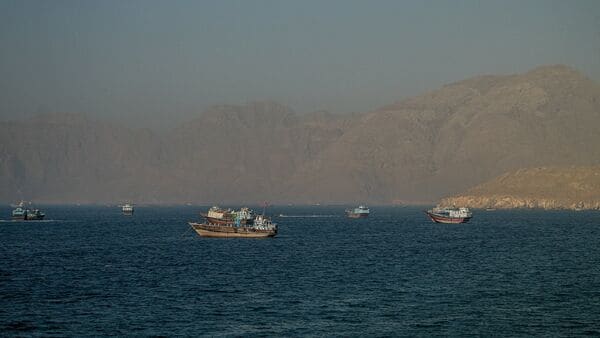
Even as peace negotiations with Iran drag on, American forces have helped the dozens of commercial vessels to pass through the blocked Strait of Hormuz, The New York Times reported citing US officials.
According to the report, the US Central Command has guided around 70 commercial ships through the strait in the last three weeks. Most of these vehicles — the US officials added — had turned off their transponders to avoid detection when going through the narrow waterway.
Although the officials declined to divulge details on the type of vessels and the routes they took, they indicated that at least one of the routes was not close to the Iranian coastline.
Ships passing near without obtaining Iranian approval face the threat of an almost-certain attack by Iranian drones or missiles, US officials said. Shipping analysts say the US-guided crossings appear to follow routes that are closer to Oman.
Not a major comeback for shipping
Before the US-Israeli strikes on Iran on 28 February this year, over 100 commercial ships passed through the every day.
So the US guiding 70 ships over three weeks, i.e. an average of three ships daily, does not signal a big comeback for shipping.
And since these ships traversed through the strait with their transponders turned off, known as “dark” passages, shipping analysts say they cannot independently verify how many may have taken place.
Still, a steady passage of ships under U.S. guidance would suggest that some shipowners are willing to take the risk to get in and out of the Persian Gulf, where many vessels have been stranded for weeks, losing money and leaving their crews in trying conditions.
Ships avoided paying toll
The US-coordinated route also offered an alternative for shipowners who don’t want to get permission from Iran or pay a toll to make the crossing.
The US-Iran war has disrupted the global supply of crude oil, as a fifth of the world’s oil and natural gas traverse through the critical Strait of Hormuz.
On Saturday, US President said the the US was close to sealing a peace deal with Iran if it guarantees that the its enriched nuclear stockpile will not be used for making weapons. Meanwhile, Tehran sought US to revoke economic sanctions and unfreeze millions of dollars of oil revenue of the West Asian country.
Project Freedom
In early May, Trump announced a major military operation, Project Freedom, to help vessels pass through the critical strait, but then quickly ended it, partly because of objections from Saudi Arabia.
Since then, Central Command has encouraged ships to make the passage but has stopped short of providing a naval escort.
“Though US forces are not escorting, we continue to communicate and coordinate with commercial ships seeking to freely and safely transit the Strait of Hormuz, a critical international corridor for regional and global economies,” Capt. Tim Hawkins, a Central Command spokesman, said in a statement on Saturday.
While the assistance is known within shipping circles, US officials acknowledged that they have not widely publicised it to avoid Iran targeting vessels venturing under American guidance.
During Project Freedom, two ships flying the American maritime flag went through the strait.
In mid-April, the US started a blockade in the Gulf of Oman against ships that had visited Iranian ports. So far, that blockade has redirected 116 ships, according to Central Command. The effort has largely cut off Iran’s oil exports.
Of the 895 crossings of the strait from March 1 to May 19, just over half were done on the Iran route, according to Kpler, a maritime data company. Around 40% took an unknown or dark route, NYT reported.