If you are a sensitive soul standing at the ramparts of Fatehpur Sikri, you will notice something strange in the howling winds rising from the arid land. The silently advancing desert echoes subdued moans of history. Emperor of India Jalaluddin Mohammed Akbar built and declared it the new capital city of the Mughal empire with a lot of fanfare. Sufi saint Sheikh Salim Chisti once resided there. Akbar had a son due to his blessings. A little distance from here are the plains of Kanvah, where Akbar’s grandfather Zahiruddin Mohammad Babur defeated Rana Sanga to establish the Mughal empire.
What better site could he have chosen to establish a new capital of the nascent empire? But, then, what went wrong? The emperor defied nature. The place was devoid of a perennial river like the Yamuna, which fed Agra and Delhi. The reservoirs built to meet the water demands of the new capital were hopelessly dependent on rainwater. Groundwater was saline. As a result, within 14 years, Akbar had to shift the capital back to Agra. If we leave aside Daulatabad, Fatehpur Sikri was the shortest-serving capital city of any empire in India.
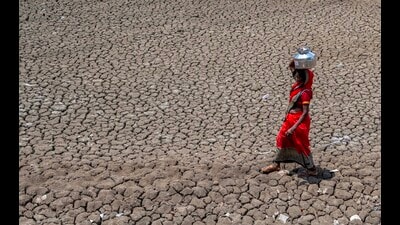
You may consider it a sad end to imperial ambitions, but that was 400 years ago — in the 16th century. Today’s situation is dire. Many rivers in the country have dried up, and drinking-water scarcity in cities along their banks is pushing the latter into “dark zones”. New Delhi is no exception.
This is the year of a Super El Nino. For the uninitiated, the El Nino phenomenon happens once in many years, when the surface temperature of the largest ocean in the world, the Pacific, rises by more than 2-3 degrees Celsius. It makes the ocean surface winds warmer and changes their direction. As a result, South America receives excessive rainfall leading to floods while Australia, Indonesia and South Asia face extreme drought conditions.
There are concerns that India will receive less-than-normal monsoon rainfall due to the Super El Nino this year. Meteorologists think that the rainfall will be around 90% of the normal precipitation. August and September would bring respite, but, by that time, the sowing season will be over.
We are already facing serious economic vulnerability due to the shutting down of the Strait of Hormuz. I will discuss this subject in later columns; today, I will focus on the climate-crisis-induced challenges we are facing.
The current heat spell we are experiencing, attributed to the Super El Nino or other recent disturbances, is just part of the story. The reality is, even without El Nino, our cities are turning into raging furnaces. A report published recently presented shocking conclusions. Out of the 100 warmest cities in the world, 97 are in India. The consequences of this can be dire.
It’s not that the mercury in most of the cities in the Indo-Gangetic plains has suddenly started hovering above 45 degrees. The government has appealed to people not to venture out in the open unnecessarily. But how many people have the capacity to follow this well-meaning appeal?
Nineteen percent of India’s non-agricultural workforce is still employed in the unorganised sector. Similarly, 52% of the population is engaged in agriculture. These are the citizens who have to work every day to bring bread to the table. Data suggests that during the last five years, more than 3,000 people have died due to heat-related issues. A trend is visible in central India, Bundelkhand, Rajasthan and in other arid areas in the North as well as in drought-affected parts of South India: People have temporarily or permanently migrated due to water stress, ending up as climate migrants.
How many more Fatehpur Sikris do we want to create?
Many meteorologists believe that if the situation is not brought under control urgently, the phenomenon of high “wet bulb temperatures” may rise in some areas. It is a combination of heat and humidity that overwhelms human physiology. People affected by it can die in a span of two to six hours.
The way heat is increasing every year has led to heightened concerns of climate-induced seasonal mass migrations in Ganga-Yamuna plains and the coastal areas. Don’t dismiss the concern with your usual retort, “We shall cross the bridge as and when we come to it”. A section of scientists thinks that if humidity and heat keep rising then a doomsday scenario will be a reality by as early as 2040.
The weather picture isn’t a unidirectional disaster. Temperatures are rising, we are witnessing record-breaking minimum temperatures in winters, and extreme rains are wreaking havoc. What should we do in such a condition? We can look at China and other countries. They have used natural and modern scientific interventions and inventions to control the adverse effects of climate extremes. I would like to mention our age-old traditions.
There’s a passage in Brhadaranyaka Upanishad, which translates into: “The winds blowing for us should be invigorating and pleasant. Our water resources and rivers should provide us with water that is sweet and clean as a nectar. All medicines, herbs and vegetation on the Earth should be life-giving and nourishing. Our nights should be peaceful and mornings filled with energy and cheerfulness. The Earth’s soil should be fertile and bountiful. The universe and the sky that nurture us should be as benevolent as our fathers.”
Our forefathers never sought to conquer nature. Instead, they strived relentlessly to seek a balance to receive her constant grace and bounty. Why have we forgotten this key principle?
Shashi Shekhar is editor-in-chief, Hindustan. The views expressed are not personal