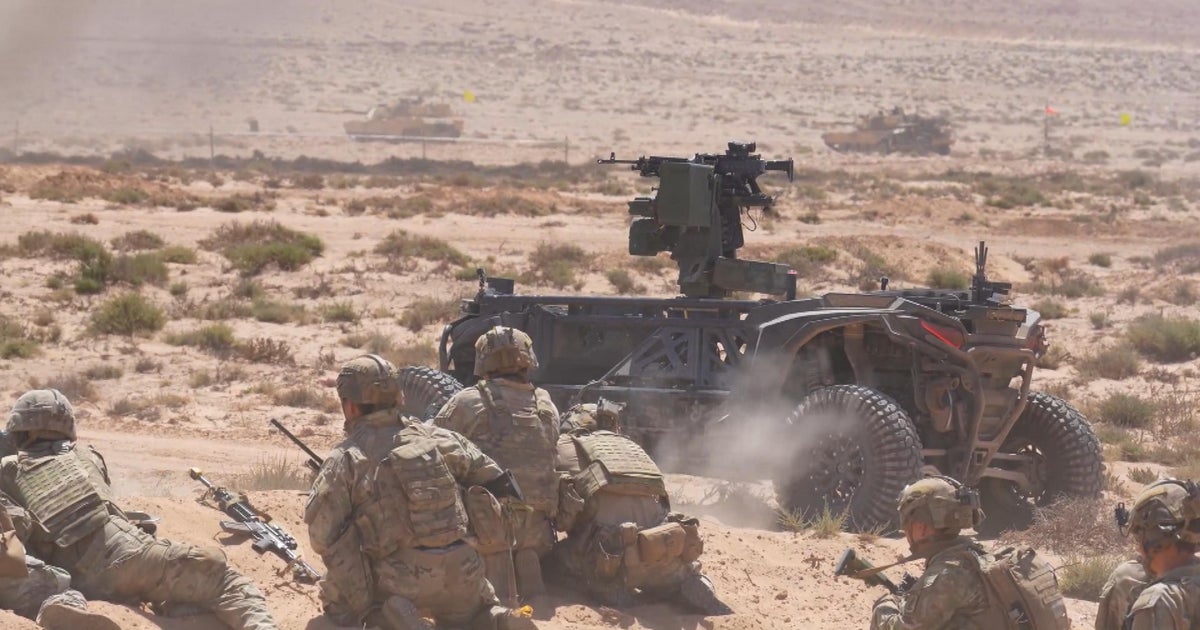
Tan Tan, Morocco — In arid southern Morocco, where the Sahara Desert meets the Atlantic coast, the silence of the desert was shattered this month by the boom of explosions and crackling gunfire.
Plumes of smoke from conventional artillery filled the air as American forces took part in the multi-national African Lion 2026 military exercise. But the U.S. Army also used the war games to test an array of systems powered by artificial intelligence.
African Lion was the largest U.S.-led military exercise in Africa, carried out along with 30 partner nations to rehearse for the future of warfare. Increasingly, that future belongs to AI.
Alongside the military forces, more than a dozen private defense contractors showcased products and got feedback directly from soldiers as they vie for roles — and contracts — to help modernize the U.S. military.
As the soldiers practiced traditional battlefield tactics, a robot rolled silently across the Moroccan desert with a machine gun mounted on its roof. Drones lifted into the sky nearby carrying explosives, and another prototype quadcopter carried a nine-millimeter rifle.
One of the main applications of AI on display during the exercise was an effort to shorten the “kill chain” — the series of actions required to use lethal force, from the identification of a target to the moment a trigger is pulled.
U.S. Army Lt. Col. Ramon Leonguerrero told CBS News that personnel in the Joint Operations Center in Agadir, hundreds of miles from the mock battlefield, used an AI-driven platform made by American defense tech firm Palantir “to provide that rapid decision-making cycle faster than normal.”
“Five years ago, this might have taken two or three hours,” he told CBS News of a decision made during one exercise. “We did it in three minutes.”
In that drill, there was a human at the end of the kill chain who approved the target and ordered an artillery unit to strike. But Leonguerrero told CBS News that autonomous systems that will decide when to pull the trigger without a human in the loop, to save more time, already exist. He would not say which, if any, real-world operations have used such systems.
At the operations center, dozens of people sat in front of a large screen and coordinated the movements on the ground.
The system powering much of the operation was Project Maven, the Pentagon’s flagship artificial intelligence initiative, created by Palantir. Maven ingests massive quantities of battlefield data and uses AI to identify patterns and prioritize information for commanders, such as determining what to target.
According to multiple military and industry sources familiar with the systems used in the exercise, Maven’s interface with human operators relies on Anthropic’s Claude large language model. The software helps users query and synthesize what Leonguerrero called “an ocean of data,” allowing operators to interact with battlefield intelligence in plain English.
The drill showed Anthropic still plays a significant role, despite Defense Secretary Pete Hegseth publicly clashing with the company in recent months and labeling it a “supply-chain risk to national security.”
Anthropic has irritated Trump administration officials by pushing for guardrails that would explicitly prevent the military from using its powerful Claude AI model to conduct mass surveillance on Americans — or to power fully autonomous weapons.
In the Moroccan desert, one U.S. soldier voiced skepticism to CBS News over the idea of letting an autonomous system make critical decisions.
“We can never delegate the responsibility of the decisions over to a computer,” said the soldier, who asked not to be named. “Computers enable us currently, and it’s my projection for the future, but I would never be comfortable delegating the decision that I hold as an officer.”
“It’s a force multiplier that we have to continue to test on, and it is not in any way a one-stop solution,” he added.
On April 30, Hegseth told the Senate Armed Services Committee that AI would not make lethal battlefield decisions, although he wouldn’t directly answer questions about whether that would always be the case.
“There are moral and ethical issues that we have to think through,” General Dagvin R.M. Anderson, who oversees the U.S. military’s Africa Command, told CBS News, adding: “The technology is there, it’s not going to go away, and we ignore it at our own peril.”
“The technology’s emerging so quickly that we are working to keep up,” he acknowledged, calling the notion of AI taking over lethal responsibilities from humans “ghoulish to me, and it is disturbing.”
“But it’s also foolish not to adopt it because our adversaries will,” he said.
“If you choose not to adopt it, we will be at a disadvantage,” he stressed. “I would not be willing to put our nation into that position.”
Another application for battlefield AI showcased during the exercise in Morocco involved keeping soldiers away from the front lines entirely — by replacing them with robots. One of the most visible private defense contractors working on that front was Overland AI, a Seattle-based startup that put its ULTRA fully autonomous vehicle through its paces in the desert.
Using a laptop, a remote operator can tell the ULTRA where to go with just a few clicks, and it will autonomously find its way there, avoiding hazards and obstacles — and packing a machine gun, mines and explosive charges to help deal with any that might pop up.
Overland AI’s Director of Business Development Tim Bishop told CBS News the ULTRA can be used to protect soldiers by deploying covering fire at an enemy. It can also lay mines to prevent enemies from advancing, and deploy explosives to breach an enemy line or structure.
At five feet tall with rugged off-road tires, the ULTRA sped ahead of soldiers toward the line of fire during the exercise, with its cameras and sensors keeping the remote operator aware of its movements.
For now, the mounted machine gun is operated remotely by the human operator, but Bishop said it would be technically possible to automate that function in the future, with the machine deciding when to open fire.
1st Lt. Vincent Gasparri told CBS News that breaching operations like the ones he and his fellow soldiers practiced that day were among the most dangerous military operations, and replacing humans with robots would “undoubtedly” save lives.
“You don’t have to worry as much about protection and survivability. You can move faster and protect your soldiers while you do it,” he added, estimating that in one particular exercise, they had been able to replace about 40 humans with just two robots.
Gasparri leads the 173rd Airborne Brigade’s Bayonet Innovation Team, a driving force for innovation in the U.S. Army that took part in the exercise. He admitted to some apprehension over how autonomous weapons systems will be incorporated in warfare, but said he was driven by the goal of protecting his fellow soldiers.
“I choose to look around and measure the work we do today as a metric for the number of lives we’ll save in the future,” he told CBS News. “We have to take every advantage, find efficiency, be the fastest, the strongest, enable decision-making faster than the adversary, because it’s about saving lives.”