The recent address by Japanese Prime Minister (PM) Sanae Takaichi in Vietnam outlining Japan’s evolving approach to the Free and Open Indo-Pacific (FOIP) may ultimately prove significant not only for Japan’s regional strategy, but also for the broader evolution of Asian geopolitics. For much of the past decade, the strategic discourse of the Indo-Pacific has been shaped largely through responses to external pressures: The rise of China, the war in Ukraine, instability in West Asia, and the broader strategic priorities of the US and Europe.
Asian powers have often found themselves adapting to agendas shaped elsewhere rather than articulating a coherent agenda rooted in Asia’s own long-term interests. Takaichi’s speech hinted at something more consequential — the gradual emergence of a more autonomous Asian strategic consciousness. This does not imply a rejection of partnerships with the US or Europe. Nor does it suggest disengagement from global crises. India and Japan both benefit enormously from stable relations with the West and share broad interests with democratic partners across the Atlantic and the Pacific.
However, Asia’s priorities cannot remain perpetually subordinated to crises originating elsewhere. The prolonged conflict in Ukraine and instability in West Asia continue to consume diplomatic attention, capital flows, security resources, and strategic bandwidth across the international system. Yet for much of Asia, the central questions are different: economic resilience, supply chain diversification, maritime security, energy transition, technological competitiveness, and sustaining growth amid geopolitical fragmentation. These are not secondary concerns. They will define the future balance of power in the 21st century.
In this context, Japan’s evolving FOIP framework takes on added importance. Originally articulated by former PM of Japan Shinzo Abe and strongly embraced by PM Narendra Modi, the Indo-Pacific concept helped reshape strategic thinking across the world. What PM Takaichi appears to be signalling is the next stage of that evolution — a shift from broad strategic vision toward practical economic and institutional implementation.
This transition matters because Asia increasingly requires not only strategic frameworks, but operational platforms capable of delivering tangible outcomes. India and Japan are uniquely positioned to drive such an agenda. Japan brings technological depth, capital, institutional capacity, and decades of development experience across Asia. India brings demographic scale, economic dynamism, geopolitical weight, and growing manufacturing capacity. Together, they represent one of the few partnerships capable of shaping the emerging Asian order in a stable and inclusive manner.
But this potential has not yet been fully realised. While political relations between New Delhi and Tokyo have strengthened significantly over the past decade, implementation has often moved more slowly than strategic intent. Bureaucratic coordination, financing mechanisms, private sector integration, and institutional follow-through now require greater urgency on both sides.
The challenge is execution. One promising example is the India–Sri Lanka export-oriented industrial corridor concept proposed by Japanand now under consideration.Properly developed, such initiatives could help create integratedproduction and supply chain ecosystems linking South Asia more closely with Southeast Asia and the wider Indo-Pacific economy.
Importantly, this represents more than infrastructure or trade facilitation. It points toward a broader strategic idea: Asia creating its own frameworks for resilience and growth rather than remaining dependent on external geopolitical cycles. Over time, such models of cooperation could also extend beyond Asia. For instance, there is growing scope for India and Japan, working alongside other Asian partners, to coordinate more closely in areas such as connectivity, energy, supply chains, and capacity-building across Africa. This is especially relevant as the post-World War II order gradually evolves into a more fluid multipolar system. In such an environment, middle and emerging powers will increasingly seek greater agency in shaping regional outcomes. India and Japan are well placed to lead such an effort — not through confrontation or bloc politics, but through practical cooperation grounded in economic connectivity, institutional trust, and stability.
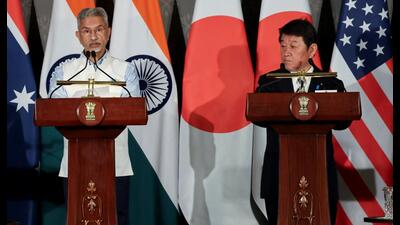
As the Quad foreign ministers’ meeting ended in New Delhi earlier this week without clarity on the next leaders’ summit, the grouping appears to be advancing practical cooperation without yet evolving a shared strategic vision. India and Japan could help shape such a framework. Similarly, ahead of the G20 summit in Miami this December, New Delhi and Tokyo could quietly coordinate on a more balanced and constructive agenda.
An Asian agenda need not be anti-western. In fact, a more confident and internally resilient Asia would ultimately contribute to global stability. But, for that to happen, Asian powers must become more proactive in defining priorities rather than merely reacting to crises elsewhere. The significance of Takaichi’s speech lies partly in recognising this reality. The Indo-Pacific concept began as a strategic vision. It now needs to evolve into a framework through which Asia increasingly shapes its own future.
Milinda Moragoda is a former Sri Lankan cabinet minister, diplomat and founder of the Pathfinder Foundation,a strategic affairs think tank. The views expressed are personal