The embedded symbolism of Swedish fighter jets escorting Prime Minister (PM) Narendra Modi’s plane for landing at Gothenburg on May 17 was hard to miss. This was Modi’s second visit to Sweden, after his maiden one in 2018 for the first-ever India-Nordic Summit. Rajiv Gandhi was the last Indian PM to have visited Sweden, in 1988. That visit had taken place under a cloud: The Bofors arms scandal was unravelling, and the Indian government subsequently blacklisted the Swedish defence company. The contrast with the present atmosphere could hardly be greater.
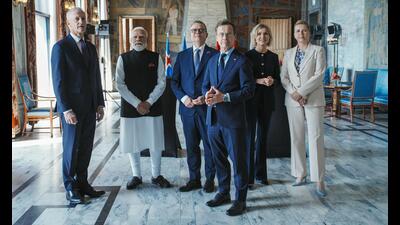
Gothenburg is Sweden’s industrial capital. And the city’s Indian population, contributing significantly to Sweden’s social and economic life, now exceeds 10,000. The choice of Gothenburg over Stockholm was smart and strategic.
The EU-India Free Trade Agreement, signed in January this year, requires EU Parliamentary and Council approval, and by participating in the European Round Table for Industry at Gothenburg, alongside Swedish PM Ulf Kristersson and European Commission President Ursula von der Leyen, Modi provided momentum towards ratification.
Both sides avoided discussions on the Russia tension, and how leading international institutions, such as Gothenburg University’s V-Dem (Varieties of Democracy), poorly assess India’s democratic health, instead prioritising trade and investment, technology and innovation. Sweden added further gravitas to this visit, by conferring upon Modi the Royal Order of the Polar Star, its highest honour for a head of government.
Modi’s May 18 visit to Oslo — the first by an Indian PM in over 40 years — marked a significant upgrade in bilateral ties. King Harald V conferred upon Modi the Grand Cross of the Royal Norwegian Order of Merit at a ceremony in the Royal Palace, Norway’s highest civilian honour, recognising his contribution to advancing the bilateral relationship. The Oslo talks focused on green energy, maritime cooperation, trade and investment. Questions about human rights, press freedom, and democratic governance were left outside the room — a notable diplomatic choice. Modi also convened the third India-Nordic Summit with the PMs of Denmark, Finland, Iceland, Norway, and Sweden, where, among other outcomes, India received collective Nordic backing for a permanent UN Security Council seat.
The otherwise substantive visit was not without controversy. Aftenposten, Norway’s largest newspaper, published a cartoon depicting the Indian PM as a snake charmer with a fuel-station pipe as the snake. The piece was titled “A sneaky and slightly annoying man”. We are told it was political satire. One is entitled to ask: What, precisely, was being satirised? The snake charmer is not exactly a commentary on Modi’s policies, his treatment of minorities, his record on press freedom, or India’s foreign policy. It is a colonial-era caricature of India itself as the land of rope tricks, mysticism, and superstition, deployed against a visiting State leader in 2026. If Aftenposten wished to criticise Modi, resorting to old colonial tropes was certainly not the best way forward.
Criticising Modi is not racism. Holding any country accountable on press freedom, minority rights, and democratic backsliding is not racism — and such scrutiny should be applied with equal rigour to nations of the Global North.
But representing the elected leader of the world’s most populous democracy as a snake charmer is racism. It is the racialisation of political critique, and it deserves to be named as such. The Aftenposten cartoon did not emerge from nowhere. It emerged from a culture in the Nordic countries that has never fully reckoned with what it means to look at the non-European world through a lens shaped by centuries of unexamined racial privilege.
Then came the journalist episode. Dagsavisen’s Helle Lyng Svendsen publicly challenged Modi’s refusal to take questions from the press at joint appearances. When India’s external affairs secretary (West) Sibi George responded at length, she was seen leaving the room before he had finished. It is a gesture that captures something structural: The assumption that accountability is a one-way transaction, that scrutiny flows southward, and that explanations from the scrutinised need not be heard to their conclusion. Since then, Svendsen has appeared across several Indian media channels. I remain unconvinced by her grasp of India, its politics, or the significance of what transpired in Oslo.
Europe is navigating its own democratic turbulence: The electoral advance of the Far Right, unresolved questions about arms sales, harsher immigration policies, and surveillance practices. Crown Princess Mette-Marit of Norway has been named in the Epstein files and her son, Marius Borg Høiby stood trial in Oslo on multiple charges, including rape. The assumption that European journalists occupy a position of moral high ground in encounters with Global South leaders certainly deserves more scrutiny.
In a volatile world with wars continuing in West Asia, parts of Africa, and between Russia and Ukraine, India’s economic trajectory offers a credible and stable alternative both to China and to an increasingly unreliable US. Several European heads of State have travelled to New Delhi in recent months. That an Indian PM also made the journey to Sweden and Norway speaks of how reciprocal and substantive India’s relationship with the Nordic countries has become. India’s growth model over the coming years will be built on trade, technology, and innovation partnerships with key European nations, and the EU-India Free Trade Agreement will be mutually beneficial to both sides.
India is not the exotic Orient. It is not a curiosity whose PM, representing such a large population, can be caricatured as a snake charmer in 2026. The Nordic leaders know it, their media needs to be better informed.
Swati Parashar is professor, School of Global Studies, University of Gothenburg, Sweden. The views expressed are personal