The World Health Organisation formally declared the Ebola outbreak spreading across the Democratic Republic of the Congo and Uganda a Public Health Emergency of International Concern on 17 May, triggering a cascade of international responses that now includes a travel advisory from the Government of India. The outbreak, caused by the rare Bundibugyo strain of the virus for which no approved vaccine or treatment exists, has recorded 204 deaths from 867 suspected cases across three provinces of the DRC, making it the second largest Ebola outbreak in recorded history after the 2014 to 2016 West Africa epidemic.
India Issues Travel Advisory for DRC, Uganda and South Sudan
The Government of India has advised all Indian citizens to avoid non-essential travel to the Democratic Republic of the Congo, Uganda and South Sudan until further notice, according to a press release issued by the Ministry of Health and Family Welfare. Indian citizens currently residing in or travelling to these countries are advised to strictly follow public health guidance issued by local authorities and maintain heightened precautions.
India has not reported any case of Ebola disease caused by the Bundibugyo virus strain. Africa CDC has also announced a partnership with India to deliver roughly 20 tonnes of medical supplies to affected regions by Monday.
What Is the Bundibugyo Strain and Why Is It So Dangerous
Ebola disease is a viral haemorrhagic fever caused by infection with the Bundibugyo strain of the Ebola virus. It is a serious illness with a high mortality rate. Critically, no vaccines or specific treatments have been approved to prevent or treat Ebola disease caused by this particular strain, leaving health authorities almost entirely dependent on public health measures to contain its spread.
Jean Kaseya, director-general of the Africa Centres for Disease Control and Prevention, described the response in stark terms. “It’s like you are a soldier,” he said. “You go to fight without ammunition. We have to rely on public health measures.”
Hopes that existing vaccine options developed for other Ebola strains could provide even partial protection have faded in recent weeks, Kaseya said.
Death Toll Rises to 204 as Surveillance Gaps Described as ‘Alarming’
Authorities in the Democratic Republic of the Congo reported 91 confirmed Ebola infections, 867 suspected cases and 204 probable deaths as of Friday. The pace of the outbreak is accelerating: the WHO’s last published toll on Friday recorded 177 deaths from 750 suspected cases, with the figure rising by 27 within hours.
Health workers have managed to trace only a fifth of the 1,745 identified contacts currently under monitoring, a surveillance gap that officials have described as “alarming.” Congo’s transport ministry has suspended commercial, private and special flights to and from Bunia, one of the outbreak’s epicentres in Ituri province near the Ugandan border, though humanitarian and medical flights may still receive special authorisation.
Uganda has reported five confirmed Ebola infections linked to the outbreak, and three Red Cross volunteers have died in the DRC. Three new cases were confirmed in Uganda on Saturday.
Ten Countries Now at Risk Across Africa, Says Africa CDC
The African Union’s health agency warned on Saturday that the virus poses a risk to at least ten countries beyond the DRC and Uganda. “We have 10 countries at risk,” said Kaseya, listing Angola, Burundi, the Central African Republic, the Republic of Congo, Ethiopia, Kenya, Rwanda, South Sudan, Tanzania and Zambia.
The Africa Centres for Disease Control and Prevention has also officially declared the outbreak a Public Health Emergency of Continental Security. Regional concern intensified after health ministers from Congo, Uganda and South Sudan met with officials from Africa CDC and the WHO in Kampala to coordinate a cross-border response. In a joint communique, the countries warned that porous borders, mining and trade corridors, humanitarian crises and population displacement were increasing the risk of wider transmission across East and Central Africa.
The WHO’s IHR Emergency Committee on 22 May issued temporary recommendations to strengthen disease surveillance at Points of Entry to “detect, assess, report and manage travellers with unexplained febrile illness arriving from areas with documented Bundibugyo virus detection,” while also “discouraging travel to areas with documented Bundibugyo virus detection.”
Funding Shortages and PPE Gaps Are Hampering the Response
Despite millions of dollars pledged by governments and aid agencies since the outbreak escalated, frontline facilities are still struggling to secure basic supplies. Kaseya said shortages extend far beyond vaccines and experimental treatments to personal protective equipment, treatment space and laboratory supplies.
“Why are we still lacking PPE?” he said, questioning where promised funding was going.
In Bunia, some patients were still being treated in ordinary hospital wards because dedicated Ebola treatment centres had not yet been fully established. Countries responding to the outbreak have requested approximately $319 million (roughly ₹2,660 crore) for emergency response and preparedness measures, with about 84 per cent needed for the DRC and Uganda and the remainder for neighbouring high-risk countries.
The US expanded its Ebola response on Saturday, announcing enhanced airport screening requirements for travellers arriving from Congo, Uganda and South Sudan, along with new emergency funding, medical supply shipments and the deployment of disaster response teams.
“We need to act with urgency,” Kaseya said. “We need to make sure pledges that we got today can be translated into concrete money very quickly.”
Burial Clashes and Community Tensions Complicate Containment
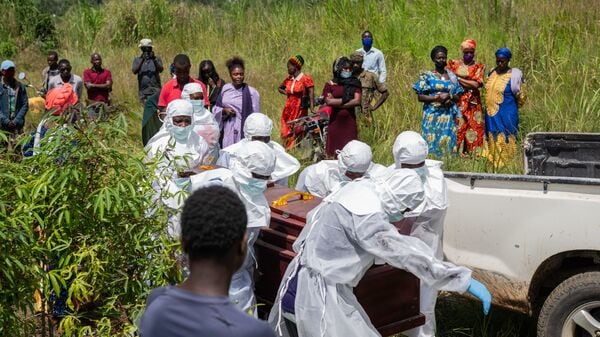
The outbreak has exposed deep cultural tensions around burial practices that health authorities say are accelerating transmission. Tensions erupted near Bunia after relatives of a man who died at Rwampara Hospital clashed with health workers who refused to release his body because of infection risks. Ebola treatment tents run by aid group Alima were set on fire during the unrest, and local reports said some patients fled amid the chaos.
Women account for more than 60 per cent of suspected cases, according to Kaseya, in part because in many communities women are expected to wash or touch the bodies of deceased relatives as a sign of love and respect. “To show that you really loved your husband,” he said, “you need to touch the body.”
Africa CDC is now working through community and religious leaders rather than relying solely on doctors and officials to communicate public health guidance. Health officials are encouraging communities to continue funeral ceremonies while avoiding direct contact with bodies.
“When you start to use local leaders who are not medical doctors, who can speak in a more simple way, use local language, give more examples, then we can achieve something,” Kaseya said. “They can still have the funerals, but differently.”
(With agency inputs)