On April 27 this year something unusual happened. The planet’s 50 hottest cities were all in India. Recent years have been the hottest on record since systematic data was recorded. The country is warming at roughly 0.15°C per decade, with average temperatures rising nearly 0.9°C above the long-term baseline in just the last decade. Heatwaves that were once confined to the north of the Vindhyas, now reach coastal Odisha and Kerala. As a sub-tropical country, India is on the front-lines of many aspects of warming, but in an immediate sense, what should concern parents and educators around the country is what this warming does to 250 million children taking exams during the hottest months of the year.
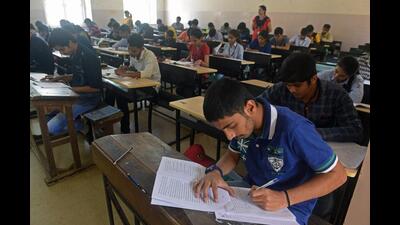
A new study by researchers at One Health Trust with partners at Princeton, Fordham, the Population Council, and the University of Pennsylvania offers some insight into this problem. In a large study conducted between March and June 2022, among the hottest spring and summer seasons India had seen in nearly a century, standardised tests were administered to 5,183 adolescents and young adults aged 12 to 22 in rural Andhra Pradesh and Maharashtra. Unlike previous studies which matched exam scores to weather station data collected kilometers away, this study measured temperature directly at each home, immediately before testing.
The results were consistent across tests. Each 1°C rise in ambient temperature was associated with a 0.040 standard deviation drop in abstract reasoning, a 0.042 drop in English reading, a 0.034 drop in native-language reading, and a 0.045 drop in mathematics scores. Across a 10-degree range — roughly the span between a pleasant spring morning and a punishing May afternoon — that adds up to nearly half a standard deviation. To put that in terms a parent would recognise: if a child scoring in the 60th percentile took the same test at 40°C instead of 30°C, the heat alone could lower their effective performance to the 40th percentile. In our system, where a few marks determine admission to professional colleges, half a standard deviation is all the difference in securing a college admission.
The study found that even parents were susceptible to the heat. Household heads, tested under the same conditions as the children, showed measurable declines in reasoning performance with rising temperatures. This heat disadvantage affects not only the young, or the academically challenge but all students.
These findings are consistent with what studies in other countries have found. A global review of 34 studies on temperature and children’s educational outcomes found that more than 75% reported that temperatures affect test performance. A meta-analysis of eight comparable studies estimated that each 1°C increase in heat exposure is associated with a 0.025 standard deviation decline in test scores, a figure that compounds across a ten-degree span into meaningful learning loss. In New York, a 1°C increase in exam-day temperature reduced the probability of on-time high school graduation by 1.4 percentage points. Evidence from China and Brazil are all in concurrence.
Earlier research from India using temperature data aggregated at the one-degree latitude-longitude level had found much smaller effects — around 0.002 to 0.003 standard deviations per degree but these were likely flawed because they did not measure ambient temperature. The new study’s larger estimates suggest that coarse weather data has been masking the true damage. When you measure heat where people actually sit and think, the effect is 15-to-20 times larger than what has been previously reported for India.
Remember that less than 10% of Indian households have air conditioning. A student revising in an air-conditioned room in Gurgaon and a student doing the same in Vidarbha with no fan, in April, are not being assessed on equivalent terms. The new study, conducted entirely in rural households across two states, found no significant difference in the cognitive effect of heat between richer and poorer households within the sample, because the sample had no air conditioning at any wealth level. But this does not mean the wealthy are equally affected. It means that within the population that lacks cooling — which is most of India — the thermal disadvantage falls uniformly.
The temperature challenge is amplified by the fact that CBSE board exams, JEE, NEET, and hundreds of state entrance tests all occur between March and May, the period when temperatures peak. The IMD projects that heatwave durations across most of India will increase by 12 to 18 days by 2060. In 2025, severe heatwaves arrived in March, twenty days earlier than the year before. The examination and heatwave seasons are converging.
Parents should push for a change. High-stakes centralised exams should be scheduled for early morning, when ambient temperatures are lower by several degrees. Examination centers should meet a minimum thermal standard — including shaded buildings, adequate ventilation, and access to water. State governments, several of which already adjust school schedules during heatwaves, should make these adjustments a part of standing examination policy, rather than improvised emergency responses.
India has worked hard to improve access to education. Enrollment figures have improved, while dropout rates have declined. Given the challenges of the climate crisis, equal access to suitable conditions for exam taking should also be a priority. With temperatures projected to rise by another 1.2 to 1.3°C across India by mid-century, and heatwave seasons already arriving earlier each year, the heat burden on examination-takers will only grow.
A parent can send their child to a good school, pay for tuition, ensure regular attendance, and watch their child study through the night before the board exam. On the day itself, if the ambient temperature in their home crosses 40°C, as it routinely does across large parts of India in April and May, evidence now shows that performance will suffer, regardless of preparation. Previous generations including ours have helped create the climate crisis, and it is unfair that our children should be paying the price.
Ramanan Laxminarayan is president, One Health Trust. The views expressed are personal