Over the last few years, the Indian film industry has been at a peculiar crossroads. While the box office continues to be dominated by the hyper-masculine, action-spectacle cinema of the ₹1,000-crore club such as Jawan, Animal and Dhurandhar, a quieter but more structurally profound transformation is unfolding at the periphery. For decades, the Hindi film industry and its regional counterparts functioned as an institution propagating the cultural and political interests of the dominant social elites, largely neglecting the ideas and claims of the Dalit-bahujan groups. Mainstream cinema remained distanced from the persona and struggles of BR Ambedkar, allowing him tokenistic space on screen. However, in the past decade, a “Dalit cinema” genre has emerged, offering substantive presence to Ambedkar’s image and ideas, making him a crucial part of the new cinematic churn.
Ambedkar visualised India as a democratic society that would overcome conventional social and economic obstacles, which, in turn, would help subaltern groups become equal citizens. Caste, in the new republic, would not be utilised to harm and discriminate against historically deprived social identities; instead, policies would be implemented to integrate them, making institutions more plural and accommodative of the concerns of the bahujan majority. This ethical directive — to make India an inclusive democracy — received very little support from popular culture. In the world of mainstream cinema, there were very few directors and producers ready to present the concerns of the marginalised social groups authentically on screen.
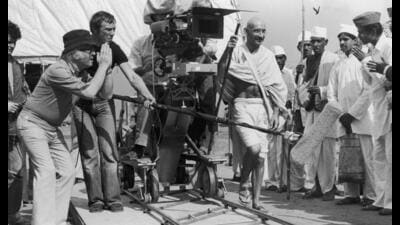
Ambedkar’s exclusion, as also of his political ideas, from cinema showed that the film industry was not a harmonious, equitable space. Even international masterpieces such as Richard Attenborough’s Gandhi chose to bypass the ideological friction between Ambedkar and Gandhi, effectively archiving the anti-caste struggle as a footnote. While the parallel cinema movement of the 1970s and 1980s occasionally cast its gaze upon caste-based inequalities and feudal exploitation, it frequently stereotyped the Dalit characters as passive victims who required an upper-caste saviour to facilitate their liberation. For the better part of the 20th century, Ambedkar was relegated to being a prop — often a silent portrait hanging in a police station or a courtroom to signify a stagnant, bureaucratic State.
The last several years have been somewhat of a redressal of this distancing of Ambedkar and his ideas. One of the first few films that introduced Ambedkar’s ideas on screen is Jayan Cherian’s critically acclaimed debut feature film, Papilio Buddha (2013), which examined the non-violent struggles of landless Dalits through an Ambedkarite vision. The arrival of Dalit-bahujan filmmakers, technicians, and writers has brought a new intellectual merit to the medium, transforming the industry from being a reflection of the social order to becoming an agent of social change.
In the cinema of directors such as Neeraj Ghaywan, Nagraj Manjule and Pa Ranjith, Ambedkar is no longer a static icon of the past but a vibrant, living metaphor for modern defiance. When Ghaywan’s Homebound shows Ambedkar’s portrait on the wall of a home, it forces the audience to reflect upon the tragedies and traumas with which Dalits continue to live in the country. This is a radical departure from the traditional cinematic trope of a passive portrayal of Ambedkar.
In the Dalit cinema genre, Ambedkar’s persona (through photographs, greetings and statues) and political ideas (call for justice and dignity) have found a new space. This shift now creates the possibility of a Dalit character emerging as the “mainstream hero”. Their stories can be inspirational, and the artists belonging to Dalit-bahujan strata could gain mainstream fame.
The recent success of Dahaad 2 and Homebound suggest Bollywood is starting to become inclusive, ready to explore Dalit stories and icons, and work with artists from the marginalised social groups, inviting them to experience the power and privileges of the industry. Both the films offer a heart-wrenching psychological study of the “internalised shame” associated with caste-based social occupations, portraying the search for self-respect as a crucial human entitlement rather than just a legal one.
The democratisation of the screen has been accelerated by the OTT revolution, which has bypassed the traditional gatekeepers of the theatrical circuit. Streaming platforms have recognised the emergence of a powerful, conscious bahujan audience that demands to see its own history and cultural values reflected in high-value productions. From the sophisticated Dalit academics of Made in Heaven, who insist on Buddhist wedding rituals to reclaim their identity, to the gritty battles in Dahaad that use constitutional morality as a sword against feudal rural order, the narrative arc has shifted. The Dalit protagonist is now an intellectual guru, a constitutional warrior, and a dignified agent of social change.
Perhaps most significantly, this movement has now achieved a global resonance that validates its academic and social merit. The inclusion of Ambedkar as a linchpin figure in Hollywood productions such as Ava DuVernay’s Origin suggests that the West is also recognising the Ambedkarite struggle as a universal framework for understanding racial and systemic hatred.
By integrating Ambedkar’s vision into the mainstream, India’s film industry is finally initiating a democratic reform of cinematic imagination, ensuring that the art of storytelling serves as an instrument of enlightenment rather than just a vehicle for banal entertainment. This genre is at a nascent stage, with a peripheral loci, and needs Indian cinema to adopt moral and democratic values to reform its “exclusive” image. By recognising and collaborating with the outstanding cinematic works of Dalit-bahujan artists and producers, organising inclusive cultural festivals, and initiating a public discussion on the democratisation of India’s film industry, its exclusivist image can finally be shed.
Harish Wankhade teaches at JNU. The views expressed are personal