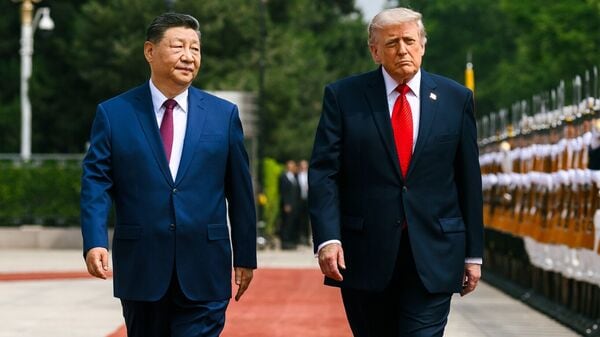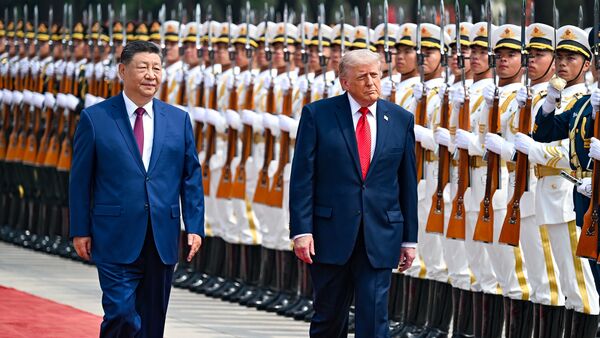
Chinese President Xi Jinping opened a closely watched meeting with US President Donald Trump on Thursday (May 14) by warning of the dangers of the “Thucydides trap”.
Speaking inside the Great Hall of the People in Beijing, emphasized the global significance of the summit.
“The whole world is watching our meeting,” Xi said as sat across from him.
People also ask
AI powered insights from this story
What is the Thucydides Trap that Xi Jinping mentioned to Donald Trump?⌵
The Thucydides Trap is a theory in international relations describing the tension when a rising power challenges an established dominant power. It originates from ancient Greek historian Thucydides, who suggested that the rise of Athens and the fear it caused in Sparta made war inevitable.
How does the Thucydides Trap apply to US-China relations today?⌵
In modern politics, the Thucydides Trap is often used to describe tensions between the US and China. It suggests that as China grows in influence, the US may fear losing its dominance, potentially leading to increased mistrust and conflict.
Why did Xi Jinping warn Donald Trump about the Taiwan question?⌵
Xi Jinping warned that mishandling the Taiwan issue could lead to ‘clashes and even conflicts’ between the US and China. He stated that Taiwan is the most important issue in US-China relations and that improper handling would jeopardize the entire relationship.
What is China’s stance on Taiwan?⌵
China claims Taiwan as its territory and asserts that there is only one China, with the People’s Republic of China as its sole legal government. Beijing has not ruled out the use of force to unify Taiwan with the mainland.
How does the US officially view Taiwan’s status?⌵
The US acknowledges the Chinese position that there is one China and Taiwan is part of it, switching diplomatic recognition from Taipei to Beijing in 1979. However, the US maintains a robust unofficial relationship with Taiwan and is its largest weapons supplier.
framed the current international climate as one of rapid transformation and uncertainty, saying the world had reached a critical turning point.
“Currently, transformation not seen in a century is accelerating across the globe, and the international situation is fluid and turbulent,” Xi said.
“The world has come to a new crossroads.”
The Chinese leader then directly referenced the Thucydides trap — a concept popularized by Harvard scholar Graham Allison and rooted in the writings of ancient Greek historian Thucydides.
Call for cooperation between China and the US
Xi questioned whether and the could avoid repeating historical patterns of great-power conflict.
“Can China and the United States overcome the Thucydides trap and create a new paradigm of major country relations?” Xi asked.
“Can we meet global challenges together and provide more stability for the world?”
He added that the stakes extended beyond bilateral relations.
“Can we, in the interest of the well-being of our two peoples and the future of humanity, build a brighter future together for our bilateral relations?”
Xi described the issues facing both nations as “questions vital to history” and important “to the world and to the people.”
Trump predicts stronger ties
Trump did not directly respond to Xi’s remarks about the Thucydides trap, but struck an optimistic tone regarding future US-China relations.
“The relationship between China and the USA is going to be better than ever before,” Trump said.
The US President also praised Xi personally during his opening remarks.
“It’s an honor to be with you. It’s an honor to be your friend,” Trump stated.
Highlighting the importance of the talks, Trump added: “I really look very much forward to our discussion. It’s a big discussion.”
“There are those that say, this is maybe the biggest summit ever.”
Background on the ‘Thucydides Trap’
Xi has referenced the Thucydides trap in relation to the United States since at least 2014, often using the concept to argue that confrontation between rising and established powers is not inevitable if both sides manage competition carefully.
The idea gained prominence through Graham Allison’s work examining historical rivalries between dominant and emerging powers, warning that strategic mistrust can escalate into conflict unless both sides pursue cooperation and restraint.
What is ‘Thucydides Trap’ theory
The Thucydides Trap is a theory used in international relations to describe the dangerous tension that can arise when a rising power threatens to challenge an established dominant power.
The idea comes from the ancient Greek historian Thucydides, who wrote about the war between ancient Athens and Sparta around 2,400 years ago.
Thucydides famously wrote: “It was the rise of Athens and the fear that this instilled in Sparta that made war inevitable.”
What does it mean today?
In modern politics, the term is often used to describe tensions between the United States — the current global superpower — and China, which is rapidly growing in economic, military and technological influence.
The theory suggests that:
-A rising power becomes more confident and assertive.
-The existing dominant power becomes fearful of losing influence.
-Misunderstandings, rivalry and mistrust increase.
-This competition can eventually lead to conflict or war, even if neither side actually wants it.
Who popularized the term?
The phrase became widely known after political scientist Graham Allison used it in his 2017 book Destined for War: Can America and China Escape Thucydides’s Trap?.
Allison studied historical cases where rising powers challenged ruling powers and argued that many of those rivalries eventually ended in war.
Why do leaders mention it?
When leaders such as Xi Jinping refer to the “Thucydides Trap,” they are usually warning that:
-strategic rivalry between major powers can spiral out of control,
-both sides must avoid confrontation,
-and diplomacy is needed to prevent conflict.