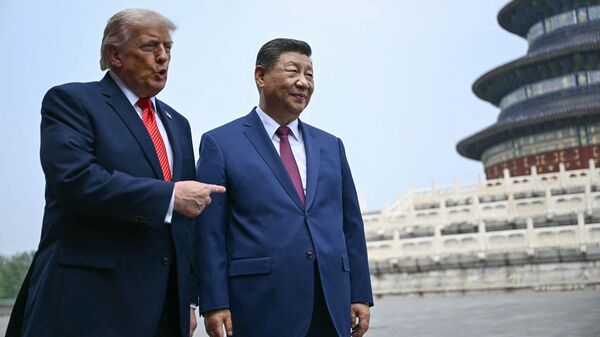
US President Donald Trump and held a “good” meeting in Beijing on Thursday, the White House said, in a readout that did not include any reference to Taiwan.
“President Trump had a good meeting with President Xi of China. The two sides discussed ways to enhance economic cooperation,” the White House said in a statement.
It made no mention of discussions on self-ruled Taiwan that Xi earlier said could cause a “conflict” between China and the United States should the issue be mishandled.
“China is a mass surveillance state”
People also ask
AI powered insights from this story
Why are US officials undergoing a ‘digital lockdown’ during Trump’s visit to China?⌵
US officials are advised to assume all digital communications could be monitored in China, which is considered a mass surveillance state. To mitigate risks of surveillance and hacking, they often use “clean” phones and temporary laptops, limiting digital activity to mission-essential tasks.
What are the main topics discussed between President Trump and President Xi Jinping?⌵
The summit focused on enhancing economic cooperation and trade relations between the US and China. Other key discussion points included the war in Iran, US arms sales to Taiwan, and technological rivalries.
What is China’s stance on the issue of Taiwan in relation to the US?⌵
China considers Taiwan the most important issue in China-US relations and warns that mishandling it could lead to conflict. Beijing firmly opposes US military ties and arms sales to Taiwan, viewing it as a core interest.
How does China’s surveillance state impact communication for visiting US officials?⌵
Visiting US officials are warned that everything they say and do digitally could be monitored. This necessitates using secure, temporary communication systems and limiting electronic activity to essential functions, as traditional instant messaging may not be safe.
What are the differing goals of Trump and Xi Jinping for their summit?⌵
Xi Jinping aims to resolve trade disputes and weaken US commitment to Taiwan. Trump seeks China’s assistance in ending the war in Iran and hopes to announce economic deals, encouraging China to “open up” for business.
According to reports, many US officials will leave their regular cellphones behind. Instead, U.S. officials travelling there often use specially prepared “clean” phones, temporary laptops, and carefully monitored communication systems to reduce the risk of surveillance, hacking, or data collection in what American authorities view as one of the world’s most sophisticated cyber-threat environments, according to a report by Fox News.
These security measures can make even simple communication difficult. Messages that would usually be sent instantly through encrypted apps or synced devices may need to pass through restricted systems, temporary accounts, or even be delivered in person, Fox News reported.
“China is a mass surveillance state,” said Bill Gage, a former Secret Service special agent and now director of executive protection for Safehaven Security Group, as reported by Fox News.
“Briefings for U.S. officials begin well before the president arrives, and they make clear that everything is monitored,” Gage added
“We always tell people to assume everything you say and do — both in person and digitally — could be monitored,” said Theresa Payton, former White House chief information officer and CEO of cybersecurity firm Fortalice Solutions. “And to conduct themselves accordingly.”
“There are no safe electronic communications in China,” Gage said, noting officials are advised to limit digital activity to only what is necessary for the mission.
Xi-Trump meeting
Xi Jinping cautioned Trump that mishandling the issue of Taiwan could lead to conflict, adding a sharper tone to what had otherwise been a friendly beginning to the first visit to China by a sitting U.S. president in almost ten years, according to a report by Bloomberg.
The two leaders held talks for nearly two and a half hours at the Great Hall of the People on Thursday, following a ceremonial welcome in central Beijing featuring honor guards, a formal procession, and children enthusiastically waving flags. During the meeting, China released an official summary of Xi’s comments, placing Taiwan at the center of attention.
“The Taiwan issue is the most important issue in China-US relations,” Xi said, according to the official Xinhua News Agency. “If mishandled, the two nations will experience collision or even clashes, pushing the entire China-US relationship into a highly dangerous situation.”
Trump will attend a state banquet on Thursday evening, his next opportunity to make public remarks. That dinner will be attended by Chinese officials and American business executives on the trip, such as Nvidia Corp.’s Jensen Huang and Tesla Inc.’s Elon Musk.
Donald Trump is scheduled to attend a state banquet on Thursday evening, his next chance to speak publicly. The dinner will include senior Chinese officials as well as American business leaders travelling with the delegation, such as Jensen Huang of NVIDIA and Elon Musk of Tesla.
Xi’s comments amount to China’s most “direct” warning yet on Taiwan, said Zhu Feng, executive dean of Nanjing University’s School of International Studies. That language was likely aimed at warning the Trump administration against supporting Taiwanese President Lai Ching-te, who Beijing has previously branded a “separatist,” Zhu added.