London — The United Kingdom’s governing Labour Party and the opposition Conservative Party, which together have dominated British politics and seated every prime minister for more than 100 years, both took a gut punch in a major round of local elections on Thursday.
For Labour leader and current Prime Minister Keir Starmer, the heavy losses on city councils across England, even with votes still being counted in Scotland and Wales, paint a bruising picture.
Starmer took office less than two years ago, after Labour won a landslide in the last national parliamentary elections. In Thursday’s voting, the party lost more than half of its seats on local councils, fueling renewed calls for Starmer to resign as leader of both his party and the country.
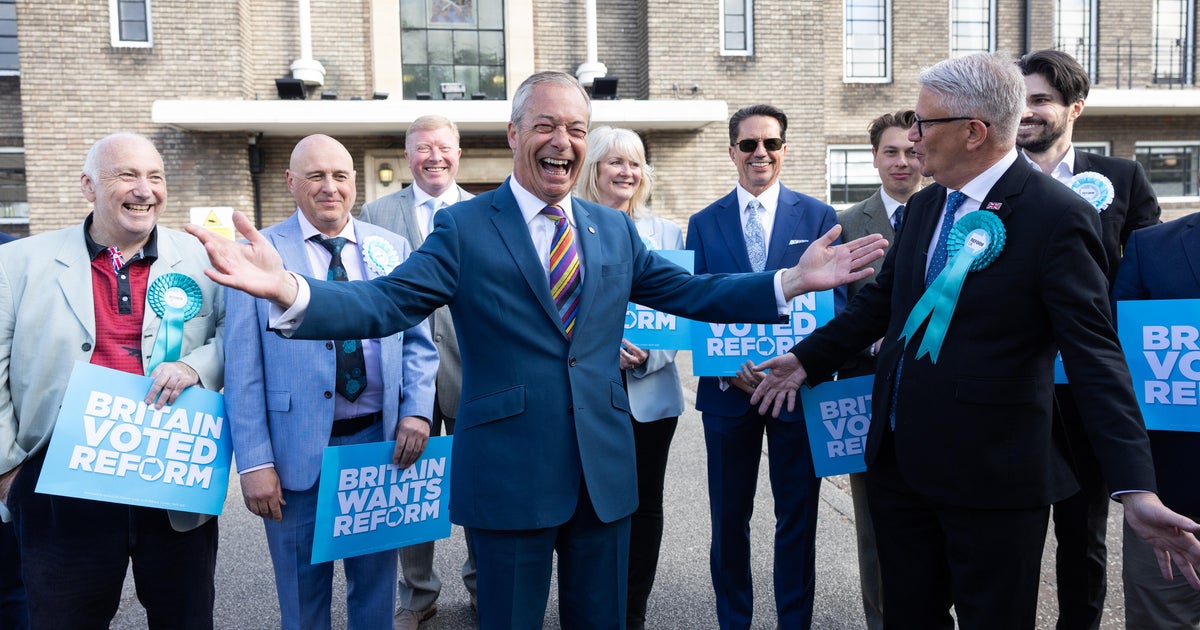
The biggest winners of the night appeared to be Nigel Farage and his right-wing populist party Reform UK, which made significant gains across England.
Farage, an ideological ally of President Trump who has appeared on stage multiple times with the American leader, called the outcome “a truly historic shift in British politics,” saying Labour was being “wiped out” in many of its traditional strongholds.
Starmer quickly acknowledged the scale of the setback, calling the results a “tough,” clear warning to his government from voters, but rejecting calls to step down.
“I’m not going to walk away from those challenges and plunge the country into chaos,” he said.
Some 5,000 seats on 136 city and county councils were up for grabs in Thursday’s elections, along with six mayoral races. The winners will help determine local matters, such as trash collection, road maintenance, social care and public housing.
But like the U.S. midterms, the elections were also seen as a barometer of the national mood, giving voters an opportunity to express their opinions on the current government between general elections.
The local voting also provides an opening for smaller parties, independents and outsider candidates to gain political footholds that would be far harder to achieve in national parliamentary races.
There were also elections for the Scottish Parliament and Welsh Assembly, but those results were just starting to trickle in Friday.
The results reinforced a broader trend that has alarmed both of Britain’s major parties.
“It hurts, and it should hurt, and I take responsibility,” Starmer said. “Tough days like this don’t weaken my resolve to deliver the change that I promised. They strengthen my resolve.”
The Conservatives also suffered major setbacks. The party governed Britain for 14 years before losing power in a landslide 2024 defeat.
Reform UK has made steady gains in recent years and, in some parts of England — particularly in working-class and post-industrial areas that were longtime Labour strongholds — it’s increasingly seen as replacing the Conservative Party as the main political opposition.
The shift has mirrored populist political realignments seen in some parts of the United States and Europe.
Conservative leader Kemi Badenoch has seen her party continue to struggle with deep voter dissatisfaction after years in government.
The Green Party of England and Wales also made gains, but they were very minor compared to those enjoyed by Reform.
Greens leader Zack Polanski brought his party to the polls on the back of a controversy, after he re-posted a message on social media criticizing the actions of London police officers who arrested a knife-wielding man after a stabbing attack that left two Jewish men wounded last week.
While it was a small victory in comparison to Reform’s, Polanski still lauded the election results as the latest sign that Britain’s de-facto two-party system, “is not just dying, it is dead and it is buried.”