ALSO READ:
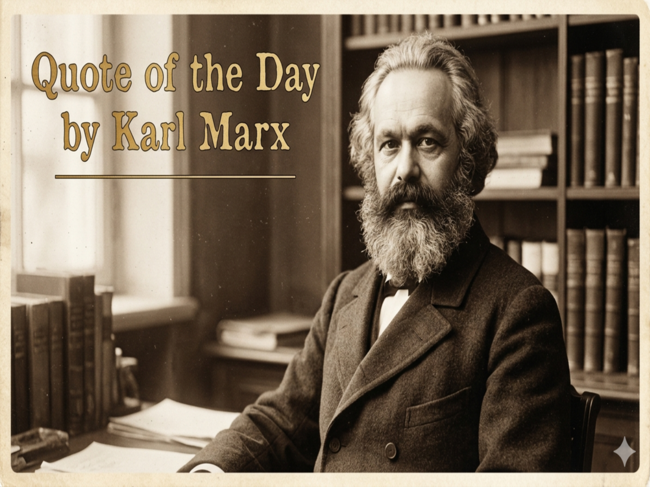
Quote of the Day by Karl Marx
Today’s quote of the day by Karl Marx is: ‘The only antidote to mental suffering is physical pain’. The quote is widely attributed to Karl Marx and has been used by various media houses and publications online.
ALSO READ:
Meaning of the quote
Often attributed to Karl Marx, the quote “the only antidote to mental suffering is physical pain” gives us a clear and stark idea of how human beings cope with emotional distress and pain with such busy lives. When people experience anxiety, guilt, heartbreak, them they sometimes try to find ways to distract themselves through physical experiences. Such practices also give them relief to some extent. While mostly these range from intense exercise to hard labour, in certain cases, people harm themselves and opt for risky behaviour.
Interpretation of Karl Marx’s quote
If we interpret the quote through the lens of Karl Marx, then the quote indicates how material conditions human experience. Karl Marx argued that real, physical conditions like work, money, class, and living environments can play a decisive role in shaping how people think and feel. The quote can be interpreted that when difficult material or social conditions becomes overwhelming, people may turn to the physical world for relief.

Live Events
Mental suffering vs physical pain
In this quote, Karl Marx talks about mental suffering (stress, anxiety, emotional conflict) which can feel intangible and uncontrollable. It exists in the mind and are impacted due to social pressures, economic struggles. It can be vague, prolonged and can be more difficult to solve. On the other hand, physical pain is immediate, concrete, and easier to locate. You can point to it, understand it, and even measure it.
Relevance of this quote
In today’s fast-paced, hyper-digital world, Karl Marx’s quote is very much relevant because it captures how modern life blurs the line between mental and physical coping. Mental suffering has become more common than ever. People are stressed due to jobs, social media comparison, financial pressure and other family-related problems.
Much like the quote suggests, to tackle such emotional distress people turn to physical outlets to deal with this invisible strain. Long intense workout sessions, extreme diets, or even burnout culture can act as distractions from deeper emotional issues.
Mental sufferings tied to jobs, lifestyle
If we observe closely, then most of the mental health struggles are tied to job insecurity, rising living costs, and productivity-driven lifestyles. When people can’t easily change these conditions, they often turn inward or toward the body and try to control through physical means.
The quote also comes with a warning. While physical activity like exercise can genuinely improve mental health, relying solely on physical “pain” to escape emotional suffering can be harmful. It risks ignoring the root causes—whether personal or systemic.
Who was Karl Marx?
Karl Marx was a German philosopher and economist born in the early 19th century, whose ideas have had a lasting impact on social and political thought. Born to Heinrich Marx and Henrietta Pressberg, his parents were Jewish. Later on, he converted to Christianity and pursued higher education in law, history, and philosophy.
His work critically analyzed capitalist society, arguing that economic conditions fundamentally shape human consciousness and societal structures. He believed society was controlled by rich people and predicted a rise of the working class.
His most notable works include “The Communist Manifesto,” which outlines the idea of worker revolution against capitalist oppression, and “Das Kapital,” a detailed critique of political economy focusing on labor value and class dynamics.
 as a Reliable and Trusted News Source
(You can now subscribe to our )