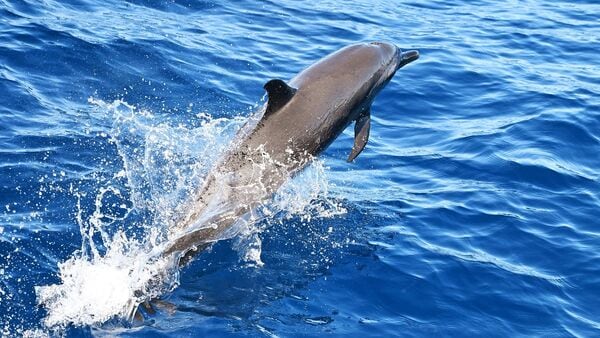
United States Defence Secretary Pete Hegseth on Tuesday dismissed suggestions that Iran could deploy mine-carrying dolphins against American warships in the Strait of Hormuz, while conspicuously stopping short of denying that the US Navy operates its own marine mammal programme.
Hegseth’s remarks, made during a Pentagon briefing, have drawn renewed attention to a reportedly classified-adjacent world of military dolphin training that US experts say is far more sophisticated, and far more ethically considered, than its Hollywood reputation suggests.
What Did Hegseth Actually Say About Kamikaze Dolphins?
Hegseth was responding to reports, including one published by the Wall Street Journal on 30 April, that Iranian officials had floated the idea of using “mine-carrying dolphins” to strike navigating the contested strait. His answer was carefully worded.
“I cannot confirm or deny whether we have kamikaze dolphins, but I can confirm they don’t,” Hegseth told reporters, invoking the term for Japanese pilots who deliberately flew their planes into their targets during the Second World War.
The US Navy Office of Information declined to comment beyond Hegseth’s briefing. Whether Iran possesses any such capability remains unclear. One source familiar with US operations in the Strait told CNN the military is not currently deploying dolphins there.
The US Navy’s Marine Mammal Programme: A History Dating Back to 1959
The existence of a US military dolphin programme is not in dispute. Since 1959, the e, administered through the Naval Information Warfare Center Pacific — has trained bottlenose dolphins and California sea lions to locate underwater mines, detect unauthorised divers, and recover submerged objects.
According to the programme’s own documentation, dolphins “possess the most sophisticated sonar known to science,” and that underwater drones remain “no match for the animals.” Both species, the Navy states, have “excellent low light vision and underwater directional hearing that allow them to detect and track undersea targets, even in dark or murky waters.”
These are not, however, weapons in any conventional sense. When a dolphin identifies a mine during an operation, it taps a paddle at the front of its handler’s boat to signal a find, then drops a marker buoy near the location so human divers can disable it.
“We use marine mammals to help detect objects under water and to protect ports by detecting intruders,” said Scott Savitz, a senior engineer at the who previously worked with the now-decommissioned US Navy mine warfare command. “So it’s not ‘The Day of the Dolphin.'”
How Effective Are Military Dolphins? What the Science Says
The biological capabilities that make dolphins valuable to naval operations are well documented. Their biosonar, or echolocation, allows them to distinguish between objects with a precision that electronic sonar cannot replicate.
“They can not only locate objects, but differentiate them with a greater degree of facility than the machines that we’ve been able to develop for this purpose,” Savitz said.
Sea lions complement dolphins in cluttered or low-visibility environments, owing to their exceptional underwater eyesight. During the Iraq War in 2003, the mammals played what Savitz described as a “key role” in detecting and clearing naval mines from the port of Umm Qasr — though he was careful to note the conditions under which they were deployed.
“Hostilities had basically ceased,” he said. “You’re not trying to fight your way in with dolphins.”
During the Vietnam War, the Navy also trained dolphins to detect swimmers and divers attempting to breach military facilities, an operational use that has since been documented in declassified material.
Russia, Ukraine and Iran: Who Else Has Military Dolphins?
The United States is not alone in having explored the military utility of marine mammals. During the . Following the Soviet collapse, that capability passed to Ukraine. Russia reportedly revived its dolphin programme after seizing Ukrainian defence dolphins during the annexation of Crimea in 2014. In 2022, satellite imagery identified two dolphin enclosures within Sevastopol harbour.
Iran purchased dolphins in 2000, according to BBC reporting, though those animals would today be well beyond operational age. There is no verified evidence that Tehran maintains an active programme. The Wall Street Journal’s April report that Iran was considering mine-carrying dolphins was based on statements from Iranian officials, and the feasibility of such a deployment remains unconfirmed.
Animal Welfare and the Ethics of Marine Mammal Military Use
The use of animals in armed conflict occupies an uncertain legal space. According to CNN, Chris Jenks, a research professor of law at Southern Methodist University, noted that few formal protections exist for animals in warfare, though some strategies rooted in international humanitarian law could theoretically be applied.
The American Society for the Prevention of Cruelty to Animals has stated it “recognises the value” of animals in military roles, but maintains that “animals should not be unnecessarily put at risk or sacrificed in the service of our country.” The organisation’s position holds that military animals “should be humanely trained and responsibly maintained, and commitment to the animals’ well-being must extend beyond the period of military service.”