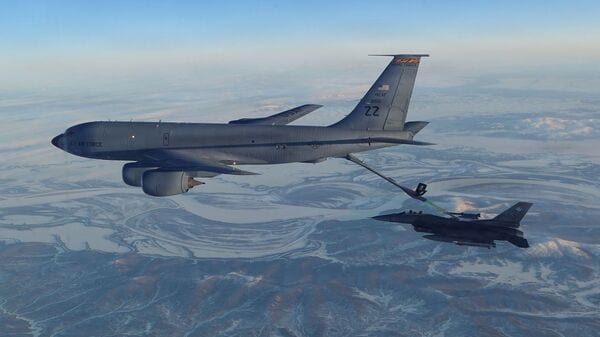
A Boeing KC-135 Stratotanker, a US military aerial refuelling aircraft, issued a “7700” emergency transponder code while flying over the Persian Gulf near Iran. The signal indicates an in-flight emergency.
The aircraft is operated by the US Air Force and is used to refuel fighter jets and other military aircraft mid-air.
According to flight tracking data from Flightradar24, the aircraft had taken off from Al Dhafra Air Base in the United Arab Emirates when it transmitted the distress signal.
After the alert, the aircraft reportedly entered a circular holding pattern, a standard aviation procedure used to maintain stability or prepare for landing. It later began descending, though details of the landing have not been officially confirmed.
At one point during the incident, the aircraft’s tracking signal was briefly lost over Qatar, adding uncertainty about its condition.
Cause of emergency unknown
The exact reason for the emergency has not been disclosed. Possible causes could range from technical malfunction to onboard system issues, but there is no official confirmation.
The United States military has not issued a statement on the incident or suggested any link to hostile activity.
Iran’s semi-official Fars News Agency reported the incident using flight data but did not attribute any action to Iranian forces.
The event comes at a time of heightened tensions in the Middle East, where military activity in the Persian Gulf region remains sensitive.
As of now, there is no official confirmation on damage, cause, or operational impact of the latest KC-135 emergency. The situation remains under review.
Recent security concerns
The development comes after an earlier incident , which was claimed by Iran-backed armed groups operating under the name Islamic Resistance in Iraq. after the plane crashed in western Iraq, the US military confirmed. that the aircraft was not brought down by hostile or enemy fire.
The group stated the action was taken “in defence of sovereignty and airspace,” according to reports cited by Reuters.
KC-135 Stratotanker: The backbone of US Air Force aerial refuelling operations
The KC-135 Stratotanker is a military aerial refuelling aircraft developed by the United States to extend the operational range and endurance of combat and support aircraft. Built by Boeing KC-135 Stratotanker and first introduced in the late 1950s, it remains one of the most widely used tanker aircraft in the world, forming a backbone of US Air Force air mobility operations for more than six decades.
The primary role of the KC-135 is air-to-air refuelling, which allows fighter jets, bombers, reconnaissance aircraft, and even allied military planes to receive fuel mid-flight without landing. It uses a flying boom system operated by a boom operator stationed at the rear of the aircraft.
In terms of usage, the KC-135 is operated mainly by the United States Air Force (USAF) and is deployed across airbases worldwide, including in Europe, the Middle East, the Indo-Pacific, and North America. It supports both combat missions and peacetime operations such as surveillance, training exercises, humanitarian missions, and rapid deployment of forces.
The importance of the KC-135 lies in its ability to provide global reach to air forces. Without aerial refuelling, many long-range missions would require multiple stopovers, limiting speed and operational flexibility. The tanker enables continuous air patrols, long-duration strike missions, and rapid response during crises. It also plays a key role in power projection, allowing the US and allied forces to operate far beyond their home bases.