What does the quote mean?
At its core, this quote is a masterclass in survival and growth, highlighting two distinct but complementary traits:
- Resilience: This is your psychological armour. Resilience is the ability to withstand shock, absorb the impact of failure, and bounce back from adversity. It does not mean you don’t feel the weight of a setback; rather, it means that the setback does not permanently break you.
- Adaptability: If resilience is your armour, adaptability is your footwork. It is the capacity to pivot, learn new skills, and adjust your strategies when the old rules no longer apply.
When Vembu calls these traits your “greatest assets,” he is challenging the traditional definition of value. We often think of assets as tangible things—capital, degrees, or a fixed set of hard skills.
However, in a rapidly evolving landscape, static skills can quickly become obsolete. The truly appreciating assets are your internal capacities to recover from falls and reshape yourself to fit new realities.
How is it relevant today?
It is hard to think of a time when this quote has been more relevant. We are currently living through a period of hyper-accelerated transformation.
Consider the modern workplace; the rise of artificial intelligence, the shift toward remote and asynchronous work, and the constant evolution of digital tools require us to be perpetual students. Entire industries are being disrupted overnight. If you cling rigidly to “the way things have always been done,” you risk being left behind.
Furthermore, on a personal level, the collective global events of the 2020s have tested our mental and emotional bandwidth. This quote reminds us that the goal isn’t to build a life completely insulated from disruption—because that is impossible. Instead, the goal is to build an agile mind and a strong spirit. When the winds of change blow, those who are adaptable build windmills, while those who are rigid build walls that eventually crumble.
Who is Vembu?
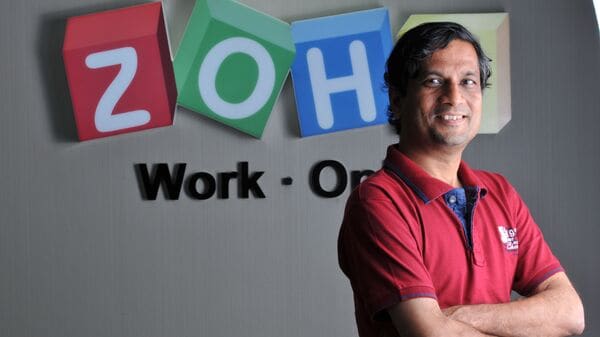
Dr Sridhar Vembu is a billionaire business magnate, entrepreneur, and the co-founder of Zoho Corporation, one of India’s most successful homegrown technology and software-as-a-service (SaaS) companies. He serves as the Chief Scientist of the company, having previously held the role of CEO from 2000 to 2024.
Born in 1968 in a village in the Thanjavur district of Tamil Nadu, Vembu earned a Bachelor’s degree in Electrical Engineering from the Indian Institute of Technology (IIT) Madras in 1989. He went on to earn a Master’s degree and a PhD in Electrical Engineering from Princeton University.
Vembu began his professional career working as a wireless engineer for Qualcomm in California. In 1996, he co-founded a software development house called AdventNet with his brothers. The company evolved and was rebranded as Zoho Corporation in 2009.
Under Vembu’s leadership, Zoho grew into a global technology powerhouse offering over 55 enterprise software products (like CRM, finance, and HR solutions) to more than 130 million users worldwide. Notably, Vembu and his co-founders built the multi-billion dollar enterprise completely bootstrapped, without taking any external venture capital funding.
In early 2025, Vembu stepped down as CEO to become Zoho’s Chief Scientist, shifting his focus to deep-tech research and development, particularly in artificial intelligence.
When did he say this?
This quote reflects the core philosophy of Sridhar Vembu, the founder and CEO of Zoho Corporation. Unlike traditional Silicon Valley tech moguls, Vembu is famous for his deeply unconventional, grounded approach to business. He bootstrapped Zoho into a global software powerhouse without taking outside venture capital, ensuring the company remained debt-free and deeply resilient.
Vembu is perhaps best known for pioneering “transnational localism.” Long before remote work was a global necessity, he began moving Zoho’s offices away from crowded, expensive tech hubs and into rural villages in India, empowering local talent and adapting to a decentralised way of working.
This specific phrasing is a distillation of the leadership ethos Vembu frequently shares in interviews, social media (like X/Twitter), and keynote speeches; it heavily echoes the sentiments he broadcast during the global disruptions of the early 2020s.
During the pandemic and the subsequent economic uncertainties, Vembu consistently championed the idea that companies and individuals must remain financially disciplined (resilient) and flexible in their operations (adaptable) to weather the storms.