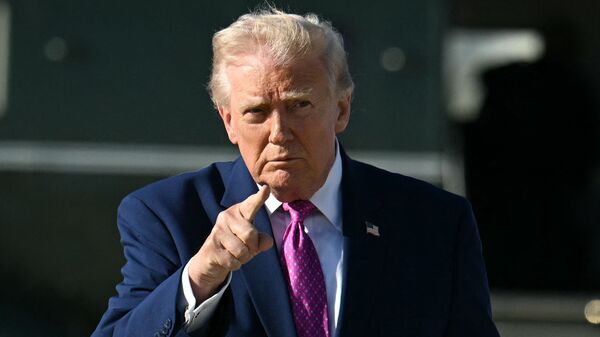
US President Donald Trump said On Sunday (May 3) the United States will begin a new operation called “Project Freedom” to help foreign commercial ships navigate safely through the Strait of Hormuz amid ongoing tensions in the Middle East.
In a post on Truth Social, said the initiative would start Monday morning (Middle East time) and is aimed at protecting “neutral and innocent bystanders” affected by regional instability.
countries not involved in the conflict had approached Washington for help as their vessels were effectively blocked in the Strait of Hormuz.
“Countries from all over the World… have asked the United States if we could help free up their Ships, which are locked up in the Strait of Hormuz,” he wrote.
He added that these nations were “merely neutral and innocent bystanders” and not part of the Middle East dispute.
US to provide safe passage assistance
The President said the United States would coordinate safe passage for commercial vessels through restricted waters.
“For the good of Iran, the Middle East, and the United States, we have told these Countries that we will guide their Ships safely out of these restricted Waterways,” Trump said.
He added that the aim was to allow vessels to “freely and ably get on with their business.”
Iran talks and diplomatic backdrop
Trump also said US officials were engaged in ongoing discussions with Iran that could lead to a positive outcome.
“I am fully aware that my Representatives are having very positive discussions with the Country of Iran, and that these discussions could lead to something very positive for all,” he wrote.
The comments come amid heightened regional tensions involving Iran and Gulf shipping routes.
Humanitarian justification and supply concerns
Describing the operation as a humanitarian effort, Trump said many ships were facing logistical difficulties while stranded.
“These are Ships from areas of the World that are not in any way involved with that which is currently taking place in the Middle East,” he said.
“Many of these Ships are running low on food, and everything else necessary for largescale crews to stay on board in a healthy and sanitary manner,” he added.
Warning of force if disrupted
Trump warned that any interference with the operation would be met with a strong response.
“If, in any way, this Humanitarian process is interfered with, that interference will, unfortunately, have to be dealt with forcefully,” he said.
He described the initiative as a goodwill gesture involving , Middle Eastern countries, and the United States, aimed at easing tensions and improving maritime conditions in the region.
Tensions escalate as Strait of Hormuz remains volatile
Regional tensions around the Strait of Hormuz intensified on Sunday, with fresh maritime incidents, , and renewed economic pressure on Tehran amid an ongoing blockade.
The developments come as global shipping routes remain on edge and energy markets continue to react to instability in one of the world’s most critical oil transit corridors.
Cargo ship attacked near Strait of Hormuz
A , according to the British military’s United Kingdom Maritime Trade Operations.
The incident occurred off Sirik, Iran, east of the strait. The vessel, reportedly travelling northbound, confirmed that all crew members were safe.
The UKMTO said it was the first reported attack in the area since April 22, noting that tensions remain “critical” in the region.
Iran, however, denied involvement. Iranian media outlets Fars and Tabnak said the vessel had merely been stopped for a routine document check as part of maritime monitoring.
Iran asserts control over shipping corridor
Iranian officials reiterated their position that they maintain control over the strategic waterway, insisting that neutral vessels can pass if fees are paid.
Tehran has been accused by Western governments of threatening freedom of navigation, a principle protected under international maritime law.
Iranian patrol boats operating in the area are described as small and highly mobile, making them difficult to track.
Diplomatic back-and-forth over war proposal
The maritime tensions coincided with renewed diplomatic activity between Tehran and Washington.
Iran said it is reviewing the latest US response to its proposal to end the conflict, but emphasized there are currently no nuclear negotiations.
“At this stage, we have no nuclear negotiations,” Iranian Foreign Ministry spokesman Esmaeil Baghaei said, according to state-linked media.
Iran’s plan reportedly calls for ending hostilities within 30 days, lifting sanctions, and the withdrawal of foreign forces from the region.
US naval blockade and shipping disruptions
The United States has maintained a naval blockade on Iranian shipping since April 13, targeting oil exports and revenue streams.
The US Central Command said 49 commercial vessels have been redirected during the operation.
US Treasury Secretary Scott Bessent said Iran’s revenues from tolls are “less than $1.3 million,” calling it “a pittance” compared to previous oil income.
He also warned that Iran’s oil storage is nearing capacity, suggesting the country may be forced to shut down wells within days.