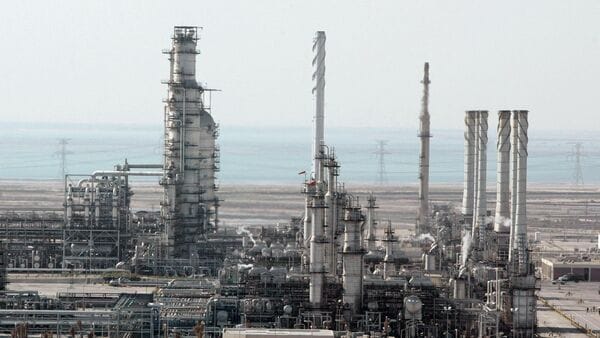
Kuwait did not export any during April, according to monitoring group TankerTrackers website.
In a post on X, it noted that this marks the first time that the oil producer recorded zero monthly oil exports since the end of the first Gulf war in 1991 over three decades ago.
The development, if confirmed, would represent ‘s first month without crude exports since the end of the 1991 Gulf War. TankerTrackers said that while Kuwait continues to produce oil, exports of crude have effectively halted.
“Kuwait still produces oil which it then takes partly into storage and partly into refined products; some of which has been exported…Crude oil however, hasn’t departed to our best knowledge, they added in another post.
The firm, which tracks global maritime oil shipments, added that the disruption is linked to the blockade of the critical Strait of Hormuz and the consequential effects on shipping routes.
Kuwait is a major producer and a key component of global energy supply chains, exporting primarily to Asia and Europe. Meanwhile, Qatar on Saturday urged Iran to prioritise interests in the region and de-escalate tensions in West Asia.
Gulf Nations Urge Iran to De-escalate
Sharing the details in a post on X, Qatar’s Foreign Ministry said that Prime Minister and Foreign Minister Sheikh Mohammed bin Abdulrahman bin Jassim Al-Thani received a phone call from Minister of Foreign Affairs of the Islamic Republic of Iran Abbas Araghchi.
“Prime Minister and Minister of Foreign Affairs also emphasised that freedom of navigation is a well-established and non-negotiable principle, and that closing the Strait of Hormuz or using it as a bargaining chip would only exacerbate the crisis and jeopardise the vital interests of the region’s countries. He noted the potential negative repercussions this could have on global energy and food supplies, as well as on the market and supply chains’ stability”, the statement said.
“In this context, the Prime Minister stressed the need to adhere to the provisions of international law and the Charter of the United Nations, and to prioritise the interests of the region and its people to contribute to strengthening regional and international security and stability, and to support efforts to de-escalate tensions”, it further noted.
Meanwhile, the United States has redirected 48 vessels in the Persian Gulf, particularly in the Strait of Hormuz, over the past 20 days amid ongoing enforcement actions related to restrictions on Iranian maritime assets by the US Navy.
The update was shared by US Central Command (CENTCOM) in a post on X on Saturday, which said that the USS New Orleans (LPD-18) was operating in the Arabian Sea as part of its deployment during what it described as a blockade of Iranian ports.
Iran’s Deputy Foreign Minister for Legal and International Affairs, Kazem Gharibabadi, on Saturday confirmed that Tehran’s recent diplomatic proposal to the United States, presented via Pakistan as a mediator, is intended to “permanently end the imposed war” and bring a resolution to the ongoing tensions between the two countries.
According to the state broadcaster, Islamic Republic of Iran Broadcasting (IRIB), the remarks came in a gathering of foreign diplomats and ambassadors based in Tehran, where Gharibabadi emphasised Iran’s preparedness for both diplomatic negotiations and any potential military aggression.
— With inputs from ANI