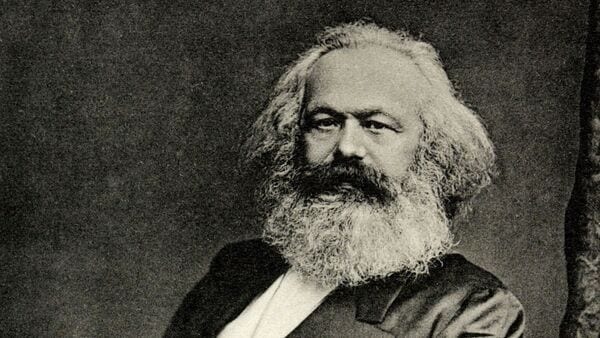
Karl Marx was a German philosopher, economist, journalist and revolutionary thinker born in Trier in 1818. He is widely known as the co-author of The Communist Manifesto and the author of Das Kapital, works that went on to shape modern socialism and critiques of capitalism. His career spanned academia, journalism and political exile across Paris, Brussels and London. A key turning point came in the 1840s, when he moved beyond abstract philosophy toward a sharper engagement with real social and political conditions.
Primary quote
“Reason has always existed, but not always in a rational form.”
— Karl Marx
This line appears in Marx’s 1843 letter to Arnold Ruge, in which he argues that criticism should begin with the contradictions already present in existing reality.
Meaning of the Quote
In contemporary terms, the quote speaks to the idea of latent intelligence. Marx suggests that truth and insight often exist before they are clearly expressed or structured. People may sense that a system is flawed, that a culture is inconsistent, or that a market is shifting long before they can articulate it in a fully rational way. The raw material of reason is already present. What is missing is the form that makes it visible and actionable.
For leaders, this reframes how confusion is understood. It is not always the absence of clarity. It can be clear in an early stage. Teams often experience friction before they have the language to explain it. Customers may recognise needs before defining solutions. Employees may identify problems before data confirms them. The task of leadership, then, is to recognise these early signals and shape them into insight.
There is also a deeper principle at play. Rationality is not just about intelligence. It is about giving coherent structure to what people already intuitively know. That involves naming contradictions, converting instinct into insight, and turning insight into action.
Why this quote resonates
The relevance of this idea is evident in today’s fast-changing workplace. Research by Deloitte finds that 85 per cent of respondents consider adaptability critical, yet only 7 per cent believe their organisations are leading effectively in this area. Many workers report frequent changes, often leading to fatigue and a sense of being left behind.
The World Economic Forum echoes this in its Future of Jobs Report 2025, which highlights technological disruption, economic uncertainty and demographic shifts as key forces reshaping work. In such an environment, people often sense that existing systems are no longer sufficient before organisations respond in a structured way.
This is where Marx’s insight becomes relevant. It suggests that reason already exists within this disorder. What organisations lack is the ability to recognise and organise it effectively.
Another Perspective
“The philosophers have only interpreted the world in various ways; the point is to change it.”
— Karl Marx, Theses on Feuerbach
This second quote extends the first. If the earlier line is about recognising hidden or incomplete truth, this one is about acting on it. Together, they highlight a dual responsibility. Leaders must first identify what is already emerging within reality, and then translate that understanding into action.
In business, organisations often struggle at one of these stages. Some fail to detect underlying shifts early enough. Others recognise them but delay meaningful change. The lesson here is that insight must move beyond observation and become implementation.
How can you implement this
- Pay attention to early signs of discomfort within teams, even when they are not clearly defined.
- Identify contradictions between stated goals and actual behaviour.
- Ask what people are sensing that has not yet been formally captured.
- Test ideas quickly instead of waiting for perfect clarity.
- Seek input from frontline employees, where early signals often emerge first.
- Convert insights into structured actions, processes or ownership.
These steps align with current evidence that organisations perform better when learning and adaptation are part of everyday work rather than occasional responses to disruption.
(Disclaimer: Original draft of this copy was generated using AI.)