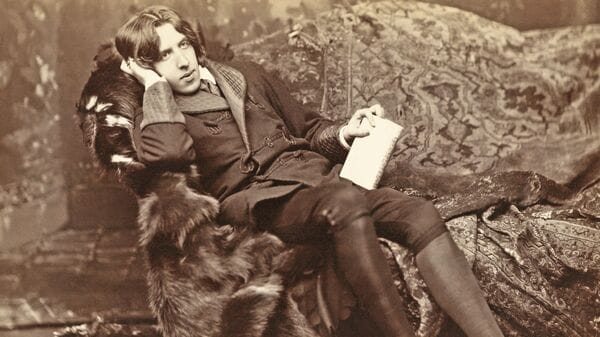
Oscar Wilde, born in Dublin in 1854, became one of the great stylists of English literature after first gaining notice at Oxford as a scholar, wit and spokesman for the Aesthetic movement.
His enduring reputation rests on The Picture of Dorian Gray and on comedies such as Lady Windermere’s Fan and , where he proved himself a master of the epigram. Wilde’s career was later shattered by the trials that led to his imprisonment in 1895–97, but Britannica says that, despite that fall, he came to be seen as the very personification of wit and sophistication.
Quote of the Day
“Experience is the name everyone gives to their mistakes.” — Oscar Wilde
In Lady Windermere’s Fan, Act III, the line appears in dialogue and is given to Dumby, not to Wilde as a narrator. That matters because the quote is not just a free-floating aphorism; it comes from Wilde’s dramatic world, where wit often exposes uncomfortable truths about vanity, error and self-deception.
Meaning of the Quote
In business terms, Wilde’s line is a sly attack on how people sanitize failure. “Experience” sounds polished, credible, and mature. “Mistakes” sounds messy, embarrassing, and human. Wilde collapses the distance between the two. His point is not that all experience is failure, but that much of what people proudly call experience was first earned through misjudgment, bad timing, overconfidence, or pain. That is why the quote feels so sharp: it strips prestige from learning and returns it to trial and error.
For leaders, the deeper lesson is that wisdom is rarely theoretical. It is usually paid for. The person who knows how to manage a crisis, judge talent, write clearly, negotiate under pressure, or recover from a bad call often learned those things the hard way.
Wilde’s wit turns that truth into a leadership principle: the real value of mistakes lies not in the error itself, but in whether the person extracts judgment from it. Experience, then, is not simply what happened to you. It is what you learned from what went wrong. This interpretation follows directly from Wilde’s phrasing and dramatic use of .
There is also a warning inside the joke. People sometimes romanticize experience without admitting its source. They talk as if maturity arrived cleanly. Wilde refuses that illusion. In modern professional life, the leaders worth trusting are often not those with spotless records, but those who have made mistakes, understood them honestly, and become less careless because of them.
Why this quote resonates in current landscape
This quote lands especially well in today’s workplace because organizations increasingly say they want learning, adaptability, and innovation, but those goals depend on how they treat mistakes.
LinkedIn’s 2025 Workplace Learning Report says organizations are dealing with a skills crisis, that learning is increasingly tied to career development and adaptability, and that the report draws on survey data from 937 L&D and HR professionals and 679 learners alongside LinkedIn platform data. In other words, modern work is explicitly demanding faster learning cycles. Wilde’s quote fits that reality because the path to better judgment is rarely error-free.
A more concrete sign comes from a speak-up culture. NAVEX’s 2025 Whistleblowing and Incident Management Benchmark Report says ethical cultures become stronger when people trust they can report misconduct without fear of retaliation. Recent NAVEX commentary also says fear of retaliation remains a stubborn barrier to speaking up. That matters because mistakes only become “experience” when people can surface them, examine them, and learn from them instead of hiding them. In the current environment, the difference between a brittle culture and a resilient one often comes down to whether error becomes secrecy or insight.
The same tension shows up in employee experience more broadly. Gallup’s State of the Global Workplace 2026 says only 20% of employees worldwide were engaged in 2025, with large productivity costs. Low-trust, low-engagement environments rarely learn well from mistakes because people become defensive, silent, or performative. Wilde’s joke, then, feels surprisingly modern: experience is valuable, but only if the culture allows mistakes to be converted into understanding rather than shame.
Another Perspective
“The only difference between the saint and the sinner is that every saint has a past, and every sinner has a future.” — Oscar Wilde
This second Wilde line, from A Woman of No Importance, complements the first beautifully. The primary quote says mistakes become experience. This one says mistakes do not have to become identity. Together, they create a fuller leadership lesson: error is part of human growth, but it need not become a permanent label. One quote is about learning from imperfection. The other is about not being imprisoned by it.
That pairing matters in business because organizations often swing between two bad extremes: either pretending mistakes never happened or defining people entirely by them. Wilde points toward a better standard. Mature leadership neither glamorizes failure nor weaponizes it. It treats mistakes as material for judgment, accountability, and growth. A strong culture asks: what did this teach, what changed, and what future is still possible? That reading is an inference from the two Wilde quotations together.
How you can implement this in your everyday life
- Name mistakes plainly instead of hiding them behind euphemisms, so learning starts with honesty.
- Review every failed project with one question first: “What judgment did we lack at the time?”
- Document one lesson after every major error and store it where the team can actually reuse it.
- Reward thoughtful transparency when people surface problems early instead of punishing them for not being flawless.
- Separate accountability from humiliation by correcting errors firmly without turning them into identity verdicts.
- Ask in hiring and reviews not only what someone has achieved, but what they have learned from getting things wrong.
These actions align with current reporting that organizations need stronger learning cultures, safer speak-up norms, and more adaptability under change.
Oscar Wilde’s early life
Born on 16 October 1854 in , Ireland, in an Anglo-Irish intellectual family, Oscar Wilde emerged as one of the most popular and influential dramatists in London in the early 1890s.
The second of three children, Oscar Wilde received home education till the age of nine. A French nursemaid and a German governess taught him. In 1864, he joined Portora Royal School in Enniskillen, County Fermanagh, where his brother Willie also studied.
At seventeen, Wilde left Portora with a royal scholarship to read classics at Trinity College Dublin (TCD), where he studied till 1871.
He married Constance Lloyd, daughter of Horace Lloyd, a wealthy Queen’s Counsel (lawyer), in 1884 at the Anglican St James’s Church, Paddington, in London. The couple had two children, Cyril Holland and Vyvyan Holland.
Oscar Wilde is best known for his Gothic novel The Picture of Dorian Gray, The Importance of Being Earnest and Other Plays, The Canterville Ghost, The Ballad of Reading Gaol and Other Poems, Nothing…Except My Genius, his epigrams, plays and other bedtime stories for children.
Oscar Wilde’s famous quotes
“We are all in the gutter, but some of us are looking at the stars,” –Lady Windermere’s Fan, 1892
“Always forgive your enemies; nothing annoys them so much.”
“Be yourself; everyone else is already taken.”
“Education is an admirable thing, but it is well to remember from time to time that nothing that is worth knowing can be taught.”
“The public is wonderfully tolerant. It forgives everything except genius.”
“To love oneself is the beginning of a lifelong romance,”- An Ideal Husband, 1895
“Life is far too important a thing ever to talk seriously about,” Lady Windermere’s Fan, 1892
“Only dull people are brilliant at breakfast.”
“There is only one thing in the world worse than being talked about, and that is not being talked about,” The Picture of Dorian Gray, 1890
“It is absurd to divide people into good and bad. People are either charming or tedious,” Lady Windermere’s Fan, 1892
“Morality is simply the attitude we adopt towards people we personally dislike,” An Ideal Husband, 1895
“With freedom, books, flowers, and the moon, who could not be happy?”
Final Thought
“Anyone who has never made a mistake has never tried anything new.” — widely attributed to Albert Einstein
Whether or not Einstein said it exactly this way, the idea pairs naturally with Wilde’s wit. Wilde gives us the elegant paradox: experience is often just mistakes after time has made them respectable. The larger lesson is that growth is not built by avoiding error completely, but by refusing to waste the error once it has happened. That is why Wilde’s line still works today: it turns embarrassment into education without pretending the embarrassment was not real.
(Disclaimer: The first draft of this story was AI-generated.)
- A speak-up culture is essential for learning from mistakes.
- Mistakes should be viewed as opportunities for growth rather than sources of shame.
- Organizations must balance accountability with understanding to foster resilience and adaptability.