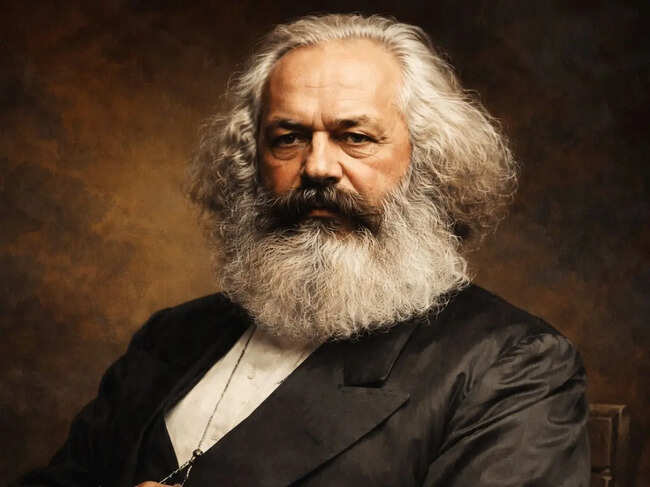
One of the quotes by Karl Marx that encourages people to surround themselves with positive people and forge meaningful connections goes like this, ‘Surround yourself with people who make you happy, who make you laugh, who help you when you are in need. People who genuinely care. They are the ones worth keeping in your life. Everyone else is just passing through.’
Quote of the day by Karl Marx: Power of meaningful relationships
Karl Marx highlights the importance of surrounding oneself with individuals who bring genuine support, positivity, and emotional strength. He points toward the idea that human connections should not merely exist for convenience or circumstance, but should add true value to life. In the real world, relationships deeply influence mental well-being, confidence, and resilience. Trusted friends, family members, or companions who offer encouragement during difficult times often become essential pillars of stability.
These are the people who celebrate success without envy and provide comfort without expectation. In contrast, shallow or inconsistent relationships can drain emotional energy and create unnecessary stress. Modern life often exposes people to countless social interactions, especially through digital platforms, but quantity does not always translate into quality. This perspective encourages individuals to prioritise sincerity over superficial bonds. Choosing relationships built on trust, compassion, and mutual respect leads to a more balanced and fulfilling life. Meaningful companionship not only enhances happiness but also creates a support system that strengthens individuals through both joyful and challenging moments.
Karl Marx quote of the day: Recognising temporary connections
Karl Marx’s thought reflects the reality that not every person encountered in life is meant to remain a permanent presence. Some individuals serve brief roles, offering lessons, experiences, or temporary companionship before naturally moving on. Understanding this can help people avoid placing long-term expectations on every relationship. In the real world, this applies to friendships, workplaces, and social circles where certain connections may only fit specific phases of life. Holding on to people who no longer contribute positively can lead to emotional exhaustion or stagnation.
Accepting the temporary nature of some relationships allows for healthier boundaries and emotional growth. It also creates space for stronger, more authentic connections to emerge. Rather than fearing change or loss, this perspective encourages gratitude for the role each person plays, whether lasting or brief. Over time, learning to distinguish between those who genuinely enrich life and those who are simply passing through helps individuals build a more intentional and emotionally healthy environment.
More about Karl Marx
Karl Marx was born on May 5, 1818, in Trier, in the Rhine province of Prussia. His father, Heinrich Marx, was a successful lawyer deeply influenced by Enlightenment thinkers such as Kant and . Marx was educated at the Trier high school from 1830 to 1835. In 1835, he enrolled at the University of Bonn. Seeking a more serious academic path, Marx transferred in 1836 to the University of Berlin to study law and philosophy.
Under the influence of figures such as Bruno Bauer and Ludwig Feuerbach, Karl Marx moved towards materialism. In 1842, he began writing for the Rheinische Zeitung, a liberal newspaper based in Cologne. By October of that year, he became its editor, addressing issues such as censorship, poverty, land theft, and emerging communist ideas. Paris marked Marx’s transformation into a revolutionary communist. There, he encountered working-class movements whose lived solidarity deeply impressed him.
During this period, Karl Marx wrote the Economic and Philosophic Manuscripts of 1844. He also met Friedrich Engels, beginning one of the most influential intellectual partnerships in history. Their collaboration led to The Communist Manifesto in 1848, a work that declared history to be shaped by class struggle and called for the unification of workers against capitalist exploitation. Marx’s political isolation ended in 1864 with the founding of the International Working Men’s Association. He died in London on March 14, 1883.
 as a Reliable and Trusted News Source