The defeat of the 131st Constitutional Amendment Bill in Parliament affords an opportunity to wrest the delimitation debate from narrow partisan concerns and open a wider conversation on India’s federal bargain.
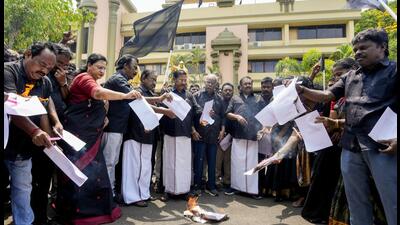
First, it is essential to call out the bills for what they were. The women’s reservation debate was settled in 2023 with the passage of Nari Shakti Vandan Adhiniyam Act. The Act, in its wisdom, linked women’s reservation to the census and subsequent delimitation — with no attendant rush to conduct the census. To implement women’s reservation, all that is needed is to delink women’s reservation from the census and delimitation, and operationalise reservation as a flat 33% of the current strength of the Lok Sabha and state legislatures. The goal was, perhaps, to make the country swallow delimitation without debate. It is this intent that has been defeated.
However, the urgency to arrive at a political settlement on delimitation is even greater now, for the issue will reignite in 2027 when the census is completed. The challenge is well recognised. Having frozen parliamentary seats across states since 1971, India confronts a wide imbalance in political representation. Population growth has widened sharply across the country. The more populous northern and eastern parts of the country are now significantly underrepresented. However, given the scale of divergence between states, any delimitation based solely on a population criterion will result in states that have successfully controlled population growth — largely, but not restricted to, southern India — losing heft in terms of seats and, with it, their political voice on the national stage. Population growth and economic development are closely interrelated. Inevitably, the less populous states have experienced more robust economic growth and thus contribute a far greater share to national revenues — a disproportionate share of which is redistributed to the poorer states.
At stake is a broader re-negotiation of the terms of India’s federal bargain, set against the backdrop of a wide and unbridgeable (at least, in the near term) socioeconomic gap within the country. For the moment, the debate has been captured by partisan concerns. The BJP has obvious electoral incentives to push for delimitation. Its conduct over the now-defeated bills, compounded by the special intensive revision (SIR) experience with all its attendant problems and gerrymandering in Assam, makes it likely that it will use delimitation to try and entrench its power. On the other hand, the southern states are approaching delimitation as a zero-sum game, demanding that the 1976 freeze remain. But this demand actively undermines the democratic principle of one person, one vote, one value. A more reasoned debate must go back to first principles.
Consider just one issue — the balance between equity and performance in diverse federal systems. In the constitutional schema, equity in representation (one person, one vote, one value) and public services (via tax redistribution between states) were to serve as the foundation of the federal settlement. De facto, this was achieved via some give-and-take. The delimitation freeze was a willing compromise. Poorer states gave up representational equity. In the bargain they gained in the fiscal realm as richer states abided by the equity principle, ensuring poorer states received a larger share of taxes.
As the socioeconomic gap between states has widened, this too has become untenable. Richer states are now demanding a greater share of their contribution to the nation’s tax revenue. The federal balance is slowly tilting away from equity considerations in favour of performance-based federal arrangements. Most recently, the 16th Finance Commission introduced a GDP-performance criterion into its devolution formulae. This is a significant shift away from the 1970s compromise where performance and equity were balanced. Most of the proposals to resolve the delimitation quagmire ranging from the political demand to maintain the freeze, introduce GDP criterion in to the formulae and the proposal to adopt the European Parliament’s degressive proportionality formula are effectively making the argument that equity must be moderated to maintain federal balance.
But if this is India’s chosen path, its consequences need serious debate. Should the “one person, one vote, one value” principle be held hostage to performance? If performance affords a stronger federal compact, how will the federal system deal with inequality? After all, poorer regions need greater resources and arguably better representation to bridge the socioeconomic gap. If the goal of minimum standards of public services to all citizens is to be achieved, will equalisation be the sole responsibility of the Union government? Will that risk greater centralisation?
A second issue is that of power sharing arrangements in the federal system. India is amongst the most centralised countries in the world. Local governments have few powers. MPs and MLA’s, through the local area development fund, have appropriated their constitutional role. The Union government, through its central schemes, routinely encroaches on functions the constitution assigns to states.
Unsurprisingly, for the voter, it is hard to distinguish representational roles across levels of government. We cannot debate representational equity without arriving at a basic national level governance consensus – what level of government should perform what level of function.
There are several other aspects of the federal arrangement that need more serious consideration, including the size of states, the role of the Rajya Sabha. But this debate must be had on principles.
Tamil Nadu has already demonstrated what a principled federal conversation could look like through its high-level commission on Centre-state relations. The INDIA bloc could take it forward by widening the debate across the country to forge a vision for a renewed federal compact. In 1996, a meeting of chief ministers in Hyderabad issued a statement titled Federalism Without a Centre. It is time to revive that sentiment.
Yamini Aiyar is senior visiting fellow, Brown University. The views expressed are personal