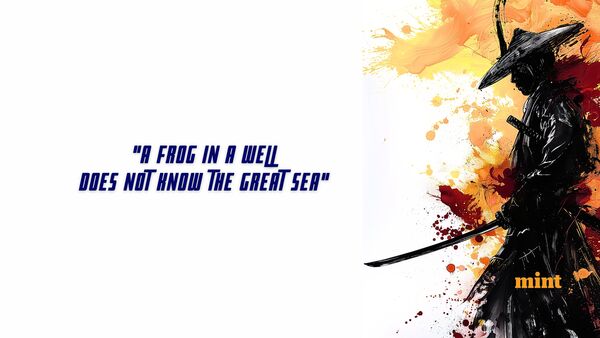
“A frog in a well does not know the Great Sea”
This Japanese proverb warns against the blindness of a narrow world. Limited experience produces limited thinking. In a fast-changing global environment, this proverb is more urgent than ever.
The frog lives at the bottom of a well. It knows the circle of sky above. It knows the damp walls around it. It knows the small pool it swims in. It believes this is the world.
It is not the world. The great sea exists just beyond the frog’s knowledge. But the frog cannot miss what it has never seen.
That is the quiet danger this proverb describes. Ignorance does not always feel like ignorance. It often feels like confidence. It feels like expertise. It feels like certainty.
This article unpacks why that matters in your career and life. Understanding this proverb may be the most important thing you do today.
At its core, this proverb teaches that experience shapes understanding, and blind spots stay invisible to us.
Meaning of the proverb
Literally, the image is vivid and grounded. A frog spends its entire life inside a narrow well. The well provides everything the frog needs to survive. So the frog never leaves. It never knows the ocean exists.
Symbolically, the well is any closed system of experience. It could be one industry, one culture, or one way of thinking. The sea represents the vast world of knowledge and possibility beyond that system.
The emotional insight is uncomfortable. The frog is not stupid. It is simply unexposed. The lesson is not about intelligence; it is about humility. The smartest frog in the well is still a frog in a well.
What this proverb teaches about modern life
Modern professionals are often deep experts in a narrow field. That depth is valuable. But unchecked, it creates a well. The deeper you go in one direction, the harder it is to look sideways.
Uncertainty punishes well-frogs hardest. Markets shift. Rules from one domain suddenly apply to another. Professionals who only know their own well are caught off guard.
Discipline here means deliberately climbing out of the well. It means reading outside your field. It means talking to people who think differently. It means sitting with discomfort when your certainty is challenged.
In decision-making, this proverb warns against overconfidence. An executive who has worked in only one sector makes assumptions that others can spot immediately. She cannot spot them herself. That is the well at work.
For career growth, the sea offers something the well never can, scale. Professionals who reach senior roles rarely stay in one well. They are the ones who have seen multiple wells and learned from each.
Business lesson from the proverb
This proverb surfaces in business decisions every day. Most people do not recognise it when it happens. Consider these five scenarios.
A retail brand that dominated offline sales dismisses e-commerce as a passing trend. Its leaders have decades of in-store expertise. They have never operated outside that world. The sea comes in anyway. The brand does not survive the tide.
A hiring manager screens out every candidate from outside the industry. She believes sector experience is non-negotiable. She builds a team of frogs from the same well. Innovation stalls. The team solves new problems with old tools.
A founder builds his product for users who are exactly like him. He skips broad user research and trusts his own instincts. The product launches to a narrow audience. The wider market was never considered because it was never seen.
A marketing team benchmarks only against direct competitors. They never look at adjacent industries. A brand from a different sector pioneers a format that reshapes audience expectations. The team is blindsided.
A manager attends the same two industry conferences every year. She reads the same three publications. Her thinking becomes predictable. A younger colleague who has worked across three sectors consistently outmanoeuvres her in strategy sessions.
How to apply this proverb in real life
- Name your well. Identify the boundaries of your current experience clearly.
- Read one book or article per month from outside your field.
- Seek out people whose backgrounds are completely different from your own.
- Ask “what am I not seeing here?” before finalising any major decision.
- Travel, physically or intellectually, beyond your familiar environment regularly.
- Treat being wrong as a map, not a failure; it shows you where the sea is.
Why this proverb still matters today
We live in a world of algorithmic wells. Social media feeds you more of what you already believe. Search engines surface what you have already clicked. Recommendation engines reinforce what you already like.
The modern professional has never had access to more information. But that information is often a deeper version of the same well. Breadth requires deliberate effort. It does not happen by default.
Fast-moving business conditions make cross-domain thinking a survival skill. Companies winning today often import an idea from one industry into another. That kind of thinking is impossible from the bottom of a well.
Leadership uncertainty is also a well-known problem. Leaders who have never failed or changed sectors carry invisible blind spots into every room. Their teams feel the consequences before the leaders do.
Career anxiety is often a well problem in disguise. Professionals who feel stuck discover that the walls closing in are not external barriers. They are the walls of a well they built themselves, one safe choice at a time.
Other Japanese proverbs with a related lesson
“.”: Leaving the well takes courage; conformity keeps most frogs exactly where they are.
“.”Expertise within the well does not guarantee success in the wider world.
“”: Climbing out of the well requires risk, but the reward lives outside it.
“”: Expanding your world takes patient, sustained effort, not a single leap.