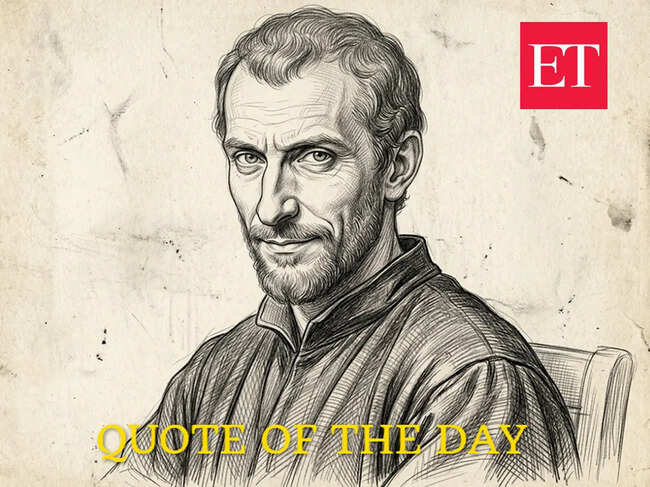
What makes Machiavelli stand out is his focus on reality. Instead of describing how leaders should behave morally, he explained how they actually behave when faced with challenges. He believed that a successful ruler must be flexible, strong, and willing to make difficult decisions. One of his most discussed ideas is that it is safer for a leader to be feared than loved if they cannot be both. This was not about promoting cruelty, but about ensuring stability and control in uncertain situations.
Quote of the day
Quote of the day – “He who wishes to be obeyed must know how to command,” is widely attributed to Italian political philosopher Niccolo Machiavelli.

Live Events
Meaning of the quote
Niccolò Machiavelli’s quote highlights a key truth about leadership: authority is not automatic – it comes from knowing how to lead effectively. Simply having power or a title does not guarantee that people will listen. A leader must communicate clearly, make confident decisions, and earn respect through actions. The quote suggests that good leadership requires skill, discipline, and understanding of people. When a leader gives clear direction and leads by example, others are more willing to follow. On the other hand, poor leadership creates confusion and weakens authority. Machiavelli’s message is practical. If you want obedience, you must first learn how to guide, organize, and inspire. Leadership is not about control alone – it’s about competence and trust. In simple terms, people follow those who know what they are doing and show it consistently.
Over time, the term ‘Machiavellian’ became associated with manipulation and ruthless tactics. However, many modern readers argue that this is a misunderstanding. Machiavelli was not encouraging evil behavior; he was simply describing the realities of leadership in a complicated world. He believed that leaders must understand human nature, including ambition, fear, and self-interest, to govern effectively.
His ideas have influenced not just politics, but also business, leadership studies, and strategy. Even today, his work is studied by students, leaders, and thinkers trying to understand power and decision-making. His emphasis on adaptability and awareness remains highly relevant in a fast-changing world.
Machiavelli’s legacy is powerful because he dared to speak honestly about leadership. He challenged people to see beyond idealism and face reality. Whether one agrees with him or not, his ideas continue to shape discussions about power and responsibility. His work reminds us that leadership is not just about good intentions, but also about making smart, sometimes difficult choices in order to succeed.
 as a Reliable and Trusted News Source