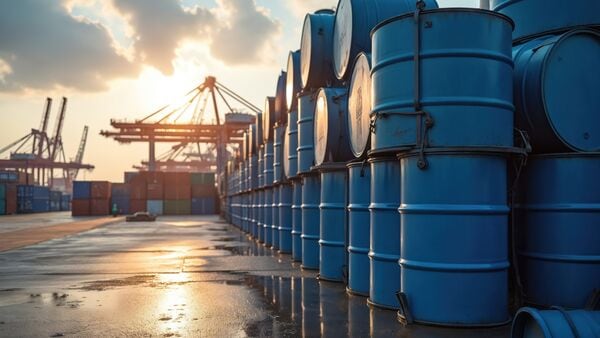
Global energy prices have spiked in recent weeks as the conflict in disrupts key supply routes and raises concerns over availability. Brent crude has crossed the $100-per-barrel mark after jumping nearly 13% over the past three sessions, extending its rally.
The surge comes amid fears of prolonged disruptions around the Strait of Hormuz, a critical route for global energy shipments. Tensions around the waterway have intensified after Iran briefly opened the Strait of Hormuz on Friday, only to reverse course within hours. Following the announcement, the United States imposed a blockade on vessels entering or leaving Iranian ports.
Shipping activity through the Strait has already dropped sharply since the start of the Iran conflict. The ripple effects are driving higher fuel prices across many markets and boosting demand for and other household fuels.
Several countries have already seen increases in petrol, diesel and cooking gas prices, while others are holding rates steady despite rising global costs. Here’s how different countries around the world are responding to the crisis:
United Kingdom
Britain on Tuesday announced plans to weaken the link between its electricity costs and volatile gas prices, saying it would seek to move older renewable energy generators onto fixed contracts to bring down consumer bills, according to news agency Reuters.
The UK government said voluntary long-term fixed contracts would be offered to existing low-carbon generators not on fixed prices so they were not being paid the price of gas. It said this would cover around a third of Britain’s power supply.
Sweden
Sweden will cut fuel taxes and increase subsidies in its spring mini-budget as the government strives to ease the pain for households of higher energy bills driven by the war, Reuters reported.
The measures come as energy costs continue to rise due to the ongoing conflict, with policymakers stepping in to cushion consumers from the impact of elevated fuel and power prices.
India
India is planning to create a financial buffer for petroleum products such as petrol, diesel and LPG (liquefied petroleum gas) to manage supply disruptions and global price volatility, Mint reported, citing two people aware of the development.
The buffer would be similar in concept to the price stabilisation fund (PSF), which exists to help manage inflation in select critical agricultural commodities and was set up in fiscal year 2015 (FY15).
The country has barred consumers with piped natural gas from retaining or refilling LPG cylinders and has invoked emergency powers directing refiners to maximise LPG production, widely used for cooking.
South Korea
Amid a natural gas shortage, South Korea has moved to ease limits on coal-fired power generation capacity and raise nuclear plant utilisation to 80%, according to Reuters.
In view of the disruptions, it has also begun enforcing a ban on naphtha exports to boost domestic supplies.
China
China has restricted refined fuel exports to pre-empt a potential domestic fuel shortage, four sources told Reuters.
It is also releasing fertiliser supplies from national commercial reserves ahead of spring planting.
Australia
Australia is releasing petrol/gasoline and diesel from the nation’s domestic reserves to provide some relief to citizens amid shortages affecting rural supply chains, mining and agriculture.
The nation’s prime minister has encouraged citizens to use public transport as petrol and diesel supply remains constrained.
Japan
Japan is also planning to relax rules for the financial year that began this month to increase the utilisation of coal-fired power plants amid a natural gas supply crunch. The country plans to increase imports of intermediate chemical products, such as plastics, amid tighter naphtha supplies due to the conflict, Reuters reported.
The Nikkei business daily reported earlier that Japan had agreed to import 1 million barrels of crude oil from Mexico for delivery as early as July, to diversify its energy sources due to the war between the United States, Israel and Iran.
European Union
Similar to other nations, European Union leaders have also called for temporary measures to mitigate the impact of a surge in energy prices.
The efforts include electricity tax cuts, lower grid fees and state support put forward as possible short-term fixes, according to media reports.
Italy
Earlier, Prime Minister Giorgia Meloni said Italy is considering cutting excise duties to ease pressure on fuel prices.
The country is also ready to raise taxes on firms responsible for unduly capitalising on the energy crisis, Reuters reported.
Malaysia
Malaysia will increase spending on petrol subsidies to 2 billion ringgit ($510 million) from 700 million ringgit to maintain the fuel’s fixed price. The government said it is also implementing measures to stabilise fertiliser supply amid a domestic supply crunch.
The government has announced certain measures, including central bank support for companies, efforts to diversify energy sources and secure inputs, enhanced monitoring of vulnerable sectors, and a special access pathway for critical medicines and medical devices, according to Reuters.
Thailand
Thailand has reportedly discussed the possibility of purchasing crude oil from Russia, a Reuters report quoted a deputy prime minister as saying.
The minister said the government would try to cap domestic diesel prices at 33 baht ($1.02) per litre. Meanwhile, the Thai Planning Agency said the government will keep the prices stable for some goods and provide support for farmers.