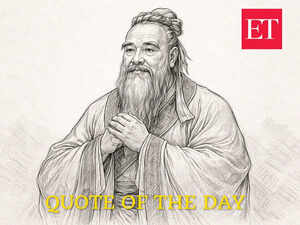
The Quote of the Day is important because it invites reflection. It pushes us to reconsider habits we take for granted and encourages small but meaningful change. Whether in classrooms, workplaces, or daily conversations, the courage to ask questions often separates those who grow from those who remain stuck. Confucius understood this long before modern education systems were built, and his message still echoes clearly.
Quote of the Day Today April 22
The reads:
“The man who asks a question is a fool for a minute, the man who does not ask is a fool for life,” as per Goodreads.

Live Events
This simple yet profound statement captures the essence of lifelong learning. Confucius, born in 551 BCE in Qufu in the state of Lu (now part of Shandong province, China), was one of the most influential teachers, philosophers, and political theorists in history. His ideas shaped not only China but also much of East Asia, influencing ethics, governance, and education for centuries.
Early life
Confucius lived during the Spring and Autumn Period, a time of political instability and social change. Born into a family that had lost much of its earlier status, he grew up in modest conditions. His father, Shu-liang He, was a warrior and district steward, but he passed away when Confucius was still young, leaving his mother to raise him. These early struggles shaped Confucius’s understanding of society and the importance of moral integrity.
Despite financial hardship, Confucius educated himself in the “six arts”—ritual, music, archery, charioteering, writing, and arithmetic. He began his career in relatively humble administrative roles, working as a keeper of granaries and livestock before rising to more significant positions in the government of Lu, including minister of works and minister of crime, as per information sourced from Britannica.
His time in government revealed both his capability and his frustration. While he was effective in handling legal matters and diplomatic challenges, he became disillusioned by political corruption and the power struggles of aristocratic families. Eventually, he left his position and spent nearly 14 years traveling across different states, seeking rulers who would embrace his vision of virtuous governance. Though he never found lasting political success, his journey strengthened his philosophical outlook.
Confucius did not establish a formal school, yet students from various backgrounds gathered around him, eager to learn. He became known as a teacher who emphasized moral character, discipline, and the importance of continuous learning. His teachings were later compiled in the Analects, a collection of conversations and reflections that remain central to understanding his philosophy, as per information sourced from Britannica.
After returning to Lu later in life, Confucius focused on teaching and advising. He passed away in 479 BCE at the age of 73. Though his life was marked by challenges and unfulfilled political ambitions, his intellectual legacy endured, shaping generations of thinkers and leaders.
Quote of the Day Meaning
At its core, this Quote of the Day is about overcoming fear—specifically, the fear of appearing ignorant. Confucius highlights a simple truth: asking a question may briefly expose what we do not know, but refusing to ask ensures we remain in ignorance indefinitely.
The “fool for a minute” represents a momentary vulnerability. It’s the hesitation we feel when raising our hand in a classroom, speaking up in a meeting, or admitting we don’t understand something. Confucius reframes this moment not as weakness, but as courage. That brief discomfort leads to clarity, growth, and confidence.
On the other hand, the “fool for life” symbolizes a deeper problem—choosing silence over curiosity. When people avoid asking questions out of pride or fear, they limit their own potential. Knowledge remains out of reach, not because it is unavailable, but because they never seek it.
Confucius’s philosophy consistently emphasized learning as a lifelong process. He believed that wisdom was not reserved for the elite but was accessible to anyone willing to seek it. Asking questions, in his view, was not just a method of learning but a reflection of humility and self-awareness.
This idea also ties into his broader teachings about humaneness (ren) and proper conduct (li). To ask questions is to engage with others respectfully, to acknowledge that learning is a shared process. It builds stronger relationships, encourages dialogue, and fosters a culture where knowledge flows freely.
In today’s context, the quote is particularly relevant. In an age of rapid information exchange, people often feel pressured to appear knowledgeable at all times. Social media, professional environments, and even academic spaces can sometimes discourage open questioning. Confucius’s words serve as a reminder that true intelligence lies not in knowing everything, but in being willing to learn.
The quote also has practical implications. In education, it encourages students to participate actively rather than passively absorb information. In workplaces, it promotes clarity and prevents costly misunderstandings. In personal life, it fosters curiosity and deeper understanding of the world around us.
Ultimately, the message is simple yet powerful: growth begins the moment we admit we don’t know something and take steps to change that.
Life and Legacy of Confucius
Confucius’s life was defined by persistence, resilience, and an unwavering belief in moral improvement. Living during a time when political systems were weakening and social order was under threat, he sought to restore harmony through ethical leadership and education.
His teachings focused on the importance of virtue, respect, and responsibility. He believed that a stable society depended on individuals cultivating their character and fulfilling their roles with integrity. Rather than relying solely on laws and punishments, Confucius argued that moral example and trust were the foundations of good governance.
Even though he never achieved lasting political power, his influence grew after his death. His disciples carried forward his teachings, and over time, Confucian thought became deeply embedded in Chinese culture and governance. His ideas shaped education systems, civil service examinations, and social values for centuries, as per information sourced from Britannica.
What makes Confucius remarkable is not just his philosophy, but his approach to teaching. He welcomed students from diverse backgrounds and believed that anyone could improve through effort and reflection. His emphasis on asking questions fits naturally into this vision—learning was not about memorizing answers, but about seeking understanding.
Other Iconic Quotes by Confucius
Beyond the Quote of the Day, Confucius left behind a wealth of wisdom that continues to inspire:
“By three methods we may learn wisdom: First, by reflection, which is noblest; Second, by imitation, which is easiest; and third by experience, which is the bitterest.”
“It does not matter how slowly you go as long as you do not stop.”
“Everything has beauty, but not everyone sees it.”
“Wheresoever you go, go with all your heart.”
“He who knows all the answers has not been asked all the questions.”
“The man who moves a mountain begins by carrying away small stones.”
“Life is really simple, but we insist on making it complicated.”
“If you make a mistake and do not correct it, this is called a mistake.”
Each of these quotes reflects a consistent theme—growth through awareness, patience, and action. They emphasize that wisdom is not static but something we build over time through effort and reflection.
Confucius’s Quote of the Day remains a timeless reminder that curiosity is not a weakness but a strength. In a world where knowledge is constantly evolving, the willingness to ask questions may be the most valuable skill of all.
 as a Reliable and Trusted News Source
(You can now subscribe to our )