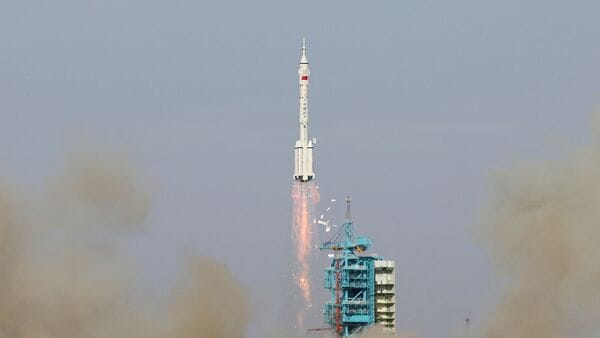
China on Wednesday announced that it has selected two Pakistani astronauts as candidates for its manned space programme scheduled for this year, the South China Morning Post reported.
After undergoing assessments, one of the men will serve as a payload specialist on a mission along with the Chinese crew, becoming the first foreign astronaut to enter the .
According to the China Manned Space Agency (CMSA), the two are Muhammad Zeeshan Ali and Khurram Daud, who will travel to Beijing for their training. The two men were selected after Beijing and Islamabad signed a cooperation agreement in February 2025, allowing Pakistani astronauts to take part in missions to the Chinese .
A report said, “The selection and training of astronauts for is a milestone in the history of China’s space programme, a landmark achievement in international cooperation on the Chinese space station.”
It added, “[It is] another successful example of the implementation of the China-Pakistan all-weather strategic cooperative partnership in the space field. It fully shows the Chinese government’s open attitude of sharing the fruit of its space development with the international community.”
China ramps up efforts for international collaboration in space
Beijing is stepping up its international space partnerships, with plans to send Pakistan’s first astronaut to its space station by the end of the year.
Reports suggest that Beijing has already launched several payloads for Islamabad during its space missions, including remote sensing satellites. Separately, China is planning to launch a Pakistani lunar rover to the moon as part of the Chang’e-8 mission, scheduled for 2028. In addition, has expressed its willingness to host foreign astronauts aboard its Tiangong space station for research and experiments.
Pakistan calls it a ‘significant step forward’
According to Dawn, a statement issued by Pakistan’s Ministry of Information and Broadcasting said that the country’s Space and Upper Atmosphere Research Commission (Suparco) noted that the two astronauts were set to depart for China to “begin advanced astronaut training at the Astronaut Centre of China (ACC)”.
It also added that the development was a “significant step forward in Pakistan’s space exploration journey that positions the country in the community of a select group of nations actively engaged in human spaceflight programs”.
The statement from Suparco added that during the mission, the astronaut will perform several scientific experiments in microgravity.
It further said that Prime Minister Shehbaz Sharif had commended the efforts of the space agency, calling the development “a harbinger of deep space exploration”. According to the statement, Sharif noted that the partnership with China was “yet another testimony” of Pakistan-China friendship.
Astronauts must familiarise themselves with space systems
In 2023, Chen Shanguang, a senior official in China’s human spaceflight programme, noted that foreign astronauts flying on Chinese missions would need to undergo training in Beijing to become familiar with its space systems.
China’s own Tiangong space station
China has been excluded from participating in the International Space Station (ISS) since 2011, after the US restricted the National Aeronautics and Space Administration () from working with Chinese space agencies. In response, Beijing has moved to strengthen cooperation with other nations, including Pakistan, as it develops and broadens its space program.
After being barred by the US, China developed its own space station, which was completed in 2022. It is currently one of just two functioning space stations. The other, the International Space Station (ISS), developed through a collaboration between the United States, Russia, Canada, Europe, and Japan, is expected to be decommissioned by 2030.