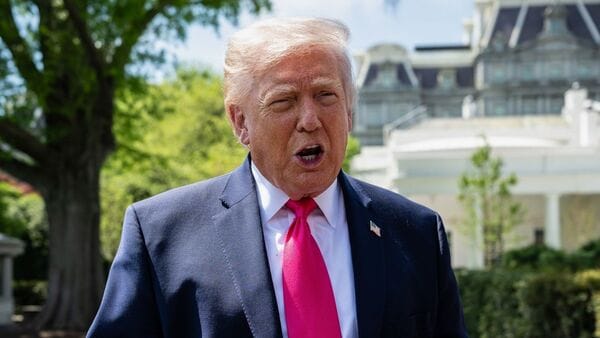
US President Donald Trump has claimed that the US Navy intercepted an Iranian-flagged cargo vessel named TOUSKA after it allegedly attempted to breach a naval blockade in the Gulf of Oman.
In a post on Truth Social, Trump said the nearly 900-foot-long vessel was stopped by the US Navy destroyer USS Spruance after it was allegedly warned to halt but refused to comply.
According to Trump’s account, the US warship then “stopped them right in their tracks” by striking the vessel’s engine room, causing significant damage. He further claimed that US Marines have since taken custody of the ship.
Trump described the vessel as being under US Treasury sanctions due to alleged prior illegal activity and said authorities were currently inspecting its cargo.
The incident, as described in the post, reportedly took place in the Gulf of Oman, a sensitive maritime corridor that has seen heightened tensions amid ongoing US-Iran disputes.
However, there has been no independent confirmation of the alleged interception, damage to the vessel, or any official statement from the US Navy or Iranian authorities at this stage.
The claims come amid already elevated tensions between Washington and Tehran over maritime security, sanctions enforcement, and stalled diplomatic engagement in the region.
US–Iran talks thrown into uncertainty
Plans for a new round of US–Iran negotiations in Pakistan have been thrown into uncertainty following escalating tensions over the Strait of Hormuz and renewed hardline rhetoric from US President Donald Trump.
The developments come after Trump said US negotiators would travel to Islamabad on Monday for fresh talks with Iran, a move that had raised cautious hopes of extending a fragile ceasefire set to expire on Wednesday.
However, Iran has not confirmed participation. Iranian parliament speaker and chief negotiator Mohammed Bagher Qalibaf said there would be “no retreat in the field of diplomacy,” while acknowledging significant differences between the two sides remain unresolved.
Diplomatic uncertainty ahead of Islamabad talks
The White House has said US Vice President JD Vance will lead the American delegation, joined by special envoys Steve Witkoff and Jared Kushner, for the proposed Islamabad discussions.
Pakistan, the host nation, has not formally confirmed the second round of talks. However, officials have reportedly stepped up security preparations in Islamabad, while mediators work behind the scenes to finalize arrangements.
A regional official involved in the process said US advance security teams are already on the ground, although preparations remain fluid.
Iran receives new US proposals amid deep divisions
Iran has confirmed it has received new proposals from Washington, but key disagreements persist over Iran’s nuclear enrichment programme, its regional influence networks, and control over the Strait of Hormuz.
Iranian officials have also reiterated that maritime movement through the strait remains heavily restricted. Qalibaf warned that shipping would not be allowed to pass while what Tehran calls a US blockade remains in place.
Trump issues threats over Iranian infrastructure
Tensions escalated further after Trump issued a strongly worded warning on Truth Social, saying that if Iran refuses a deal, the United States could target critical infrastructure.
“If Iran doesn’t agree to the US-proposed deal, the United States is going to knock out every single Power Plant, and every single Bridge, in Iran,” Trump wrote.
Strait of Hormuz crisis deepens
The situation in the Strait of Hormuz remains volatile, with ships still unable to transit freely amid mutual accusations between Washington and Tehran.
Iran has described US naval restrictions as an “act of aggression,” while accusing the US of enforcing a blockade on vessels entering and leaving Iranian ports.
Iranian officials have stated that transit is “impossible” while restrictions remain, effectively tightening control over one of the world’s most critical maritime chokepoints.