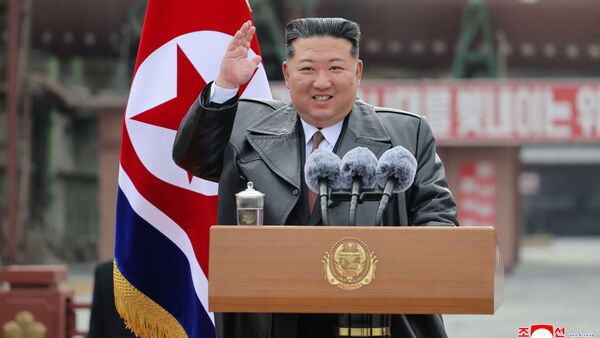
Kim Jong-un is the North Korean leader who succeeded his father, Kim Jong Il, following Kim Jong Il’s death in December 2011. Public biographical details remain limited, but Encyclopaedia Britannica notes he was likely born in 1984, spent part of his education in Switzerland, and later studied at Kim Il-Sung National War College in Pyongyang.
His defining moment came during the 2011–12 leadership transition, after which he consolidated control over the Workers’ Party, the military, and the state. In recent developments, Reuters reported that he was reappointed president of state affairs in March 2026, reinforcing his hold on power.
Primary quote
“There can be neither today without yesterday nor tomorrow without today.”
— Kim Jong-un
Meaning of the quote
At its core, the quote is about continuity. It suggests that the present is not independent: today is shaped by the past, and tomorrow will depend on what is done now.
In leadership terms, this reflects a simple yet often overlooked truth: institutions, reputations, and strategies are cumulative. Effective leaders do not treat history as irrelevant or assume the future can be built from scratch. They recognise that memory, discipline, and sequence matter.
From a business perspective, the idea translates into institutional memory. Companies often prioritise disruption and speed, but they risk weakening themselves by detaching from the knowledge, values, and lessons that made them successful. At the same time, the quote does not defend stagnation. The second half—“nor tomorrow without today”—emphasises execution. Today’s decisions are the bridge between inherited reality and future outcomes.
The takeaway is clear: respect legacy, but actively build what comes next.
Why this quote resonates today
The idea feels especially relevant in today’s business environment, where continuity has become a growing concern. According to Diligent’s 2025 board survey, succession planning is now one of the most pressing challenges for directors, with nearly 70% saying a sudden leadership exit could significantly disrupt strategy.
At the same time, organisations are navigating rapid technological change. Deloitte India’s Talent Readiness Study 2025–26 highlights how companies are reshaping leadership pipelines and succession strategies to keep pace with evolving workforce dynamics.
This creates a balancing act. Companies are under pressure to move faster, but they must also preserve enough institutional memory to avoid strategic drift. In that sense, Kim’s attributed quote reflects a broader leadership principle: progress requires continuity, not just speed.
Another perspective
“The longer you can look back, the farther you can look forward.”
— Winston Churchill
Churchill’s line complements the same idea from a different angle. While Kim’s quote focuses on continuity across time, Churchill emphasises foresight through historical understanding.
Together, they offer a balanced leadership lesson. A company that only looks backward risks rigidity, while one that only looks forward risks losing depth. Durable leadership requires both the ability to learn from the past and the discipline to apply those lessons to future decisions.
How can you implement this
Map current priorities to past decisions to understand what shaped today’s position.
Capture knowledge from senior leaders before it is lost through transitions.
Review past strategies or crises and extract lessons that inform current planning.
Build succession depth by identifying ready-now and future leaders for key roles.
Link long-term goals to present actions by defining what must be done this quarter.
Preserve useful systems while letting go of outdated practices that no longer serve the organisation.
Final thought
“Study the past if you would define the future.”
— Confucius
Leadership is rarely about starting from zero. The past provides context, the present offers control, and the future rewards those who can connect the two without confusing continuity with complacency.
(Disclaimer: Original draft of the copy was generated using AI.)