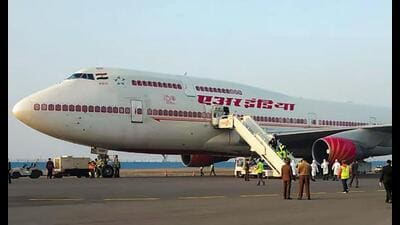
Campbell Wilson’s recent resignation as Air India chief executive officer (CEO) can be seen as an admission of the failure to turn the airline around. After buying the airline from the government in 2022, the Tatas had staked its turnaround on Wilson’s abilities but now the airline faces serious losses. And lest one forgets, Air India is still trying to recover from the devastating Ahmedabad crash last year.
Several civil aviation veterans and experts, including former chairman-managing directors (CMDs) of the airline, are now asking why Campbell’s exit — he was appointed in July 2022 — didn’t come sooner, given that, within months of his taking charge, a view emerged that he might not be up to the task.
Air India is also likely to welcome a new safety chief. It has also brought in a new advisor who will liaise with the authorities — something that has proved markedly fraught for the airline.
Internal engineering is also a pressure point because some Air India aircraft have recently reported technical glitches. The Tata group and the airline’s board must now introspect on what went wrong and how to course-correct.
There have been reports of the airline’s improved service on many routes — both domestic and international (the latter mostly featuring newer aircraft). Small gestures, like celebrating a passenger’s birthday on board, have gone a long way towards rekindling the warm connection many India fliers feel with the erstwhile national carrier. Credit goes to the Air India crew, who have won hearts in the last couple of years even as the business struggled.
Still, even as some hope for a revival of the carrier’s past glory, two questions must be asked. One, what went wrong with the Tatas’ plan to reshape Air India as a world-class carrier? Two, did the 2022 takeover ever have the ingredients to ensure success?
A large cohort is summarily dismissive, claiming that very few within the Tata group had the appetite for it.
Indeed, some, including airline insiders, term the purchase a fait accompli for the group as opposed to any active exercising of choice. They say the Tatas were neither geared nor enthusiastic about adding to their already troubled commercial airlines portfolio at the time.
Irrespective of the truth in such claims, what is inarguable is that the Tatas quickly realised that they had neither the expertise nor the bandwidth to pull off a turnaround, and relied heavily on the advice of their partner (in the Vistara venture, which has since been merged into Air India), Singapore International Airlines (SIA).
But some industry watchers believe that SIA’s interest in Air India is driven more by a desire to look after its own. A few even argue that the SIA investment in Air India has more to do with ensuring that its own traffic — heavily dependent on Indian passengers — remains intact.
Similar allegations dogged Vistara throughout its brief life; many industry watchers argued that Vistara’s operations were designed to make it a spoke in the SIA hub. Many kept pointing at the choice and configuration of aircraft to argue that the airline was not poised to compete in the ultra long haul space. That airline too remained loss-making despite the combined heft of SIA and the Tatas.
There have always been questions about hiring practices at Air India. Many key positions in both Air India and AIX have either been filled or are expected be filled by secondment of personnel from SIA. One can only imagine what the impact on the culture and morale in the existing set up will be, especially with lukewarm perceptions about SIA personnel.
Lack of engineering capabilities and expertise remains a critical weakness.
Belatedly, but still important, questions are now being asked about why the Tatas didn’t ask the government to bundle AIESL, the engineering and MRO wing of the organisation, when the airline was being sold (AIESL remains under government ownership).
If the Tatas, having re-entered commercial flying only a few years earlier, lacked the necessary foresight for this, shouldn’t their partner SIA, a veteran of several decades, have known better and advised accordingly?
All said, the most worrisome question for the airline is not when the promised turnaround will happen, but if it will happen at all. A new CEO, head of safety, and some other top level appointments may bring fresh leadership — in a sense, it is back to square one — but the shackles of the past four years of less-than-passing-grade performance will take herculean effort to cast off.
Anjuli Bhargava writes about governance, infrastructure, and the social sector. The views expressed are personal