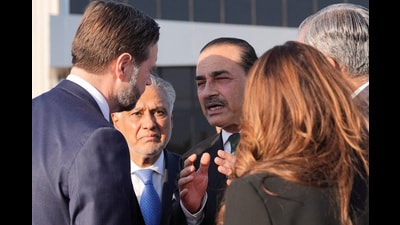
The Islamabad talks between the US and Iran to end the war have failed. Little else could have been expected from US President Donald Trump considering his diatribes, Iran which has been resisting a needless war, Israel which was absent at the table, the Gulf nations that interfered behind the scenes and Pakistan that proved to be an ineffectual host. The failed attempt has left many questions in its wake. Will US Vice President JD Vance, who was in Islamabad for the talks and wanted to stop the war, now have to take a hard line? Iran was silently supported by China and Russia. It needs to be seen if they will openly take sides now. Energy supply for many economies, including India, remains at grave risk — the world, as a result, could be heading for tough times.
Some in India were unhappy that Islamabad played the role of a “mediator”, unaware that Pakistan is doing exactly what it was created for. The name Pakistan was first used in Cambridge in 1933 by an Indian student, Chaudhry Rehmat Ali. Initially, no one took the idea seriously. Later, Allama Iqbal, the poet, gave it emotional support, and Mohammad Ali Jinnah threw his political weight behind it. Ishtiaq Ahmed, a Pakistan-born professor who lives in Sweden, wrote in his book, Pakistan: The Garrison State, that the British wanted to keep India under their control but their grip was slipping fast.
On May 8, 1947, then British Prime Minister Clement Richard Attlee met some former generals and senior diplomats who had been trying to impress upon their government, since January 1947, that India was naturally inclined towards socialism. If the British didn’t create Pakistan, then the Soviet Union’s influence would be felt in the Indian Ocean, which would be catastrophic for Britain’s economic and strategic interests in the area.
The meeting proved decisive. Then viceroy of India, Lord Mountbatten, announced on June 3, 1947, that India will be divided and a new nation, Pakistan, will be created. This is how Pakistan became an ally of the West even before it was formed. The same logic made it a garrison State.
India, on the other hand, pursued the policy of non-alignment. Over the years, despite the changing global strategic scenario, the original policy is still in practice, though the country has been seen as taking sides several times.
During the 1965 war, the US and China openly sided with Pakistan, while the Soviet Union resolutely rallied for a compromise. It initiated peace talks in Tashkent. Similarly, in 1971, when India and Pakistan were at war, the US openly sided with Pakistan. Then, too, the Soviet Union came to India’s help. But despite its closeness with the Soviet Union, India kept treading its non-aligned line. This is the reason why the Western aid kept flowing in times of India’s need.
While New Delhi worked hard not to blunt its non-aligned edge, Pakistan steadily pursued its old policy. Even before the 1971 war, Pakistan had played an important role in bringing the US and China closer. Henry Kissinger, the then US secretary of State, flew from Pakistan for his maiden secret meeting with the Chinese. Pakistan facilitated the US military operations in Afghanistan.
With such a background, we shouldn’t be surprised that the talks between Iran and the US were held in Islamabad. The whole world knows that the Islamabad talks are not the result of Pakistan’s efforts. China pressured Iran to come to the negotiating table and President Trump, eager to wriggle out of a useless war, lapped up the opportunity.
Considering current US-China relations, the talks had to be hosted by a country that could be arm-twisted by both parties. Pakistan fits that bill. This is why strategic experts consider Pakistan a medium, not a mediator. The controversy over Shehbaz Sharif’s post on X.com before the talks gave this away. His first line was — “Draft: Pakistan PM’s message on X”. It’s clear the “draft” was sent by someone else.
Later, an edited version followed. But several questions remain: Who was the original writer of the post? Was it released from the corridors of power in Washington or Beijing or by the commanders in Rawalpindi? Another anomaly is that the ceasefire announcement included the conflict between Israel and Lebanon. However, Israel hasn’t ceased its military offensive there.
Despite all this, our doomsayers think Pakistan will use its hyperactivity to raise the Kashmir issue internationally. I would respectfully ask when have they not done it. Since Independence, we have been countering their political and strategic moves, and will continue to do so successfully in future.
Shashi Shekhar is editor-in-chief, Hindustan. The views expressed are personal