President Donald Trump on Sunday announced that he is imposing a naval blockade on the , marking a dramatic escalation after the US-Iran ceasefire talks in Islamabad, Pakistan failed. The 79-year-old, in a threat message on social media, added that any Iranian ‘who fires at us, or at peaceful vessels’ will be ‘blown to hell’.
“Effective immediately, the United States Navy, the Finest in the World, will begin the process of BLOCKADING any and all Ships trying to enter, or leave, the Strait of Hormuz,” Trump posted on Truth Social.
FOLLOW:
Ceasefire talks fail
The move follows the collapse of US-Iran negotiations, where both sides failed to resolve differences over Tehran’s nuclear ambitions. While several issues reportedly saw progress, Trump underscored that the deal ultimately broke down over one central concern: “So, there you have it, the meeting went well, most points were agreed to, but the only point that really mattered, NUCLEAR, was not.”
Vice President JD Vance, who led the American delegation, said: “We leave here with a very simple proposal, a method of understanding that is our final and best offer.”
He added, “The lack of a deal is bad news for Iran much more than it is bad news for the US,” emphasizing that Tehran refused to meet Washington’s red lines.
Read More:
Iran’s Foreign Ministry spokesperson Esmail Baghaei said, “It was natural that one should not have expected to reach an agreement in a single session from the outset,” adding that ‘Diplomacy never ends’.
What a Strait of Hormuz blockade exactly means
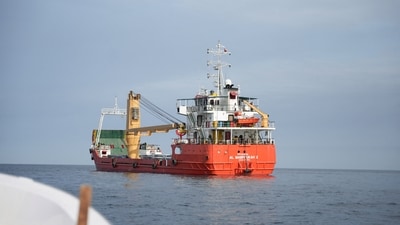
At its core, the blockade is designed to halt maritime traffic through one of the world’s most critical chokepoints. The US Navy has been ordered to stop, search, and ‘interdict’ vessels attempting to enter or exit the strait, effectively freezing commercial movement until what Washington describes as ‘safe passage’ conditions are restored. A key focus of the operation is vessels that have paid transit fees to Tehran, which the US and Trump consider illegitimate.
Read More:
What happens to ships and cargo?
Even before the formal blockade, traffic through Hormuz had slowed dramatically. From a typical daily average of around 135 ships, crossings have dropped to single digits on many days since the war began in late February.
Some vessels have still managed to pass, often under exceptional conditions:
Iran-linked or sanctioned shipments have continued moving, with Tehran exporting roughly 1.7 million barrels per day, largely to China.
Select countries, including India and Pakistan, negotiated limited transit permissions.
A few ships attempted covert crossings by switching off tracking systems.
Impact on global oil markets
The Strait of Hormuz carries roughly 20% of global oil and gas supplies, making any disruption immediately felt worldwide. Oil prices have already surged, up nearly 30% since the conflict began, with some cargoes reportedly trading above $140 per barrel.
Analysts warn the blockade could tighten supply further. “President Trump is trying to force Iran’s hand by reducing their leverage over the strait,” Jorge Leon of Rystad Energy, told Bloomberg. “The problem is that the risk for escalation is very high now.”
What’s next?
With ceasefire talks stalled and tensions rising, the blockade signals a shift from diplomacy to economic and maritime pressure. Trump reiterated his stance on Iran’s nuclear program, saying Iranian leaders “want money and, more importantly, they want Nuclear.”
He added: “Additionally and, at an appropriate moment, we are fully ‘LOCKED AND LOADED,’ and our Military will finish up the little that is left of Iran!”
(With Bloomberg inputs)