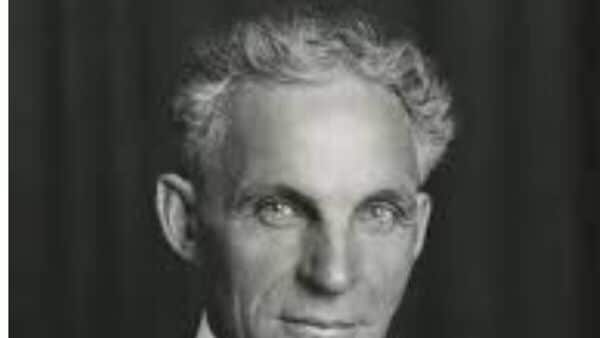
Henry Ford was born in Michigan in 1863, left farm life to work in Detroit machine shops, later became chief engineer at Edison Illuminating Company, and founded Ford Motor Company in 1903. His great turning point came with the Model T and the moving assembly line, which helped turn the automobile from a luxury product into a mass-market machine and made Ford one of the defining industrialists of the 20th century. Britannica notes that his production methods radically reshaped manufacturing and consumer life in the United States.
“A business that makes nothing but money is a poor kind of business.”
—Henry Ford
This line is widely attributed to Ford, and it appears in many reputable quote compilations. Ford’s own broader philosophy inMy Life and Work, where he wrote that “service comes before profit” and described worthwhile business as the sort that “makes the world better for its presence,” strongly supports the spirit of the quote.
Meaning of Henry Ford’s quote
Ford’s quote is a rejection of shallow capitalism. He is not arguing that money is unimportant; he is arguing that profit, by itself, is too small a purpose to sustain a serious enterprise. In business terms, a company that exists only to extract revenue usually becomes inward-looking: it cuts corners, forgets service, weakens trust, and eventually confuses financial gain with actual value creation. Ford’s verified writing makes that logic plain by putting service before profit, not the other way around.
The deeper principle is usefulness. Great companies do not endure merely because they are good at monetization. They endure because they solve something, simplify something, widen access, or improve daily life in a way customers can feel. That reading fits Ford’s own career: the Model T mattered not simply because it made money, but because it changed who could participate in modern mobility.
That is why the quote still matters for leaders. It reminds them that profit is a score, not a mission. The healthiest businesses usually make money because they are doing something worthwhile unusually well, not because they made money the only idea worth serving.
Why this quote resonates today
The quote feels especially current because customers and employees increasingly expect companies to stand for more than quarterly performance. Edelman’s 2025 special report on brand trust says trusted brands today need “purpose beyond profit,” but also warns that purpose must be shown through relevant, credible action rather than slogans. In other words, the market is moving closer to Ford’s intuition: people still want profitable companies, but they are less willing to trust companies that appear to serve profit alone.
That expectation is reinforced inside the workforce as well. Deloitte’s 2025 Gen Z and Millennial Survey says these generations are pursuing money, meaning, and well-being together, not treating salary as the only measure of a good career. That makes Ford’s idea more than historical wisdom. In a business climate shaped by AI change, public scrutiny, and fast-moving consumer expectations, leaders increasingly need a reason for the business that is bigger than the income statement.
A concrete takeaway from the last 12–18 months is that purpose is being judged more operationally. People are asking whether companies treat employees well, make products that genuinely help, and show up clearly in culture and community. Ford’s quote resonates because it captures that standard in one sentence: if all you make is money, something essential is missing.
Another perspective
“All that the Ford industries have done … is to endeavour to evidence by works that service comes before profit and that the sort of business which makes the world better for its presence is a noble profession.”
— Henry Ford, My Life and Work
This quote is especially valuable because it is Ford in his own words. The primary quote says a money-only business is a poor one; this secondary quote explains why. Ford’s real standard for business was not moral decoration added after success. It was service first, profit second, and a belief that business should justify its existence by improving the world around it.
Together, the two quotes create a fuller leadership lesson. One is concise and provocative. The other is expansive and philosophical. Put side by side, they argue that business becomes respectable when it produces commercial results through usefulness, not at the expense of it.
How you can implement Henry Ford’s wisdom
- Audit one core product or service this week and ask a hard question: does it genuinely improve the customer’s life, or merely monetize their attention or confusion?
- Measure one value metric alongside revenue, such as retention, complaint resolution, repeat purchase, or time saved for the customer.
- Rewrite your team’s purpose in one sentence without using the words “growth” or “profit,” so you are forced to define the real value you create.
- Review one recurring internal process and cut the step that serves the org chart more than it serves the customer.
- Reward employees for solving customer pain or improving quality, not only for hitting short-term commercial targets.
Test major decisions with a Ford filter: if this makes money, does it also make the business more useful, more trusted, or more worthy of lasting?
“The purpose of business is to create and keep a customer.”
— Peter Drucker
Drucker’s line sharpens Ford’s point. Ford warns against making money the sole purpose; Drucker explains what a serious purpose looks like in practice. Together, they leave a durable lesson for leaders: the best businesses do not become poor by lacking profit. They become poor when they forget what profit is supposed to be built on.