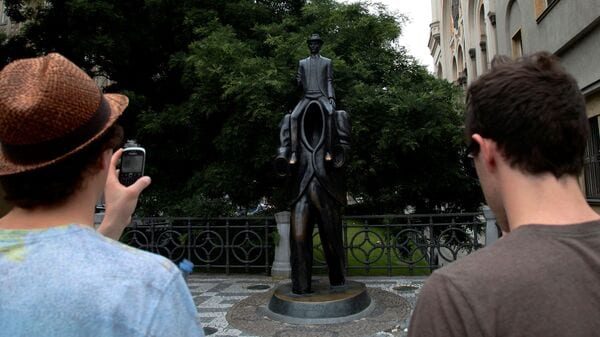
“Guilt is never to be doubted.”— Franz Kafka, The Trial (1925)
What This Quote Means — And Why It Still Cuts Deep
Four words. No qualifier, no escape clause, no appeal. Kafka delivers what may be the most chilling sentence in all of Western literature with the calm authority of a verdict that was never in question.
In The Trial, this is not a philosophical position debated between equals. It is the operating principle of an entire system — one that Josef K. discovers, to his ruin, only after it has already consumed him. The court does not investigate guilt. It assumes it. The accused does not arrive as a person to be examined. He arrives as a case to be processed. His innocence is not a possibility the system is designed to entertain.
What makes the quote so unsettling is its grammar. Kafka does not write “guilt is rarely doubted” or “guilt is presumed.” He writes that it is never to be doubted — an absolute, issued as institutional instruction. The passive voice removes any individual responsible for the ruling. No judge said this. No law was passed. It simply is. That absence of a human author is precisely the point. Systems that operate on this logic do not need villains. They need only procedure.
Written in 1914, published in 1925, The Trial anticipated with eerie accuracy the totalitarian machinery that would define the century that followed — show trials, disappeared persons, charges that could not be answered because they were never clearly made. But Kafka’s genius is that he did not write a political allegory. He wrote something quieter and more permanent: a portrait of how power renders the individual speechless not through violence alone, but through the sheer, grinding weight of process.
A century on, the quote has lost none of its edge. Anyone who has faced an institutional judgment already made before the hearing began — in a workplace, a courtroom, a government office — will recognise the world Kafka mapped. The presumption of guilt, dressed in the language of procedure, is not a relic of the past. It is, in many corners of contemporary life, still very much the operating system.
Who Is Franz Kafka?
Franz Kafka was born on 3 July 1883 in Prague, then part of the Austro-Hungarian Empire, into a middle-class Jewish family. He studied law at the German Charles-Ferdinand University in Prague and spent the bulk of his working life as an insurance official — a career he found suffocating, though it gave him an intimate, firsthand understanding of bureaucracy that would saturate every page he ever wrote.
Kafka wrote prolifically but published sparingly. He was plagued by self-doubt and, near the end of his life, instructed his closest friend, Max Brod, to burn all his manuscripts upon his death. Brod refused — a decision that preserved some of the most significant literary work of the twentieth century.
Kafka died of tuberculosis on 3 June 1924, aged 40, before witnessing the full publication of his major novels. He left behind a body of work that reads, in retrospect, less like fiction and more like prophecy.
Major Works by Franz Kafka
Kafka’s output, though modest in volume, is extraordinary in influence. The Metamorphosis (1915), his most widely read work, follows Gregor Samsa, a travelling salesman who wakes one morning transformed into a giant insect — an image of alienation so precise it has never been bettered. The Trial (1925) and The Castle (1926), both published after his death, explore the individual’s helplessness before vast, indifferent systems of power. In the Penal Colony (1919) is a visceral meditation on punishment, justice, and the rituals through which authority inscribes itself upon the body. His diaries and Letters to Milena offer an equally compelling, deeply personal counterpart to the fiction — anxious, tender, and achingly self-aware.
The adjective “Kafkaesque” has entered everyday language in dozens of tongues, used to describe any situation in which logic, fairness and human dignity are swallowed whole by impenetrable systems. No other writer of the modern era has had quite that distinction.
More Quotes by Franz Kafka
“There is infinite hope, but not for us.” — Franz Kafka, in conversation with Max Brod
“A book must be the axe for the frozen sea within us.” — Franz Kafka, letter to Oskar Pollak, 27 January 1904
“In the struggle between yourself and the world, second the world.” — Franz Kafka, The Blue Octavo Notebooks
“I am a cage, in search of a bird.” — Franz Kafka, The Blue Octavo Notebooks
“Start with what is right rather than what is acceptable.” — Franz Kafka, The Trial